
Top 7 Custom Software Development Challenges (and How to Overcome Them in 2026)
Keyur Patel
December 10, 2025
8 min
Last Modified:
December 11, 2025
Think like this. It is Q3 of 2025. You are a CTO or a Product Manager. You have just secured the budget for a new enterprise platform that promises to revolutionize your supply chain. You hire a software development company, sign the contracts, and the kickoff meeting feels perfect. Everyone is nodding. Everyone gets it. Yes!
Fast forward six months.
The budget has evaporated. The revolutionary features are broken. The developers are blaming the API documentation, and you are stuck explaining to the board why the launch is delayed, again.
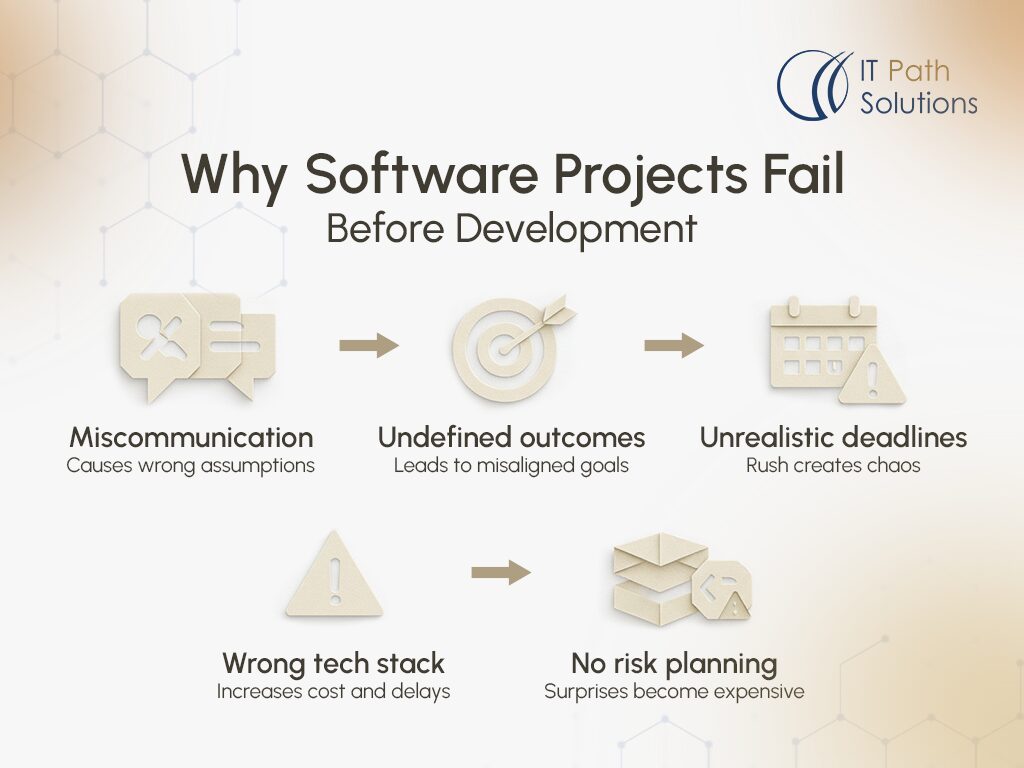
This is the statistical norm rather than just a bad luck story. A 2025 Quixy report found that 67% of software projects fail due to overshooting the budget, missing deadlines, or not delivering expected value. This isn’t just a bad luck story; it is the statistical norm. According to recent data, nearly 66% of enterprise software projects fail to meet their original objectives.
But here is the controversial opinion we hold at IT Path: Projects don’t fail because of bad code; they fail because of bad questions.
This distinction is critical because the margin for error has vanished. In 2025, the landscape of custom software development has shifted. It’s no longer just about writing lines of code; it’s about navigating an ecosystem of AI agents, legacy debt, and security minefields. If you want to be in the 34% of leaders who succeed, you need to stop looking at development as a “to-do list” and start seeing it as a strategic battlefield.
The true challenge of today’s tech landscape lies in managing the interplay between AI agents, legacy code, and security protocols. If you want to be in the top leaders who succeed, you need to stop looking at development as a to-do list and start seeing it as a strategic thing.
Here are the 7 real challenges you will face, and the well-tested strategies to overcome them.
1.The Wide Scope
We often hear clients say, ‘We know exactly what we want.’ But in our experience as an IT consulting services provider, ‘what you want’ on day one is rarely what you need on day ninety.
The Challenge: Scope creep isn’t usually a dramatic explosion; it’s a slow leak. It starts with a small change to the user interface. Then, a stakeholder from marketing asks for an AI chatbot integration because they saw a competitor do it. Suddenly, your lean custom software development process has bloated into a Frankenstein monster. The deadline hasn’t moved, but the workload has doubled.
The Solution: Welcoming the living scope. Stop treating requirements like stone tablets. In 2025, the best approach is Agile with a hard commercial edge.
- The Trade-Off Rule: Every new feature request must replace an existing one of equal size. If the marketing team wants that chatbot, what are they willing to cut? This forces stakeholders to prioritize value over volume.
- Visual Prototyping over Documentation: Don’t write a 50-page specification doc that no one reads. Build a clickable prototype in week one. When stakeholders see the flow, they spot gaps immediately, preventing expensive changes later in the coding phase.
2.The Integration Nightmares
The Scenario: You are building a sleek, modern enterprise software solution for your customers. It looks beautiful. But the moment you try to connect it to your internal ERP system built in 2010, everything crashes.
The Challenge: This is the little secret of digital transformation: Old systems hate new software. You might be ready for cloud-native microservices, but if your core data is locked in an on-premise server that only works with CSV files, your project will hit a wall. We call this integration nightmares: the harder you fight to modernize the frontend, the more the backend pulls you down.
The Solution: Don’t try to replace the old system all at once, that is the core of disaster. Instead, use the following pattern.
- Isolate: Build an API layer around your old legacy system.
- Intercept: Reroute specific calls to your new custom software.
- Replace: Slowly kill off the old system one function at a time.
This approach lets you innovate on the customer-facing side immediately without waiting years to fix your backend mess.
3.The AI FOMO
The Opinion: Just because you can use AI, doesn’t mean you should (everytime!)
The Challenge: In 2025, everyone demands AI. However, we often see clients burning budgets on complex Machine Learning models for problems that standard, deterministic code could solve faster and cheaper.
The Solution: Prediction vs. Process Use the right tool. If the rules are clear and predictable (like routing forms), use standard automation. Reserve AI for ambiguous tasks where traditional logic fails, such as sentiment analysis or sales forecasting. Don’t build a neural network when a calculator will do.
4.The Black Box of Communication
The Story: We once took over a project from another vendor where the client hadn’t seen a demo in three months. The developers were working hard, but they were building the wrong thing. When they finally revealed the product, the client’s face went pale. “This isn’t what we talked about in January,” they said.
The Challenge: Tech jargon is a barrier. When a developer says, “We need to refactor the backend because of technical debt,” a business owner hears, “We are wasting time and money.” This translation gap is where trust dies.
The Solution: Great software development companies don’t just send status reports; they provide access.
- Demo or Die: Bi-weekly demos are non-negotiable. If you can’t show it, it doesn’t exist.
- Shared Vocabulary: We ban vague terms like optimizing or refactoring in client meetings. Instead, we say, “We are rewriting this module so the page loads in 2 seconds instead of 8.” Speak in business outcomes, not technical inputs.
5.Security as an Afterthought
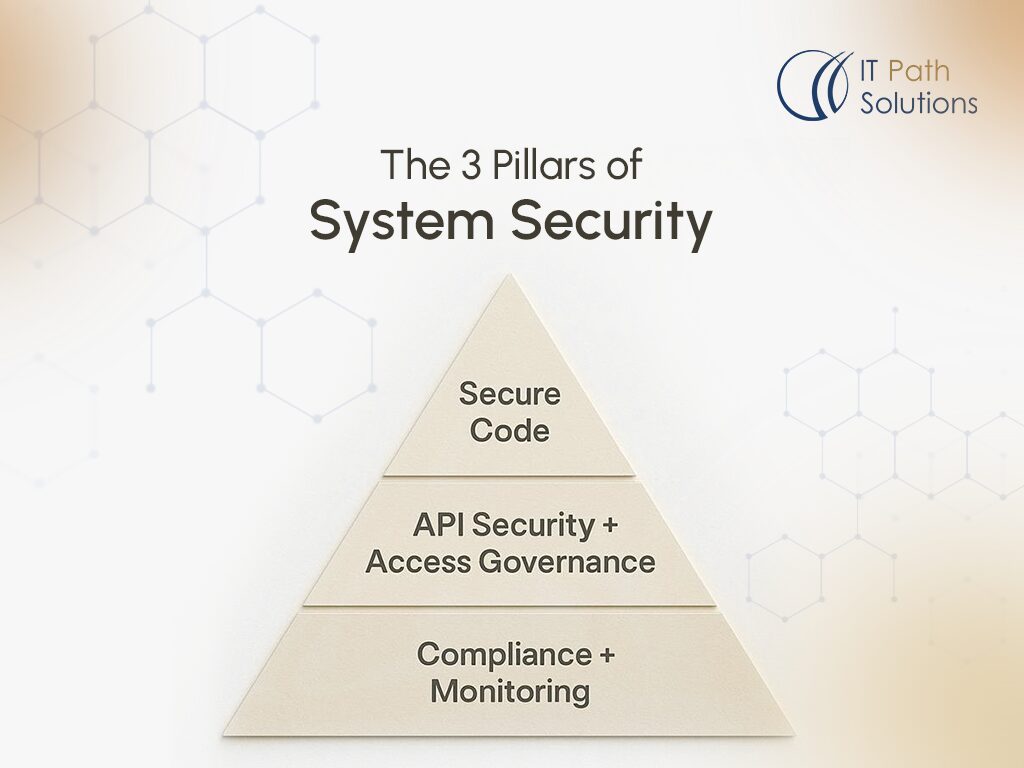
The Reality Check: In the rush to launch, security is often the item that gets pushed to ‘Phase 2.’ In 2025, with AI-generated code flooding repositories, vulnerabilities are easier to introduce than ever before.
The Challenge: Hackers aren’t breaking down walls; they are walking through the doors you left open. A single exposed API key or a poorly configured cloud permission can compromise your entire enterprise software solution.
The Solution: Shifting left, which means moving security to the start of the custom software development process, not the end. Automated security scans should run every time a developer saves code. It’s like having a building inspector check the foundation while the cement is wet, rather than waiting until the house is built to tell you it’s unsafe.
6.The Talent Illusion
The Challenge: There is no shortage of developers. You can find thousands of resumés online today. The challenge is the shortage of custom software developers. A coder will build exactly what you ask for, even if it’s a bad idea. A product engineer will push back and say, “This feature will confuse the user and ruin your conversion rate.”
The Solution: When vetting a partner or team, don’t just test their coding logic. Give them a vague business problem and see if they ask questions. If they start coding immediately without asking “Why?”, run. You need partners who act as consultants, not just keyboard operators.
7.The Shiny Object Syndrome
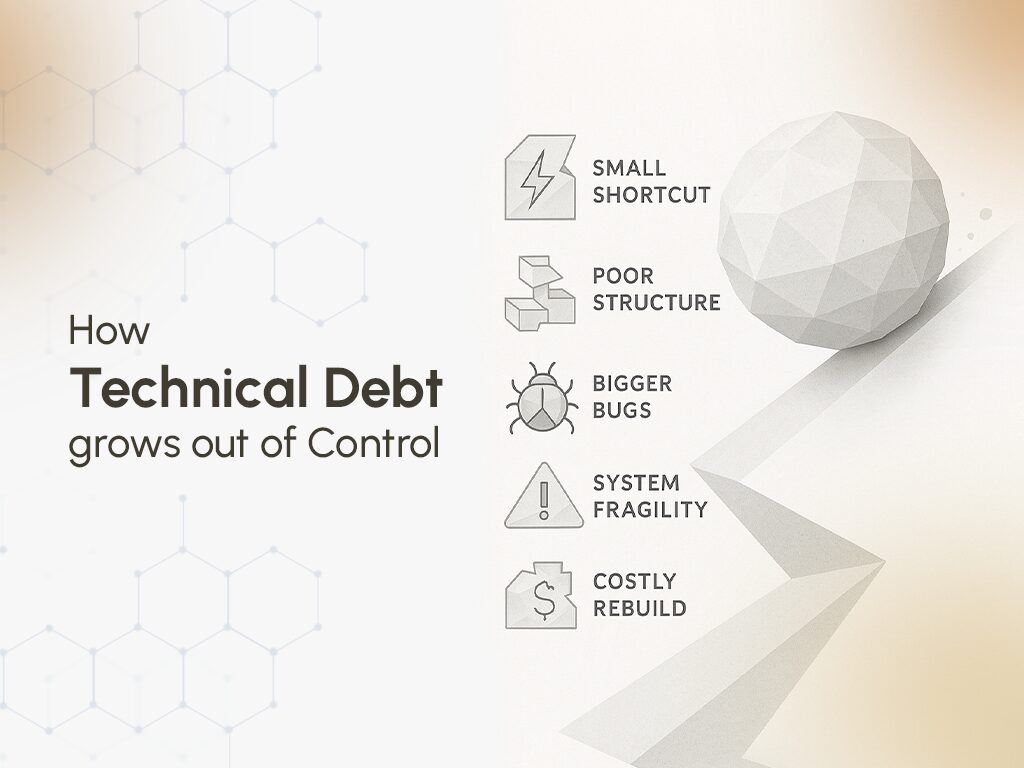
The Story: A startup approached us recently wanting to build a simple e-commerce store using a complex, bleeding-edge blockchain framework. Why? Because they read a tweet saying it was the future. Using that stack would have cost them 3x more and made it impossible to find developers to maintain it later.
The Challenge: Choosing a tech stack based on hype rather than stability is a fatal error.
- The Challenge: Choosing a technology stack based on hype (“It’s the future!”) rather than business utility is a fatal error that leads to debt and hiring struggles.
- The Solution: Strategic Innovation For the core of your business, “boring” (stable, proven) technology is usually the safest bet. However, you shouldn’t ignore new tools when they offer a genuine performance advantage.
- For example, while Node.js is the standard, scenarios demanding ultra-fast execution might benefit from modern runtimes like Bun.js for web development.
- he Rule: Only adopt bleeding-edge tech if it solves a specific bottleneck that older tech cannot. Innovate for ROI, not for cool factor.
The Final Verdict
Looking at these challenges, you might feel overwhelmed. And you should be, if you are trying to do it alone.
The difference between a failed project and a market-leading product often comes down to who is sitting on the other side of the table. IT consulting services are not just about outsourcing work; they are about outsourcing risk.
At IT Path, we challenge your assumptions, we predict the roadblocks (because we’ve hit them before), and we guide you through the fog of custom software development with a map drawn from experience.
Are you ready to build software that actually solves the problem? Let’s move past the lists and start a real conversation about your vision.

Keyur Patel
Co-Founder
Keyur Patel is the director at IT Path Solutions, where he helps businesses develop scalable applications. With his extensive experience and visionary approach, he leads the team to create futuristic solutions. Keyur Patel has exceptional leadership skills and technical expertise in Node.js, .Net, React.js, AI/ML, and PHP frameworks. His dedication to driving digital transformation makes him an invaluable asset to the company.
Related Blog Posts
TypeScript 7.0 Migration Guide: What Changed, What Can Break, and Should You Upgrade?

How We Built a Fully Offline GDPR-Compliant Transcription System