
Bun.js for Web Development: Why Modern Agencies Choose It Over Node.js in 2025

Keyur Patel
November 27, 2025
15 min
Last Modified:
June 12, 2026
Every quarter, a new technology lands on the desks of engineering leaders, promising to rewrite the rules. Lately, that name has been Bun.js.
It is quickly emerging as a serious contender in modern JavaScript development. It offers agencies blazing-fast performance, lower build times, and a simplified toolchain compared to Node.js.
For teams delivering high-traffic APIs, real-time platforms, or rapid MVP cycles, Bun.js for web development offers measurable gains in speed and efficiency.
Bun’s Node-compatible ecosystem also means teams can migrate selectively without disrupting existing workflows.
IT Path Solutions is among the first agencies to implement production-grade Bun.js for backend development. It enables clients to benefit from improved reliability, optimized performance, and faster project turnaround.
If you are evaluating Bun.js vs Node.js for an upcoming project, our engineering team can walk you through the right choice based on performance, scalability, and long-term maintainability.
What Bun.js Actually Is, In Business Terms
Bun.js is a next-generation JavaScript runtime built to simplify and accelerate modern web development.
It delivers high performance through the JavaScriptCore engine and the Zig language. It helps applications kick off faster, use fewer resources, and operate more efficiently than traditional Node.js setups.
Rather than relying on separate tools for package management, bundling, testing, TypeScript execution, and hot reload, Bun consolidates these functions into a unified environment.
For agencies, this consolidation directly lowers development hours and the operational friction caused by maintaining multiple build tools. Speedier installs, quicker builds, and native TypeScript support lower onboarding time and ongoing maintenance effort.
The best part: Bun.js also aligns well with modern engineering practices by reducing configuration overhead and minimizing the number of moving parts that can fail during a project lifecycle.
In practical terms, Bun gives agencies a leaner foundation for delivering web and backend applications with remarkable speed and predictability.
Why Agencies Are Looking Beyond Node.js (Why Bun Is Winning)
Though Node.js remains dependable, its ecosystem has become heavy and fragmented. It often requires multiple external tools for tasks like bundling, testing, transpiling, and hot reloading.
This plugin-dependent model slows teams down and introduces more integration points that can break during a project lifecycle.
Bun.js addresses these limitations by providing a unified environment that collapses the entire toolchain into a single runtime. It resolves both the performance bottleneck and the tooling fragmentation problem that agencies struggle with.
The result is swifter delivery cycles, lower development and infrastructure costs, and more predictable performance metrics that agencies can confidently present to clients.
For teams working on modern web development and backend systems, Bun.js offers a measurable operational advantage that is challenging for Node.js to match without significant custom tooling.
Core Advantages of Bun.js for Web and Backend Development

Agencies adopting Bun.js for web development prioritize lightning-fast delivery, lower infrastructure costs, and simpler toolchains. Here are some incredible benefits that make Bun.js a frontrunner pick.
Blazing Speed for APIs and Backends
Bun runs on Apple’s JavaScriptCore, which consistently outperforms Google’s V8 engine in raw speed, startup time, and request throughput. Agencies handling high-traffic APIs or real-time interfaces see immediate gains.
The cold starts to drop noticeably. It is crucial for microservices and serverless workloads, where every millisecond affects responsiveness and cost.
In benchmark and community-reported comparisons:
1. Higher HTTP throughput: Multiple independent benchmarks show Bun handling significantly more requests per second than Node.js in minimal-server tests.
2. Much faster startup times: Developers note that Bun’s JavaScriptCore engine starts noticeably faster than Node/V8, making cold starts quicker.
3. Package installation speed: Real-world developer tests show “bun install” completing dramatically faster than npm, even on large monorepos.
4. Strong performance on CPU-bound microbenchmarks: Independent comparisons show Bun outperforming Node on pure JavaScript CPU tests, loops, and basic operations.
These gains help agencies ship faster, run leaner infrastructure, and deliver smoother performance without rewriting existing project logic.
Ultra-Fast Cold Starts for Serverless, Edge, and CLI Workflows
Cold start speed is one of Bun’s prominent practical advantages. It initializes far quicker than Node, giving agencies a healthy edge in environments where functions spin up frequently.
Implications for real-world usage:
- Serverless and Edge Computing: Bun’s rapid initialization makes it highly effective for AWS Lambda and edge deployments where every millisecond of startup latency impacts user experience and SLA performance.
- CLI Tools: Tools built on Bun feel instantly responsive since commands execute with near-zero startup time, improving workflow efficiency for development teams.
- Reduced Latency: Applications begin processing faster during initial execution. It bolsters overall responsiveness and makes high-traffic or real-time experiences feel noticeably smoother.
This speed translates into better user outcomes, lower operational delays, and more predictable performance for agency-delivered systems.
All-in-One Toolkit That Cuts Tooling Overhead
Bun consolidates package management, bundling, testing, TypeScript execution, and hot reload into one runtime. Agencies save time because there are fewer tools to configure, fewer integration issues to troubleshoot, and no separate build systems to maintain.
The result is shorter delivery cycles, lower development costs, and less risk of “tooling breakage” slowing projects down.
Native TypeScript and Modern Developer Experience
Bun runs TypeScript and JSX files natively with zero configuration. It reduces build complexity, shortens onboarding, and helps teams move swiftly during MVP development or frequent iteration cycles.
Built for Modern Architectures
Bun.js supports real-time applications with built-in WebSocket tools and handles SSR & SSG efficiently. It includes an integrated SQLite engine for lightweight apps.
Node.js Compatibility for Low-Risk Adoption
Bun runs most npm packages, supports both import and require, and follows familiar Node.js conventions. Agencies can adopt it with almost zero rewrite cost and minimal operational risk.
Teams can migrate incrementally or use Bun for new services without disrupting existing systems, which keeps delivery stable while exploring performance gains.
Something interesting: Fast-growing startups also benefit from Bun.js microservices and serverless workloads, where latency determines user experience and margin.
Bun.js vs Node.js: Practical Comparison for Agencies
Agencies evaluating Bun.js for web development need a clear, business-focused comparison. The table below presents the core differences that impact delivery speed, stability, and long-term maintainability.
Bun.js vs Node.js: Decision Table for Agencies
| Category | Bun.js | Node.js |
| Performance | Faster cold starts, higher RPS throughput, quicker installs | Stable under heavy loads, proven performance over many years |
| Tooling | All-in-one toolkit (runtime, bundler, test runner, package manager) | Requires external tools like Webpack, Jest, Babel, and Nodemon |
| Ecosystem | Compatible with most npm packages, growing steadily | Largest JS ecosystem, highly mature and widely supported |
| Developer Experience | Zero-config TypeScript and JSX, swift feedback cycles | Reliable but slowed by tooling layers and config requirements |
| Operational Efficiency | Lower resource usage and infrastructure cost | Predictable scaling patterns for large, complex systems |
| Learning Curve | Simple for existing JS and Node teams | Already familiar to most developers, minimal transition needs |
Where Bun.js Performs Best
- High-performance APIs and backend services
- Microservices and distributed systems
- Real-time apps such as dashboards or streaming interfaces
- Developer tooling and CLI utilities
- Server-rendered sites and static site generation workflows
When Node.js Remains the Better Fit
- Legacy enterprise applications
- Very large monolithic backends
- Teams deeply tied to Node-specific plugins or infrastructure

When Agencies Should Choose Bun.js (Decision Criteria)
Agencies evaluating Bun.js for web development require direct signals, not theory. The criteria below outline when Bun becomes the smarter operational pick compared to traditional Node environments.
Bun.js Adoption Checklist for Agencies
Use Bun.js confidently when your agency needs:
✔️ Blazing-fast performance
Bun’s runtime executes APIs and backend logic significantly faster. It allows high-traffic systems to run with fewer servers and tighter response times.
✔️ Rapid development cycles
Bun’s built-in bundler, test runner, and TypeScript support remove toolchain overhead. It enables teams to ship features sooner with fewer interruptions.
✔️ Lower cloud costs
Bun.js’s speedier execution and reduced resource usage translate into leaner infrastructure bills, especially across microservices and serverless deployments.
✔️ Building new projects
Greenfield builds to gain immediate benefits from Bun’s speed and unified tooling without being constrained by older Node.js dependencies.
✔️ A team with real-world Bun experience
Most agencies are still experimenting. IT Path Solutions has already deployed Bun in production environments. It provides your project with a safer and more predictable adoption path.
Expertise That Supports Your Bun.js Adoption
We have already integrated Bun.js internally and deployed it for client projects across multiple regions. While most agencies are still testing Bun in side projects, our engineering teams work with it in production environments.
Agencies partnering with IT Path Solutions receive a team that is not learning the runtime, but already operating at maturity with it.
Where Bun.js Fits in Real Client Projects
Bun.js adds the most value in modern, performance-sensitive digital projects. These are the scenarios where agencies see immediate impact.
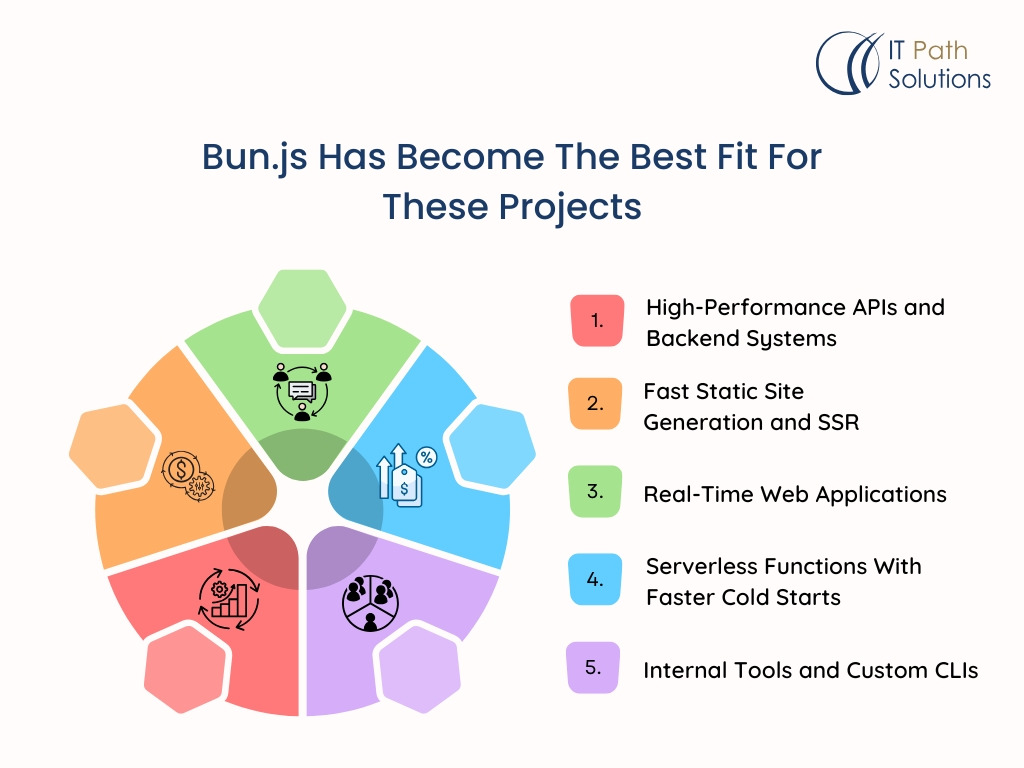
1. High-Performance APIs and Backend Systems
Why Bun.js works here: Bun uses the JavaScriptCore engine and a Zig-based runtime to handle more requests per second with lower latency. It consolidates multiple Node tools into one fast, minimal stack.
Business impact for agencies: Serve more traffic on fewer servers, reduce infrastructure cost, and deliver faster responses for end users during peak load.
2. Fast Static Site Generation and SSR
Why Bun.js works here: The built-in bundler and rapid build pipeline significantly speed up static site generation and server-side rendering, especially on content-heavy or multi-page websites.
Business impact for agencies: Shorter build times, quicker deployments, and lower CI/CD or hosting costs for client websites.
3. Real-Time Web Applications
Why Bun.js works here: Bun offers strong I/O performance with native WebSocket support, which makes it suitable for applications that depend on continuous data flow.
Business impact for agencies: Smoother live experiences for chats, dashboards, multiplayer tools, and collaboration apps with less lag and fewer scaling challenges.
4. Serverless Functions With Faster Cold Starts
Why Bun.js works here: Bun has very fast startup times, making it ideal for serverless environments where functions initialize on demand.
Business impact for agencies: Lower serverless compute costs, quicker function responses, and better performance for on-demand workloads.
5. Internal Tools and Custom CLIs
Why Bun.js works here: Scripts and utilities run almost instantly because of Bun’s lightweight runtime and fast execution model.
Business impact for agencies: Faster automation, faster testing, and smoother developer workflows with minimal overhead.
Migration: How Easy Is It to Move from Node.js to Bun.js?
Most agencies hesitate to adopt new runtimes because they fear lengthy rewrites, unstable tooling, or migration risks. Bun.js avoids most of those concerns. Its high Node compatibility means many projects can move with minimal or no code changes, as long as the migration is handled methodically.
At IT Path Solutions, we follow a structured migration workflow designed for agencies that cannot afford downtime or engineering disruption.
How IT Path Solutions Handles Bun.js Migrations

| Step | What We Do | Why It Matters for Agencies |
| 1. Runtime Compatibility Check | Validate whether the existing Node features and framework choices run smoothly in Bun | Prevents surprises during migration and ensures accurate estimates |
| 2. Module Compatibility Scan | Analyze npm dependencies for Bun compatibility, polyfills, or alternatives | Avoids runtime breakage and ensures a stable production environment |
| 3. Minimal or Zero Rewrite Migration | Migrate incrementally where possible to preserve existing codebases | Keeps delivery predictable and avoids unnecessary redevelopment costs |
| 4. CI/CD Setup with Bun | Integrate Bun into testing, builds, and deployment pipelines | Ensures faster pipelines and smooth developer workflows |
| 5. Cloud Deployment Support | Deploy on Bun-supported providers or wrap Bun in Docker for universal hosting | Guarantees compatibility across AWS, GCP, Azure, or edge platforms |

Limitations You Should Be Aware Of
Even with all the advantages Bun.js brings to modern web development, agencies still need a grounded view of what adopting a young runtime really means. It is where the conversation shifts from performance claims to operational realities that only surface once teams begin building with it.
Here are some limitations you must know:
- Windows support is still catching up
Most Windows developers rely on WSL for local development. It works reliably, but it adds an extra layer that teams must plan for during setup and onboarding.
- The ecosystem is young and evolving
Bun.js moves quickly in the surrounding ecosystem that is still maturing. Agencies need engineers who can distinguish which parts of Bun are production-ready and which are still stabilizing.
- Some Node modules may require polyfills or alternatives
Most popular packages work without issue, but modules with native bindings or deep V8 assumptions may need adjustments. The key is catching these early so they do not disrupt timelines.
These are not roadblocks. They are reminders that adopting Bun safely requires a team that has already navigated these edges.
That’s where IT Path Solutions emerges as a no-brainer pick. We bring hands-on Bun.js experience, allowing agencies to leverage modern performance without exposing projects to avoidable risks.
Why IT Path Solutions Is The Right Bun.js Development Partner
Choosing Bun.js is a strategic move, but choosing the team that implements it is what actually determines the outcome. Agencies do not need developers who are experimenting on the job. They need a partner who has already built real products with Bun, shipped them, and solved the edge cases most teams only discover months into a project.
At IT Path Solutions, Bun.js is not a lab experiment. It is already part of our production workflow, and we were early adopters long before most engineering teams even began evaluating it. Our engineers have built internal accelerators, refined templates, and streamlined the entire flow from setup to bundling, testing, and deployment.
Our cross-runtime architects work across Bun, Node, and Deno, which means we recommend technologies based on long-term technical fit, not trends.
We also bring years of experience working with digital agencies in the US, EU, UK, and Australia, giving us a strong understanding of global delivery expectations and project realities.
If your agency wants the advantages of a modern, high-performance runtime without taking on unnecessary operational risk, partnering with a team that has already delivered production-ready Bun.js projects is the most reliable and practical path forward.

FAQs
What is Bun.js, and why should agencies consider it?
Bun.js is a high-performance JavaScript runtime with built-in tooling for installing, bundling, testing, and TypeScript.
Agencies have a strong reason to explore it early because it speeds up development, simplifies tooling, and elevates backend performance while keeping everything in the familiar JS environment. It is not yet widely adopted, which presents an excellent opportunity.
What are the key features of Bun.js?
Bun.js is a modern JavaScript runtime built for speed. It runs on JavaScriptCore (Apple’s fast JS engine) and is written in Zig, which gives it extremely low-level performance advantages.
Bun replaces multiple Node.js tools with one unified system: a blazing-fast package manager, bundler, transpiler, and test runner. It is designed to help developers build and run web or backend applications much faster with far fewer dependencies.
Is Bun.js better than Node.js for backend performance?
Yes, for raw speed. Benchmarks often show Bun handling 3-4x more requests per second than Node.js, with some tests reaching around 150k HTTP requests per second, compared to Node’s ~75k.
For now, Node.js still wins in maturity and ecosystem depth. Agencies that prioritize delivery speed and performance gains often choose Bun.js for new projects.
How hard is it to migrate from Node.js to Bun.js?
Most Node.js projects migrate with minimal changes. The primary work involves validating dependencies, adjusting a few native modules, and updating scripts.
Experienced teams, such as those at IT Path Solutions, can complete compatibility checks quickly and work in stages without rewriting the codebase.
Can Bun.js be used for serverless architectures?
Yes. Bun’s rapid startup times and lower resource usage make it well-suited for serverless functions where cold start latency and cost efficiency are paramount. Many agencies adopt it specifically for serverless workloads.
Does Bun.js reduce development time and cost?
Often yes. Since Bun includes package management, testing, bundling, and TypeScript support, teams avoid configuring multiple tools. It reduces setup time, lowers DevOps complexity, and accelerates day-to-day development.
Is Bun.js stable enough for production?
It is stable for many use cases, especially APIs, tools, and new applications. The ecosystem is still young. Hence, teams such as those at IT Path Solutions with experience in Bun.js are pivotal to handling compatibility gaps and ensuring smooth deployment.
Are any prominent companies using Bun.js yet?
Early adopters include fast-moving tech teams and SaaS companies that care about performance. IT Path Solutions is among the first agencies to build and deploy production-grade applications using Bun.js.
We provide our clients access to practical, real-world experience at a stage when most teams are still experimenting.
Which cloud providers support Bun.js deployments currently?
Bun runs on any cloud that supports Linux containers. Teams typically deploy it using Docker, Kubernetes, or serverless platforms that allow custom runtimes. It makes it flexible across AWS, GCP, Azure, and edge platforms.
Can Bun.js handle TypeScript natively?
Yes. Bun can execute TypeScript without individual compilers or build tools. It simplifies project setup and reduces build times, especially for agencies handling multiple concurrent projects.
How do I decide if Bun.js is right for my project?
It depends on priorities. Bun is highly suitable when performance, build speed, and lower infrastructure cost are crucial, especially for new applications. Legacy systems may still lean toward hiring Node.js developers.
A short consultation with the expert team at IT Path Solutions will provide you with a clear and risk-aware recommendation.

Keyur Patel
Co-Founder
Keyur Patel is the director at IT Path Solutions, where he helps businesses develop scalable applications. With his extensive experience and visionary approach, he leads the team to create futuristic solutions. Keyur Patel has exceptional leadership skills and technical expertise in Node.js, .Net, React.js, AI/ML, and PHP frameworks. His dedication to driving digital transformation makes him an invaluable asset to the company.
Related Blog Posts

DevExpress Web Reporting: A Complete Guide to Browser-Based Reporting

Laravel vs Django vs NestJS: The 2026 Backend Framework Comparison