Laravel vs Django vs NestJS: The 2026 Backend Framework Comparison
Keyur Patel
April 14, 2026
18 min
Last Modified:
September 10, 2026
In 2026, Laravel is the best backend framework for PHP-based web apps requiring rapid development and a rich built-in ecosystem. Django is the strongest choice for Python teams building data-heavy or AI-integrated applications, offering a mature batteries-included architecture. NestJS leads for TypeScript teams building scalable microservices or enterprise APIs. No single framework is universally superior – the right choice depends on your team’s language expertise, project architecture, and scalability requirements.
If you’ve spent any time researching this decision, you’ve already read a dozen articles that list ten-plus frameworks and tell you each one is “great for scalable apps.” That’s not useful when you’re trying to choose between three specific technologies and justify that choice to a team or a board.
This post does something different: it evaluates Laravel, Django, and NestJS directly against each other using criteria that actually drive project outcomes: architecture, ecosystem maturity, AI/ML readiness, real-time capability, and talent availability. We’re not covering every framework.
Spring Boot, FastAPI, and Express are all legitimate choices that fall outside this comparison: FastAPI is worth serious consideration for pure Python API workloads, and Express remains the most downloaded Node.js framework. But for full-featured backend development in 2026, these three represent the most frequently shortlisted options – a pattern consistent with what the Stack Overflow Developer Survey has tracked across the last several years.
Comparison Table
| Criterion | Laravel | Django | NestJS |
|---|---|---|---|
| Primary Language | PHP | Python | TypeScript / Node.js |
| Architecture Pattern | MVC (Symfony-based) | MVT (Model-View-Template) | Modular MVC (Angular-inspired) |
| GitHub Stars (Jan 2026) | 84,025 | 87,258 | 75,176 |
| Best For | Web apps, CMS, eCommerce, SaaS | Data-heavy apps, AI integrations, rapid prototyping | Microservices, enterprise APIs, real-time apps |
| ORM | Eloquent (built-in) | Django ORM (built-in) | TypeORM / Prisma (third-party) |
| Learning Curve | Low–Medium | Low–Medium | Medium–High |
| Built-in Admin Panel | Yes (via Nova / Backpack) | Yes (native, powerful) | No (requires third-party) |
| Real-time Support | Via Laravel Echo + WebSockets | Via Django Channels | Native via WebSocket gateway |
| AI / ML Integration | Limited native; via APIs | Strong (Python ecosystem: TensorFlow, scikit-learn) | Moderate (Node.js ML libraries, API integration) |
| Community Size | Large (PHP ecosystem) | Large (Python ecosystem) | Growing (Node.js/TS ecosystem) |
| Typical Talent Availability | High | High | Medium–High |
| Enterprise Adoption | Medium | High | High |
Table reflects publicly available data as of January 2026. Criteria such as deployment cost, hosting ecosystem, and framework-specific SaaS tooling vary by project – validate those for your specific context before making a final decision.
What Is a Backend Framework and Why Does Your Choice Matter in 2026?
A backend framework is a structured set of pre-built components, routing, ORM, authentication, and middleware, that handles the server-side logic of a web application. Instead of writing boilerplate request handling, database abstraction, or session management from scratch, a framework provides tested patterns for all of it, letting engineers focus on the application logic that actually differentiates their product.
In 2026, that choice carries more weight than it did five years ago. Three forces have raised the stakes: the push toward AI-driven workloads that demand native ML pipeline integration, real-time performance requirements that punish frameworks not designed for concurrency, and a constrained global talent market where the language ecosystem behind your framework directly affects your hiring costs and timeline. The JetBrains Developer Ecosystem Report is worth consulting for current language adoption data before committing to a stack.
This post evaluates the three frameworks most frequently shortlisted by technical teams in 2026, Laravel, Django, and NestJS, across eight criteria that actually drive project outcomes. Other frameworks exist and are worth considering. Spring Boot is the default for Java shops. FastAPI is increasingly the preferred choice for Python teams building pure API services. Express gives Node.js developers maximum flexibility. If any of those is a stronger fit for your constraints, use them. But if you’re choosing between Laravel, Django, and NestJS, this is the comparison you need.
Laravel in 2026 – Strengths, Weaknesses, and Best-Fit Projects
⭐ 84,025 GitHub stars · PHP ecosystem · MVC architecture
Architecture
Laravel is built on top of Symfony components and follows a Model-View-Controller architecture. What makes it productive day-to-day is Eloquent, its built-in ORM, which maps database tables to PHP classes with a readable, fluent API that dramatically reduces query boilerplate. Artisan, Laravel’s command-line tool, handles scaffolding, migrations, queue workers, and task scheduling from the terminal – keeping the development loop tight. For teams comfortable with PHP, the architecture is familiar and the conventions are consistent enough that new team members ramp up quickly.
Real-World Usage
Laravel has production deployments at 9GAG, Pfizer, and Razorpay. Its strongest territory is content-managed web applications, eCommerce platforms, SaaS products, and admin-heavy systems. If your product has a complex backoffice, recurring billing, or complex user roles, Laravel’s ecosystem has mature, well-maintained packages for all of it.
Where Laravel Excels
Rapid time-to-market is Laravel’s defining advantage. The combination of Eloquent, Artisan, and a batteries-included approach means a team can move from schema to working API in a fraction of the time it takes in more minimalist frameworks. The ecosystem is deep: Laravel Horizon (queue monitoring), Forge (server provisioning), and Vapor (serverless deployment on AWS Lambda) provide infrastructure tooling that few other frameworks can match. Community package coverage is broad, and the documentation is among the best in the PHP world.
Where Laravel Falls Short
Honest assessment: Laravel is not the right choice for projects requiring native AI/ML processing. You can call ML models via external APIs, but the Python ecosystem’s native access to TensorFlow, PyTorch, and scikit-learn is a genuine structural advantage Django holds. Additionally, while the global PHP developer talent pool is large, in some markets (particularly in the US enterprise sector) Python and TypeScript roles attract more competition and can be easier to staff than PHP roles.
There is also a perception challenge worth acknowledging honestly: PHP carries legacy baggage in some enterprise procurement conversations. It is not a technical limitation – Laravel is a modern, well-engineered framework – but if your organisation’s engineering culture is Python or TypeScript-first, that cultural fit matters as much as the technical evaluation.
On the admin tooling front, Laravel Nova, the official first-party admin panel, is a paid product, not open-source. Backpack for Laravel is a popular open-source alternative, but neither is “free and first-party” in the way Django’s admin is. This is a real trade-off for teams expecting a no-cost admin interface out of the box.
✓ Strengths
- Fastest path from schema to working application
- Eloquent ORM reduces database boilerplate significantly
- Deep ecosystem: Horizon, Forge, Vapor, Sanctum
- Large global talent pool at competitive rates
- Strong eCommerce and CMS package support
✗ Limitations
- No native AI/ML processing – relies on external APIs
- PHP perception gap in some enterprise environments
- Laravel Nova (admin panel) is a paid product
- Not optimised for high-concurrency real-time workloads
Django in 2026 – Strengths, Weaknesses, and Best-Fit Projects
⭐ 87,258 GitHub stars · Python ecosystem · MVT architecture
Architecture
Django follows a Model-View-Template pattern and was designed with a “batteries-included” philosophy: the framework ships with an ORM, an authentication system, form handling, a migration engine, and, crucially, a native admin panel that requires minimal configuration to produce a fully functional backoffice interface. This isn’t a bolted-on afterthought; Django’s admin is a genuine competitive advantage. It auto-generates CRUD views from your models, supports custom actions, and can be extended significantly without replacing it entirely.
Real-World Usage
Instagram and Pinterest are the canonical Django scale references: both built their initial products on Django and scaled to hundreds of millions of users. That track record matters when you’re making the case internally. Django is the go-to framework for data-heavy web platforms, API backends that need to sit alongside Python ML pipelines, and rapid-prototyping environments where shipping fast matters more than perfect architecture.
The Python Ecosystem Advantage in 2026
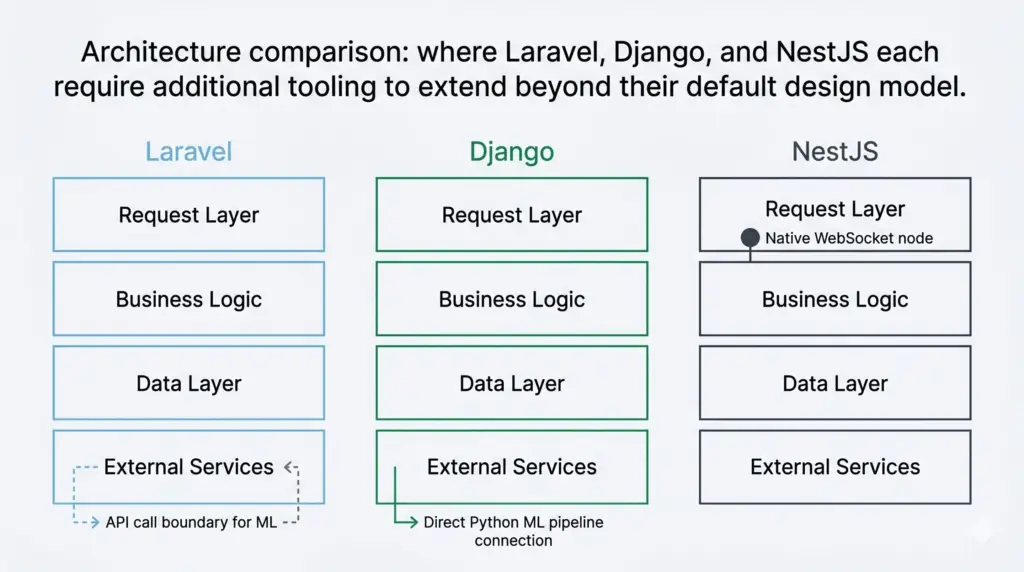
This is where Django’s 2026 argument becomes genuinely compelling: Python is the language of AI and machine learning. TensorFlow, PyTorch, scikit-learn, Pandas, and NumPy are all Python-native. If your application has a roadmap that includes AI-driven features, recommendation engines, fraud detection, natural language processing, forecasting models, Django lets your backend team and your ML team work in the same language, share data models, and run inference without serialisation overhead or external API hops. Laravel and NestJS can call ML models via HTTP, but Django can import them directly. That’s a structural architectural difference, not a feature gap.
Teams whose roadmap goes further, into autonomous agents, multi-step AI workflows, or agentic systems, may also want to look at agentic AI development as a distinct discipline from standard AI feature integration.
Where Django Falls Short
Honest assessment: Django’s monolithic default structure can feel constraining for teams building pure microservices architectures. The framework was designed for cohesive applications, not distributed systems – decomposing it into microservices requires deliberate effort and adds complexity. Django Channels extends the framework with WebSocket and async support, but it is not native to the core framework and adds operational overhead. For high-concurrency real-time applications, NestJS’s native event-driven architecture is a better starting point.
For API-only projects, FastAPI is increasingly the better Python choice. FastAPI is built on Starlette and Pydantic, offers automatic OpenAPI documentation, and outperforms Django in raw throughput benchmarks for API workloads. Django REST Framework is mature and capable, but if you are building a pure API with no server-side rendering and no admin interface, FastAPI’s performance and type safety characteristics are worth evaluating before defaulting to Django.
✓ Strengths
- Native admin panel – powerful, open-source, zero cost
- Python ecosystem: direct access to TensorFlow, scikit-learn
- Instagram/Pinterest scale track record
- Batteries-included: ORM, auth, migrations, forms built-in
- Large global Python talent pool; growing AI-era demand
✗ Limitations
- Monolithic defaults constrain microservices architectures
- Real-time/WebSocket support requires Django Channels add-on
- FastAPI outperforms Django for pure API workloads
- Async support is maturing but not the primary design model
NestJS in 2026 – Strengths, Weaknesses, and Best-Fit Projects
⭐ 75,176 GitHub stars · TypeScript / Node.js · Modular MVC
Architecture
NestJS takes deliberate architectural inspiration from Angular: modules, controllers, providers, and dependency injection are all first-class citizens of the framework. This is intentional and consequential: the same mental model that frontend Angular teams use carries directly into the backend. TypeScript is not optional; it is the default language and the primary design rationale. Decorators define routes, validation pipes handle input, and the dependency injection container manages service lifecycles. For a team of five or more engineers working on a shared codebase, this level of convention prevents the architectural entropy that Express-based projects notoriously accumulate over time.
The TypeScript Advantage at Scale
TypeScript’s adoption across the Node.js backend ecosystem is near-total in 2026 – building a new Node.js backend in plain JavaScript is increasingly uncommon in production teams. NestJS is the framework most aligned with this direction: type safety surfaces integration errors at compile time rather than runtime, IDE tooling provides navigation and refactoring across the entire codebase, and the module system enforces separation of concerns in a way that survives team growth. A junior engineer joining a NestJS project can understand the architectural intent from the file structure alone – and that is not true of an Express project.
Real-World Use Cases
NestJS is the right framework for enterprise REST APIs and GraphQL services, microservices architectures (it ships with a native microservices module supporting TCP, Redis, NATS, Kafka, and gRPC transports), and real-time applications that require a WebSocket gateway as a first-class architectural primitive, not an afterthought bolted on with a library.
NestJS vs Express
Express remains more popular by raw npm download numbers, and it is the right choice for small projects, prototypes, and teams that need maximum flexibility. The argument for NestJS is not that Express is bad; it’s that Express’s lack of opinions becomes a liability at scale. Every Express project ends up inventing its own architecture; NestJS provides that architecture out of the box. As codebase complexity and team size grow, NestJS’s structure typically reduces technical debt accumulation more effectively than Express’s flexibility allows.
Where NestJS Falls Short
Honest assessment: For small projects and solo developers, NestJS’s abstraction layers can feel like over-engineering. The dependency injection system, module decorators, and provider pattern add cognitive overhead that Express or Fastify do not impose. If your project is a simple REST API with five endpoints and one developer, NestJS is likely the wrong tool. Additionally, NestJS does not ship with a built-in ORM, TypeORM and Prisma are the most common choices, both third-party, and the community is meaningfully smaller than Laravel’s or Django’s, which means fewer ready-made package solutions for edge-case requirements.
Talent availability for senior NestJS engineers is growing but not yet at parity with Laravel or Django pools in most markets. TypeScript expertise is widespread, but NestJS-specific architectural patterns are not yet as broadly taught or credentialed as PHP Laravel or Python Django skills.
✓ Strengths
- TypeScript-first: type safety reduces runtime errors at scale
- Native microservices module (Kafka, Redis, NATS, gRPC)
- Built-in WebSocket gateway – real-time is a first-class feature
- Angular-inspired conventions, familiar for frontend Angular teams
- Strong architectural consistency across large team codebases
✗ Limitations
- Abstraction overhead can feel like over-engineering for small projects
- No built-in admin panel; third-party ORM required
- Smaller community than Laravel or Django
- Express still dominates by raw download numbers
- Senior NestJS talent at a premium in some hiring markets
Head-to-Head Comparison – Performance, Scalability, and Ecosystem
The frameworks profile differently enough that a single performance ranking would be misleading. Here is how they compare across the dimensions that drive architectural decisions.
⚡ Performance
For high-concurrency I/O-bound workloads, NestJS (Node.js) has an architectural advantage from its non-blocking event loop. For typical CRUD web applications, Laravel and Django are comparable at scale when properly configured with Redis caching and background job processing. It is worth stating plainly: raw framework throughput benchmarks are almost never the bottleneck in production. Database query efficiency and infrastructure configuration have far greater real-world impact than the framework’s request-handling overhead. Verify against a current, credible benchmark before citing these claims in architectural documents.
📈 Scalability
All three frameworks scale horizontally. NestJS has a native microservices module for distributed architectures. Django scales well behind a load balancer and benefits significantly from Redis caching and Celery for background tasks. Laravel Queue and Horizon provide robust background job infrastructure. The scalability ceiling for all three is determined more by your infrastructure design and data layer choices than by the framework itself.
🌐 Ecosystem Maturity
⚠ Laravel (84,025 GitHub stars) and Django (87,258) are the most mature by community signal. Both have been in active production use for over a decade, have large package registries, and are actively maintained. NestJS is younger but has experienced rapid growth and is now a well-established choice in the Node.js/TypeScript ecosystem. All three receive active development and long-term maintenance commitment from their core teams.
🤖 AI/ML Readiness
⚠ Django holds a clear structural advantage here. Python is the native language of the AI/ML ecosystem: TensorFlow, PyTorch, scikit-learn, and virtually every major ML library are Python-first. Django backends can import and run models in-process. NestJS can integrate with ML services via HTTP or message queues, capable but with serialisation overhead. Laravel follows the same API-call integration pattern as NestJS. For applications where AI features are a core product requirement rather than a peripheral service call, Django’s Python adjacency is a genuine differentiator.
👥 Talent & Hiring
⚠ All three frameworks have global talent pools, but the markets differ. Hire Python developers are in the highest absolute demand in 2026, driven by AI and data science adoption, which benefits Django hiring. PHP/Laravel developers are abundant globally and typically cost-competitive, making Laravel strong on budget-constrained or India/Eastern Europe-sourced teams. TypeScript/NestJS talent is growing but senior NestJS expertise is at a premium in many markets. Validate current rates and availability for your target hiring geography before committing.
🏢 Real-Time Support
NestJS is the clear winner for applications where real-time is a first-class requirement – its WebSocket gateway is native to the framework. Django Channels extends Django with async and WebSocket support but requires additional setup and operational management. Laravel Echo provides WebSocket integration via a Pusher or Redis driver but is not as architecturally native as NestJS’s approach. If real-time is at the core of your product (chat, live collaboration, financial tickers), start with NestJS.
Which Backend Framework Should You Choose? A Decision Framework
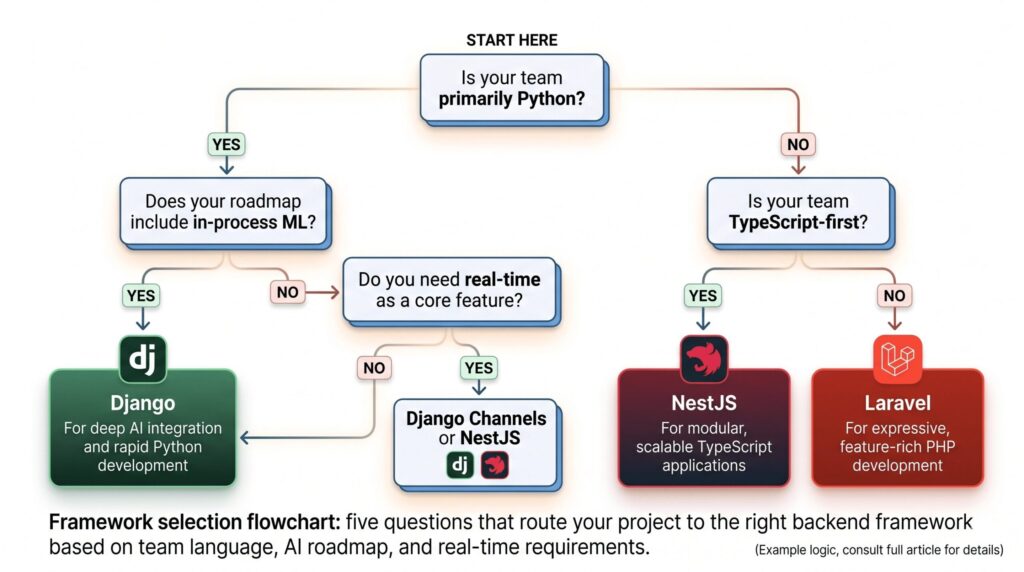
The comparison table and profiles above are inputs to a decision, not the decision itself. Below is the practical filter: not a ranked verdict, but a set of conditions that indicate which framework is the right fit for your specific situation.
🔴 Choose Laravel if…
- Your team has existing PHP expertise or your legacy codebase is PHP-based
- You are building a content-managed web application, eCommerce platform, or SaaS product with a rich admin interface
- You need rapid time-to-market with a batteries-included framework
- Your project does not require native AI/ML processing
- You want a large global pool of hire Laravel developers at competitive rates
🟢 Choose Django if…
- Your team is Python-first or you are integrating with a Python-based data science or ML pipeline
- You need a built-in, fully open-source admin panel with minimal configuration
- You are building a high-traffic web platform at Instagram or Pinterest scale
- Your roadmap includes AI-driven features that leverage the Python ecosystem natively
- You value a batteries-included philosophy that minimises third-party dependency management
🔴 Choose NestJS if…
- Your team is TypeScript-first or already uses Angular on the frontend
- You are building a microservices architecture or a high-concurrency enterprise API
- You need real-time features (WebSockets) as a core architectural requirement
- You prefer strongly typed, annotation-driven code conventions for large team codebases
- You are starting a greenfield project and can absorb the higher initial learning curve
Important: None of these choices is permanent. Migrations between frameworks are possible, but they are costly in both engineering time and risk. Make this decision for the next two to three years of your project’s trajectory, not forever. Re-evaluate as your product, team, and technical requirements evolve.
If you are building a Python-focused team and hiring Python development services for AI-integrated applications, Django’s ecosystem position in 2026 is particularly strong. For organisations already invested in web and mobile app development with PHP, Laravel is the natural next step rather than a migration risk.
Working with IT Path Solutions on Your Backend Project
IT Path Solutions builds production applications with Laravel, Django, and NestJS for startups and enterprises across industries. If you’ve worked through this comparison and still have questions about which framework fits your specific project constraints, team size, timeline, existing infrastructure, or AI roadmap, we’re happy to think through it with you.
Frequently Asked Questions
Is Django or Laravel better?
Neither is universally better, the answer depends on your language ecosystem and project type. Django is better for Python teams building data-heavy or AI-integrated applications, thanks to Python’s ML ecosystem and Django’s powerful built-in admin. Laravel is better for PHP teams building web applications, SaaS platforms, or eCommerce solutions, offering a rich built-in toolset and a large developer community. For most standard web applications, both deliver comparable performance and developer productivity.
Which backend framework is fastest?
For high-concurrency I/O-bound workloads, NestJS (Node.js) has a performance advantage due to its non-blocking event loop architecture. For typical CRUD web applications, Laravel and Django perform comparably at scale when properly configured with caching (Redis) and background job processing. Raw framework speed is rarely the bottleneck in production; database query optimization and infrastructure configuration have far greater impact on real-world application performance.
Is NestJS better than Express?
For large teams and enterprise projects, NestJS is generally a better choice than Express because it provides opinionated structure, TypeScript-first development, built-in dependency injection, and modular architecture conventions that Express deliberately avoids. Express is better for small projects, prototypes, or teams that need maximum flexibility without imposed conventions. As team size and codebase complexity grow, NestJS’s structure typically reduces technical debt more effectively than Express.
What is the most popular backend framework in 2026?
By GitHub stars as of April 2026, Django leads with 87,258 stars, followed by Laravel with 84,025 and NestJS with 75,176. By developer survey data, Django and Laravel consistently rank in the top five most-used backend frameworks globally. NestJS is the fastest-growing framework in the Node.js/TypeScript ecosystem. Popularity alone should not drive framework selection – team expertise and project fit are more reliable decision criteria.
Is Laravel still in demand in 2026?
Yes. Laravel remains one of the most in-demand backend frameworks in 2026, with strong demand in eCommerce, SaaS, and enterprise web application development. Companies including 9GAG, Pfizer, and Razorpay use Laravel in production. The global PHP developer talent pool remains large, and Laravel’s ecosystem continues to receive active development and enterprise tooling support.
Is Python still in demand in 2026?
Python is one of the most in-demand programming languages globally in 2026, driven primarily by AI, machine learning, and data science adoption. Django, the leading Python web framework, benefits directly from this demand. Organizations building AI-integrated web applications increasingly choose Django to keep their backend and ML pipelines in the same language ecosystem. Python developer salaries reflect this demand, with senior rates significantly higher than many comparable backend roles.
Last reviewed April 2026 by IT Path Solutions. Framework star counts, talent pricing, and tooling availability change frequently – verify all figures against current sources before using them in procurement decisions, RFPs, or public documentation.

Keyur Patel
Co-Founder
Keyur Patel is the director at IT Path Solutions, where he helps businesses develop scalable applications. With his extensive experience and visionary approach, he leads the team to create futuristic solutions. Keyur Patel has exceptional leadership skills and technical expertise in Node.js, .Net, React.js, AI/ML, and PHP frameworks. His dedication to driving digital transformation makes him an invaluable asset to the company.
Related Blog Posts

DevExpress Web Reporting: A Complete Guide to Browser-Based Reporting

How Web Application Development Boosts Digital Transformation for SMEs