How Web Application Development Boosts Digital Transformation for SMEs
Keyur Patel
December 31, 2025
10 min
Last Modified:
January 5, 2026
There is a pervasive myth in the business world that “big” equals “better.” We assume that the Fortune 500 companies, with their billion-dollar budgets and armies of IT staff, have the technological upper hand.
In current times, that assumption is dead wrong.
Large enterprises are like cruise ships. They are massive, powerful, and stable. But if they need to change course? It takes them three miles and forty meetings to turn the wheel. They are weighed down by legacy code, bureaucratic red tape, and compliance departments that stifle innovation.
You? You are a speedboat. As an SME (Small to Mid-sized Enterprise), your lack of size is your greatest weapon. You can pivot. You can experiment. You can implement a new idea on Tuesday that you had on Monday.
But a speed boat without an engine is just a raft floating in the water.
Web application development is that engine. It is the equalizer that allows a 50-person company to compete with a 5,000-person giant. It is the difference between doing digital things (having a website and email) and being digital (having operations that run at the speed of code).
This isn’t just about upgrading your software; it’s about upgrading your entire business model. Here is the strategic manifesto for how SMEs are using custom web apps to steal market share from the giants.
The Digital Facade vs. True Transformation
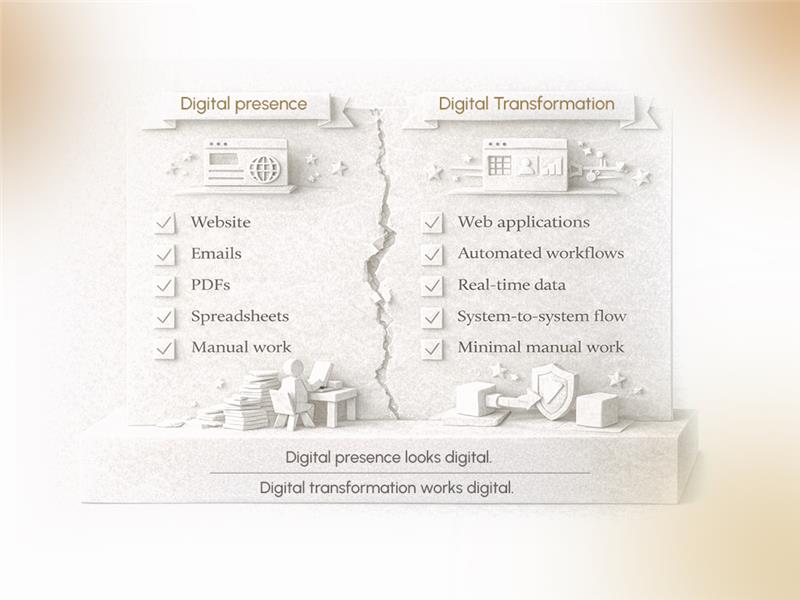
Let’s clear the air on what Digital Transformation actually means, because the term has been abused by marketing consultants for a decade.
If you scan your paper invoices and save them as PDFs on a Google Drive, that is digitization. You haven’t changed how you work; you’ve just changed the storage medium. You are still doing manual data entry; you’re just doing it on a screen instead of paper.
Digital Transformation is when the work happens without you.
Traditional workflows rely heavily on human intervention: orders arrive, someone checks availability, someone else updates internal systems, and another person prepares production or delivery tasks.
Every step introduces delays, errors, and dependency on specific staff members.
- A custom web app removes this chain of manual handling.
- Information flows automatically from customer input to inventory, production, billing, and dispatch.
- Teams work from live data. Customers receive instant confirmations. The entire process becomes consistent and independent of individual availability.
This approach is what shifts a business from digital presence to true digital operations.
This is the power of web app development for SMEs. It removes the human middleware, the people paid to move data from one place to another, and frees them to do high-value work, like sales or quality control.
The Economics of Build vs. Buy (The SaaS Trap)
When you decide to digitize, your first instinct is to buy Software as a Service (SaaS). There is a tool for everything: Monday.com for projects, Salesforce for CRM, Xero for accounting.
SaaS platforms are a strong starting point for SMEs. They are affordable, easy to adopt, and ideal for getting operations digitized quickly. But as a business grows, so do its processes. At that stage, companies often discover that SaaS tools can only take them part of the way.
- The Reality of Growth: Your workflows become more specific. Your teams require deeper integration across systems. You need automation that matches how your business operates, not how a general-purpose tool assumes you work.
- Where Custom Web Apps Step In: Instead of replacing SaaS, custom development complements it. A tailored web app can connect your existing tools, automate the gaps between them, and extend capabilities in ways standard platforms cannot. It gives SMEs the flexibility to build processes around their strengths instead of adjusting their strengths to fit a tool.
- The Strategic Advantage: Custom web applications provide a layer of control, integration, and precision that SaaS platforms aren’t built to offer by default. Together, they give SMEs a scalable and future-ready ecosystem.
The Asset Mindset:
When you engage a Web Development Company to build a proprietary solution, you are building an asset. It is Capital Expenditure (CapEx), not Operational Expenditure (OpEx).
- Long-Term Control and Flexibility: Unlike SaaS tools that limit customization to their predefined features, a custom web application grows with your business needs. You decide how workflows function, how data moves, and how systems integrate. This gives SMEs the freedom to refine processes continuously without waiting for a vendor’s update or feature release.
- Workflow Precision: Every SME has unique operational quirks. When you build your own web app, those workflows are designed exactly as your teams require; not “close enough” or “workaround friendly,” but precise by design. This alignment removes friction, reduces training time, and eliminates the compromises forced by generic software.
- Unified Ecosystem: Over time, SMEs often accumulate several disconnected SaaS subscriptions across departments. A custom solution lets you consolidate these scattered tools into a single, integrated platform, reducing subscription fatigue, minimizing context switching, and improving operational clarity across teams.
The 24/7 Salesperson (Customer Portals)
In 2025, B2B buyers are acting like B2C consumers. They don’t want to call a sales rep to get a quote. They don’t want to wait for an email response to simple questions like, “Where is my shipment?”
They want Amazon-level transparency, and they want it now.
The Self-Service Revolution: We recently worked with a construction material supplier. Their customer-facing team was overwhelmed with constant availability and pricing inquiries. Contractors would call multiple times a day to check stock levels, reserve materials, or confirm delivery timelines. These were simple questions, but answering them manually consumed hours every week.
To solve this, we developed a custom inventory and ordering portal. Contractors could log in, view real-time stock, reserve items for a limited time, and complete purchases instantly from their phones, even while on-site.
The result was a smoother experience on both sides. The supplier reduced repetitive calls, and contractors gained immediate access to the information they needed to keep their projects moving.
- Contractors could check stock levels in real-time from their mobile phones on the job site.
- They could lock inventory for 4 hours.
- They could pay via credit card instantly.
The Outcome: Phone calls dropped by 70%. Sales increased by 40% because contractors preferred buying from the supplier that gave them instant answers, even if that supplier was slightly more expensive.
The Lesson: In the SME world, convenience is a stronger currency than price. A custom web app is your 24/7 salesperson that never sleeps, never takes a holiday, and never gives the wrong quote.
The Super-Employee (Internal Operations)
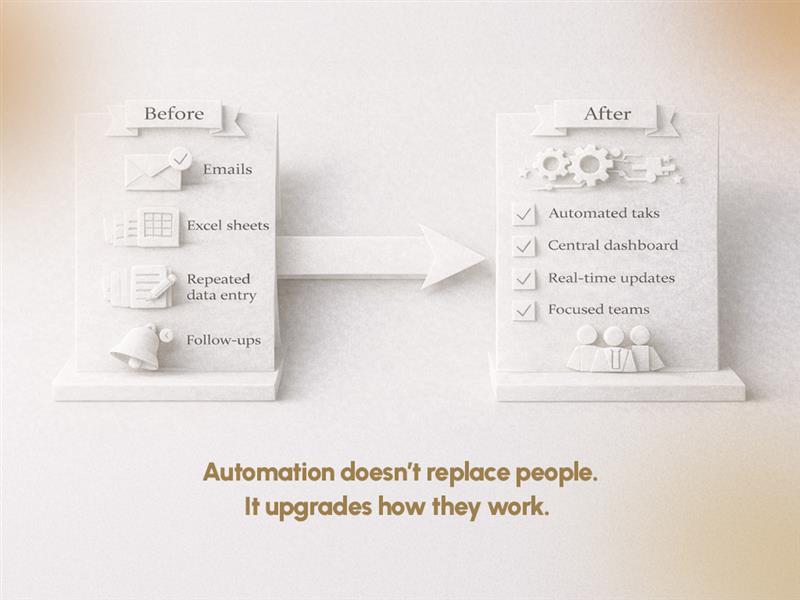
The biggest lie in business is that automation kills jobs. The truth is: Automation kills boring jobs.
Your employees didn’t go to college to copy-paste data from an email into a spreadsheet. When you force them to do that, they burn out. They quit. High turnover is the silent killer of SME growth.
Custom web application development strengthens internal teams by removing repetitive, low-value tasks from their daily workload. When routine actions are automated, and information is easy to access, employees can focus on work that actually drives growth.
Instead of spending time updating spreadsheets, passing information across departments, or performing manual data entry, your team operates within systems that handle these steps automatically. Processes become consistent, faster, and less dependent on individual staff members.
This shift doesn’t replace employees; instead, it supports them. It creates an environment where technology manages the operational load, and people can focus on decision-making, relationships, and innovation.
This is how you create a super employee. You aren’t replacing people; you are giving them tools that make them 10x more productive. You are creating a culture where technology handles the drudgery, and humans handle the strategy.
The Roadmap (How to Start Without Going Broke)
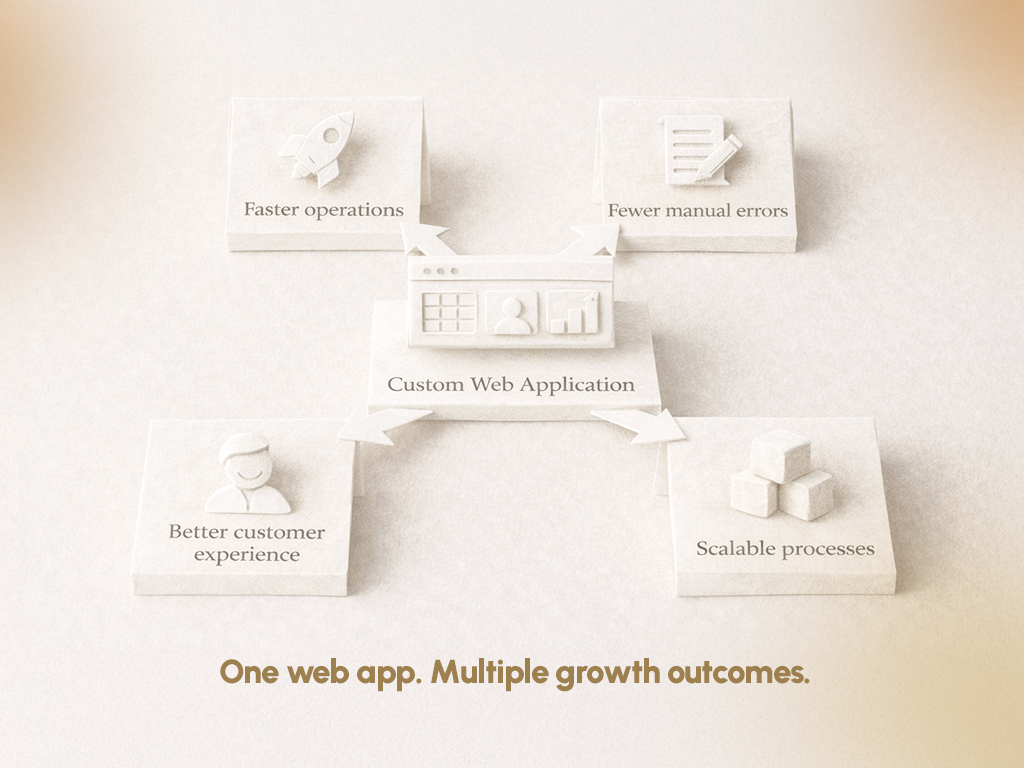
The common misconception and fear about a Custom Web App Development is usually financial. One can’t afford a $100,000 software project.
Good news: You shouldn’t spend $100,000. Not at first. The era of waterfall development, where you spend a year building a massive system before launching, is over. The smart money is on agile iteration.
Step 1: The Discovery Workshop:
Don’t start with code. Start with a whiteboard. Sit down with a partner who offers web application development consulting. Map out your entire workflow. Circle the steps that are red (slow, error-prone, manual). That red circle is your target.
Step 2: The MVP (Minimum Viable Product):
Build a web app that solves only that red circle.
- If invoicing is the problem, build an invoicing app.
- If scheduling is the problem, build a calendar app. Get it live in 6 weeks. Let your team use it.
Step 3: The Feedback Loop:
Your team will respond positively and naturally point out other capabilities they’d like the system to include. That is your roadmap for Phase 2.
By building in chunks, you manage your cash flow. Instead of expecting instant ROI, the MVP gives you early validation. You learn how your team uses it, what gaps remain, and which features will truly move the needle. That clarity shapes Phase 2, ensuring you build on real user behavior rather than assumptions.
This is how an SME builds an Enterprise Web Solution without an enterprise budget, brick by brick, funded by efficiency gains.
Security in an Insecure World
We cannot talk about web apps without talking about risk. SMEs are the #1 target for cyberattacks in 2025. Why? Hackers know that big banks have billion-dollar firewalls, but small businesses often leave the back door open.
If you are relying on Excel sheets emailed back and forth, you are leaking data. Emails are not secure. Spreadsheets have no audit trails.
A professionally developed web app introduces Role-Based Access Control (RBAC).
- The intern sees only the data they need to do their job.
- The manager sees the reports.
- The admin sees everything.
- Every click, every edit, and every download is logged.
Security is no longer just IT protection; it is a sales asset. Security is not just a technical requirement; it is part of your value proposition. Demonstrating SOC2-aligned controls and encrypted workflows positions your business as a reliable partner, especially when compared with processes that still depend on unsecured email exchanges.
The Future: The AI-Ready Business
As operations become more digital, the next opportunity naturally opens up: AI-driven insights. But meaningful AI adoption only works when your processes run through a unified system. A custom web app becomes that foundation, giving SMEs a practical path to adopting smarter tools over time.
You cannot use AI if your data is on paper or in scattered spreadsheets. AI needs structured data. By building a custom web app now, you are building the container for your future AI.
- Today, your web app tracks sales, tomorrow you plug in an AI module that predicts them.
- Similarly, it might store customer emails today, and an AI agent might end up drafting the replies for you tomorrow.
You are laying the foundation for the next decade of growth.
Conclusion
The biggest barrier to digital transformation isn’t technology; it’s mindset. It’s the mindset that advanced technology is meant only for big companies. Amazon was once a small bookstore. Netflix was once a small DVD rental service. They didn’t become giants by waiting until they were big to build great technology. They became giants because they built great technology when they were small.
Your competitors are likely still stuck in the Spreadsheet Era. They are drowning in admin work, losing leads, and burning out their staff. You have an opportunity to break away.
At IT Path, we specialize in helping SMEs make this leap. We don’t just write code; we look at your business logic, find the friction, and smooth it out with elegant, powerful web applications.
Are you ready to build your engine? Let’s turn your business into a speed boat.
[Start Your Transformation Journey]

Keyur Patel
Co-Founder
Keyur Patel is the director at IT Path Solutions, where he helps businesses develop scalable applications. With his extensive experience and visionary approach, he leads the team to create futuristic solutions. Keyur Patel has exceptional leadership skills and technical expertise in Node.js, .Net, React.js, AI/ML, and PHP frameworks. His dedication to driving digital transformation makes him an invaluable asset to the company.
Related Blog Posts
Laravel vs Django vs NestJS: The 2026 Backend Framework Comparison
Top .NET MAUI Developer Skills You Need In 2025: A Complete Guide