
AI for Inventory Management: Benefits, Use Cases & Implementation
Keyur Patel
September 12, 2025
15 min
Last Modified:
September 29, 2026
AI for inventory management uses artificial intelligence and machine learning to analyze inventory, sales, demand, supplier, and market data to improve forecasting, replenishment, stock optimization, and operational decision-making. By applying AI to inventory management, businesses can identify demand patterns, predict potential stockouts, optimize inventory levels, and automate repetitive processes.
The role of AI in inventory management is expanding as businesses look for more accurate forecasting, better inventory visibility, lower carrying costs, and faster responses to changing demand. This guide explains what AI inventory management is, how it works, its key use cases and benefits, the technologies involved, implementation considerations, and the challenges businesses should evaluate before adopting an AI-powered inventory system.
The market for artificial intelligence grew beyond 184 billion U.S. dollars in 2024, a considerable jump of nearly 50 billion compared to 2023. This staggering growth is expected to continue with the market racing past 826 billion U.S. dollars in 2030. The significant market growth in 2024 reflects the expanding role of AI across various sectors, from healthcare and finance to manufacturing and retail. So all industry verticals are adopting artificial intelligence at an unprecedented rate, leveraging its capabilities to enhance efficiency, drive innovation, and gain competitive advantages.
What Is AI Inventory Management?
AI inventory management is the use of artificial intelligence, machine learning, predictive analytics, and automation to monitor inventory, forecast demand, optimize stock levels, automate replenishment decisions, and identify potential inventory risks.
Traditional inventory systems often rely on predefined rules, historical averages, and manual analysis. An AI-powered inventory management system can analyze larger and more diverse datasets, identify patterns, generate predictions, and adapt recommendations as demand and business conditions change.
Depending on the business and available data, AI can support activities such as demand forecasting, stock optimization, replenishment planning, warehouse operations, supplier analysis, inventory tracking, and risk detection.
How Does AI Inventory Management Work?
An AI inventory management system typically combines inventory, sales, purchasing, supplier, and other operational data to generate predictions and recommendations. The process can be summarized as:
Data Collection → Data Analysis → Demand Prediction → Inventory Optimization → Recommendations → Continuous Monitoring
1. Data Collection
The system collects relevant information such as sales history, current inventory levels, purchase orders, supplier information, promotions, seasonality, and other demand-related data.
2. Data Analysis
AI and machine learning models analyze the available data to identify patterns, relationships, trends, and unusual inventory behavior.
3. Demand Prediction
Predictive models estimate future product demand based on historical and current data. This can help businesses anticipate changes in purchasing behavior and demand patterns.
4. Inventory Optimization
The system can use predicted demand and current inventory information to recommend appropriate stock levels, reorder quantities, and replenishment timing.
5. Automated Recommendations
AI can flag potential stockouts, excess inventory, unusual demand, or replenishment requirements so inventory teams can take appropriate action.
6. Continuous Monitoring and Learning
As new sales, inventory, and operational data becomes available, AI models can be monitored and updated to improve future predictions and recommendations.
How AI Is Used in Inventory Management
AI Inventory management can help optimize business processes at all stages. By leveraging AI development services, businesses can streamline inventory management and minimize the possibility of overstocking and under stocking.
Artificial intelligence (AI) is more proficient in predictive analytics, which allows businesses to make informed decisions about inventory replacement, pricing strategies, and product promotions. AI-based inventory management systems can continue learning and updating their algorithms and models to reflect better changing market and business conditions.
AI-driven inventory management allows businesses, whether large enterprises or small manufacturers, to transform their operations end-to-end by streamlining processes, reducing costs, and enhancing overall efficiency.
This is why AI-driven inventory management is recognized as a game changer; its advanced functionality and intelligent capabilities are reshaping how businesses manage their inventory. In this blog, we will discuss the remarkable role of artificial intelligence in inventory management, study the top use cases, and analyze the challenges of the same.
Key Advantages of AI in Inventory Management
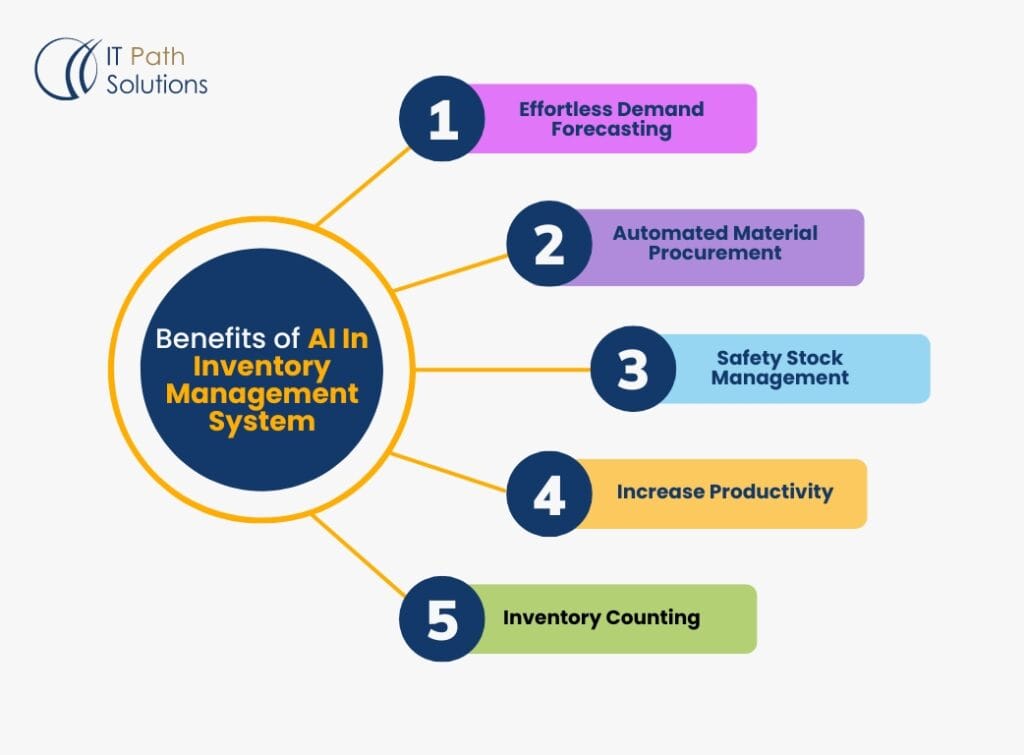
Integrating AI into inventory management systems offers transformative benefits for businesses looking to optimize their operations. Let’s look at them.
Effortless Demand Forecasting
AI enhanced inventory management systems can spot demand patterns, and use this data for accurate forecasting and optimizing warehouse replacement plans. AI Inventory management uses sophisticated algorithms to analyze various data points, including historical sales data, market trends, and external influences like seasonality and promotional activities. This powerful approach to inventory management empowered businesses to meet customers’ demand effectively while reducing excess inventory cost.
Automated Material Procurement
All manufacturing businesses need to transform automated procurement processes in place of large numbers of documents and paperworks. Artificial intelligence can help automate such processes, right from getting best quotes to taking material through the supply chain.
Safety Stock Management
A-driven system can automatically trigger safety stock management based on real-time sales data, inventory levels and demand forecasting. AI for stock optimization systems ensure business to maintain optimal stock level and avoid stockout and overstock situations.
Increase Productivity
AI inventory management software boosts productivity by automatic repetitive tasks and providing valuable insights. AI business integrations allow employees to focus on higher value activities and better monitoring of aspects such as lead times, quantities, and operational inefficiencies.
Cost Reduction
Businesses lose more in revenue due to poor inventory management. By integrating AI in the inventory management system, businesses can improve their operations and they can cut operational cost and improve cash flow by huge margins. AI-powered inventory optimization algorithms enable businesses to maintain optimal stock level, reducing need for inventory storage and associated costs.
Inventory Counting
Computer vision based inventory management solutions help across various industries from manufacturing and retail to healthcare and logistics. It provides more accurate inventory counting, optimized labor, equipment cost, and streamlined decision making on stock replenishment.
Improved Employee Performance
AI can boost and improve the overall performance of employees through business education tools such as administration programs that offer the latest courses, topics and management information.
Discover More:- An Expert’s Guide On AI Business Integration For 2024
AI in Inventory Management: Key Use Cases
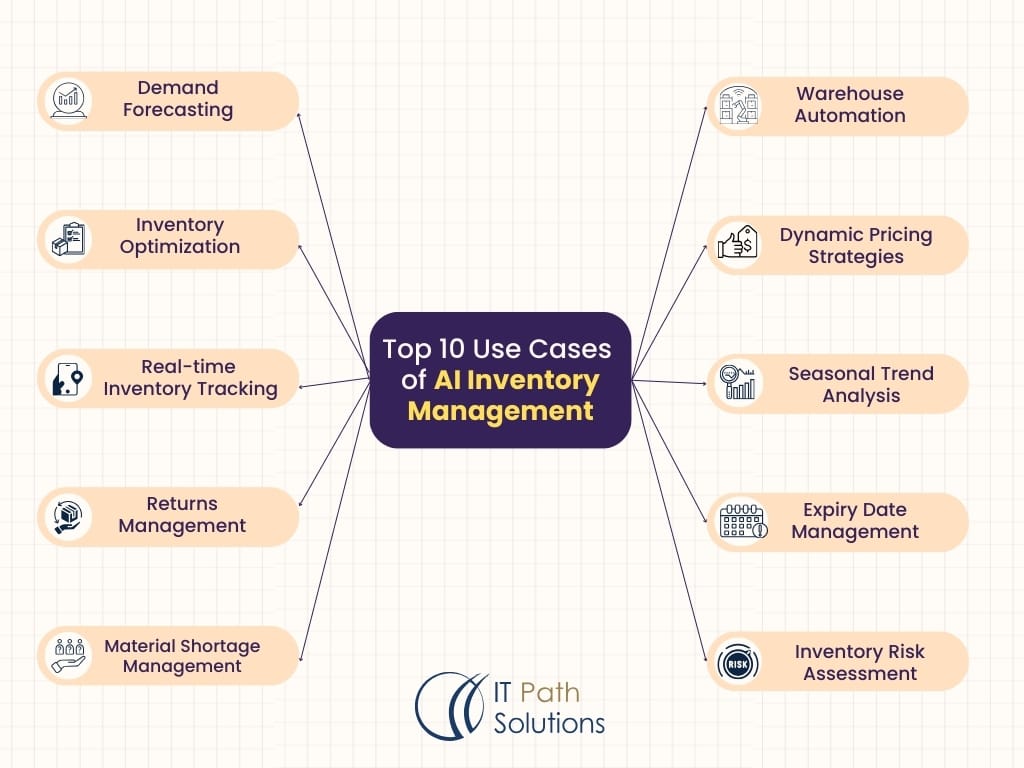
Demand Forecasting
AI Inventory management leverages machine learning algorithms to evaluate large datasets which include historical sales data, market trends, consumer behavior and promotional activities.
Generative AI Inventory management identifies intricate patterns and correlations that enable businesses to generate precise demand forecasts. As a result organizations can optimize stock levels, minimize stock outs and enhance overall efficiency.
Inventory Optimization
AI-powered inventory optimization considers various factors such as lead times, demand variability and storage costs to determine optimal inventory levels. As a result AI enables businesses to maintain adequate stock and operate more efficiently, managing inventory without unnecessary costs or shortage.
Real-time Inventory Tracking
Integrating AI System into Inventory management, provides real-time effective tracking capabilities and control of inventory across the locations. With the help of this cutting edge technology, businesses can enhance operational efficiency and track their inventory status.
Furthermore, organizations can reduce risk of stockout and overstock situations, which help optimize their supply chain, save on financial losses and improve overall profitability.
Warehouse Automation
AI helps streamline warehouse management by automating real-time inventory tracking, picking, packing and layout optimization tasks such as order fulfillment and inventory tracking.
AI Inventory management optimizes warehouse layouts and storage configuration based on historical data, maximizing space utilization and minimizing operational costs.
Dynamic Pricing Strategies
Dynamic pricing with AI helps companies to adapt prices in real-time based on demand fluctuations, competitors strategies and inventory levels. With the help of AI technology, businesses can analyze overpricing and underpricing by optimizing the pricing model, ensuring maximum revenue generation.
Thus AI-based dynamic pricing becomes a vital tool for businesses trying to compromise between meeting consumer demand and maximizing earning.
Seasonal Trend Analysis
By implementing AI in inventory management, organizations can analyze seasonal trends and sales patterns to optimize stock level, promotions and marketing strategies. By utilizing AI inventory management, businesses can avoid stockout during peak seasons while minimizing overstocking during off-seasons.
By integrating AI-powered demand forecasting, companies can improve their specific seasonal trends data and maximize revenue potential and enhance overall profitability.
Expiry Date Management
By implementing AI-based solutions focused on expiration management and waste reduction, companies can achieve significant cost savings, ensure product quality, and build more sustainable supply chain operations.
Thus by leveraging artificial intelligence and data analytics capabilities, organizations can gain real-time visibility into inventory and develop intelligent systems to prioritize products based on expiration dates.
Inventory Risk Assessment
Artificial intelligence in Inventory management is crucial in control of various potential supply chain risks. AI uses sophisticated analytic algorithms to identify disruption in supply chain operations such as the possibility of natural disaster that could affect inventory management.
This proactive approach helps businesses to implement strategic measures and minimize the potential impact of disruption to their inventory. AI-driven risk management can examine historical data, current market patterns and external factors to predict any supply chain risks.
Discover More:- A Guide To Developing an AI-Powered Chatbot For Your Business
AI-Based Inventory Management Systems
An AI-based inventory management system combines inventory data with machine learning, predictive analytics, and automation to support forecasting, replenishment, stock optimization, and risk detection.
Unlike a system that relies only on fixed rules, an AI-based approach can analyze changing patterns in sales, demand, inventory, and supply data to generate updated predictions and recommendations.
Common capabilities of an AI-based inventory management system include:
- Demand forecasting
- Inventory optimization
- Automated replenishment recommendations
- Stockout and overstock prediction
- Inventory anomaly detection
- Supplier performance analysis
- Warehouse optimization
- Predictive alerts
- Inventory reporting and analysis
The exact capabilities depend on the quality of available data, the AI models used, system integrations, and the business requirements.
Traditional vs AI-Based Inventory Management
Traditional and AI-based inventory management systems can differ in how they analyze data, forecast demand, and support inventory decisions.
| Area | Traditional Inventory Management | AI-Based Inventory Management |
|---|---|---|
| Demand forecasting | Historical data and manual analysis | Predictive models and data analysis |
| Replenishment | Fixed rules and reorder points | Data-driven recommendations |
| Stock optimization | Manual calculations | Dynamic optimization |
| Risk detection | Often reactive | Predictive alerts and anomaly detection |
| Data analysis | More limited or predefined | Multiple data sources and patterns |
| Decision-making | Primarily manual | AI-assisted |
| Updates | Periodic analysis | Continuous or near-real-time analysis |
| Scalability | Can require more manual effort | Can automate repetitive analysis |
AI does not necessarily replace inventory teams. Instead, it can provide predictions, recommendations, and alerts that help people make faster and more informed inventory decisions.
AI Technologies Used in Inventory Management
Different AI technologies can support different inventory management requirements.
Machine Learning
Machine learning models can analyze historical and current data to identify patterns and improve demand forecasts and inventory predictions.
Predictive Analytics
Predictive analytics uses historical and real-time information to estimate future demand, inventory requirements, and potential risks.
Computer Vision
Computer vision can support automated inventory counting, product recognition, shelf monitoring, and warehouse inspection when appropriate imaging infrastructure is available.
Generative AI
Generative AI can help users analyze inventory information through natural-language interfaces, generate reports, summarize trends, and assist with inventory-related queries.
Optimization Algorithms
Optimization techniques can support decisions involving inventory levels, replenishment quantities, warehouse operations, and resource allocation.
Anomaly Detection
Anomaly detection can identify unusual changes in sales, inventory levels, demand, or other operational data that may require investigation.
Limitations of AI in Inventory Management
Artificial intelligence plays a significant role in overcoming challenges and complexity faced by traditional inventory management systems. Here let’s discuss how AI addresses each of these challenges.
Complexity
Integrating AI Inventory management often involves high degree complexity as it requires proper understanding of the specific need of the inventory system, significant amount of resources and time.
Collaborate with AI development companies that can help you to manage complexity and deploy AI Solutions effectively.
Data Quality
AI requires a large amount of high quality data to function accurately, it is not often guaranteed to provide the same outcomes, incorrect and poor data quality can lead to wrong predictions and entire decision making process.
Ensuring your inventory input data is accurate, reliable, and up-to-date is a significant challenge that businesses must address to successfully implement AI solutions.
Implementation Costs
Few firms, especially smaller ones may find these costs prohibitive, limiting their ability to adopt AI solutions for inventory management.
Look at a scalable pricing model for AI-based solutions, consider small scale implementation projects to show ROI, and look for funding sources to maintain cost budget.
Security and Privacy
AI in Inventory management often handles sensitive supply chain and inventory data that are susceptible to security threats like cyberattacks.
As a solution businesses need to implement robust security monitors and update their security protocols to safeguard their AI systems and the data they handle.
How to Implement AI in Inventory Management
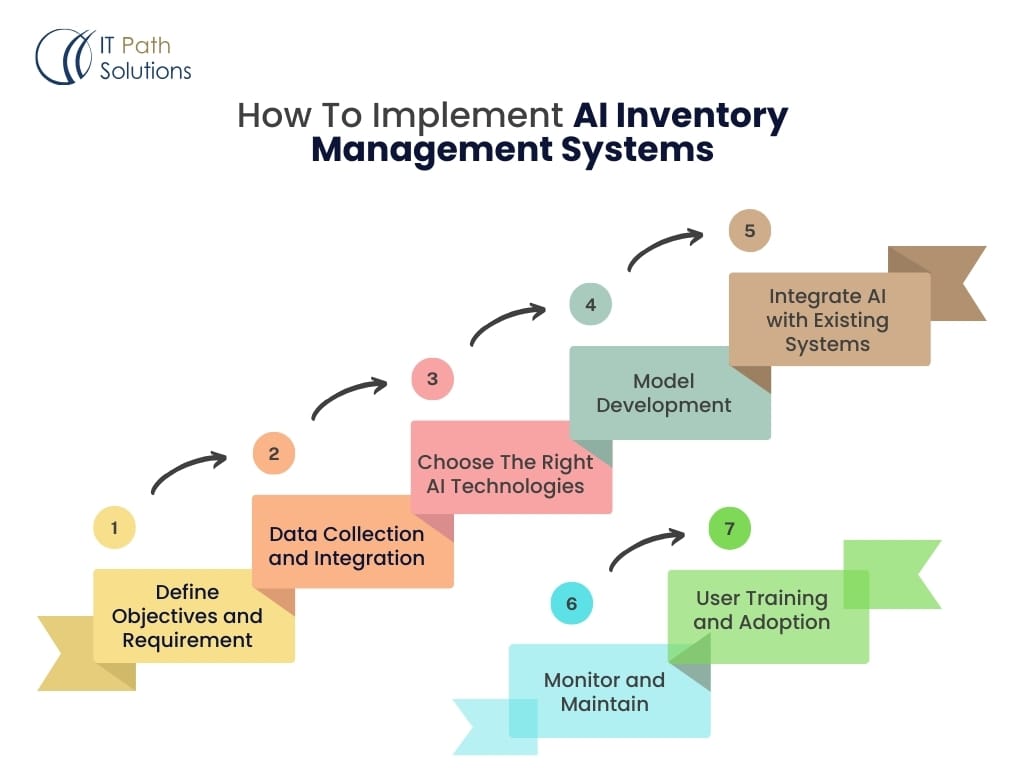
Implementing Artificial Intelligence in inventory management has a bunch of benefits as it streamlines processes and improves efficiency, accuracy and decision making.
Let’s discuss how to implement AI Inventory management systems.
Define Objectives and Requirement
In this phase you need to understand your inventory management process, your current challenges and requirements. This could include stockouts, overstocking, inaccurate forecasting and many more.
Data Collection and Integration
During this phase, collect relevant data from multiple sources such as sales record, purchase orders, historical demand data, supplier information. Integrate this data into a centralized system for analysis by hiring AI Developers.
Choose the Right AI Technologies
Choose suitable AI techniques based on your specific requirements. Find a top AI & ML Development Company that has expertise in machine learning development, predictive analytics and natural language processing (NLP) for analyzing unstructured data like customer feedback, etc.
Model Development
With the help of your AI Development Partner, build an AI model to your inventory management needs such as demand forecasting, inventory optimization, supplier performance analysis and stockout prediction. Finally test and validate the model to ensure accuracy, reliability, and scalability.
Integrate AI with Existing Systems
Integrate the AI models with your existing inventory management systems and processes. ensure seamless data exchange and real-time updates between AI and other systems.
Monitor and Maintain
Continuously monitor the performance of AI models in real-time and make necessary changes to business conditions, market dynamic and seasonal variations.
User Training and Adoption
Train users on how to use and interpret AI-powered inventory insights. Give them a live demo of the benefits of AI-driven inventory management such as improved accuracy, reduced costs, and better decision-making, to encourage adoption.
Why Choose IT Path Solutions for AI-Powered Inventory Management
Effective and proactive inventory management is crucial for operational success, ensuring that products are available as needed while maintaining an optimal balance of stock and resources. As the demand for efficient inventory management increases, optimizing inventory has become essential for achieving excellence in supply chain operations. In this context, IT Path Solutions has come out as a strategic partner for companies beginning on the AI Inventory management software development journey.
Looking to transform your inventory management with AI? Hire Python developers from IT Path Solutions to create custom AI-powered inventory management solutions tailored to your specific business needs.
Get in touch today with our talented team to create innovative, future-ready solutions.
Frequently Asked Questions About AI in Inventory Management
What is AI for inventory management?
AI for inventory management uses artificial intelligence, machine learning, predictive analytics, and automation to analyze inventory and demand data, forecast future requirements, optimize stock levels, and support replenishment and inventory decisions.
How is AI used in inventory management?
AI can be used for demand forecasting, inventory optimization, automated replenishment, stockout prediction, real-time inventory analysis, warehouse optimization, supplier analysis, dynamic pricing, expiry management, and inventory risk detection.
What are the benefits of AI inventory management?
Benefits can include improved demand forecasting, fewer stockouts, lower excess inventory, better inventory visibility, faster replenishment decisions, improved warehouse efficiency, and potentially lower inventory carrying costs.
How does AI improve inventory forecasting?
AI can analyze historical sales, seasonality, promotions, inventory levels, and other relevant data to identify patterns and generate predictions about future demand.
What is an AI-based inventory management system?
An AI-based inventory management system combines inventory data with machine learning, predictive analytics, and automation to support forecasting, replenishment, stock optimization, and inventory risk detection.
Can AI predict inventory demand?
Yes. AI and machine learning models can be trained to forecast future demand using historical and current data. Forecast accuracy depends on factors such as data quality, product characteristics, demand volatility, and model design.
Can AI reduce stockouts and overstocking?
AI can help identify potential stockouts and excess inventory by analyzing demand patterns, current inventory, lead times, and other relevant factors. Businesses can use these predictions to improve replenishment and inventory planning.
What data is needed for AI inventory management?
Common data sources include sales history, inventory levels, purchase orders, supplier information, lead times, product information, promotions, seasonality, pricing, and other demand-related or operational data.
How much does it cost to implement AI in inventory management?
The cost depends on the AI use cases, data infrastructure, integrations, software or development requirements, automation level, and ongoing maintenance. A business using an existing AI-enabled inventory platform may have a different cost structure from one developing a custom solution.

Keyur Patel
Co-Founder
Keyur Patel is the director at IT Path Solutions, where he helps businesses develop scalable applications. With his extensive experience and visionary approach, he leads the team to create futuristic solutions. Keyur Patel has exceptional leadership skills and technical expertise in Node.js, .Net, React.js, AI/ML, and PHP frameworks. His dedication to driving digital transformation makes him an invaluable asset to the company.
Related Blog Posts

Beyond Basic RAG: Building a More Reliable Retrieval Pipeline With Hybrid Search

LLM Inference on Limited GPU Memory: What We Learned From Layer-Wise Model Streaming