
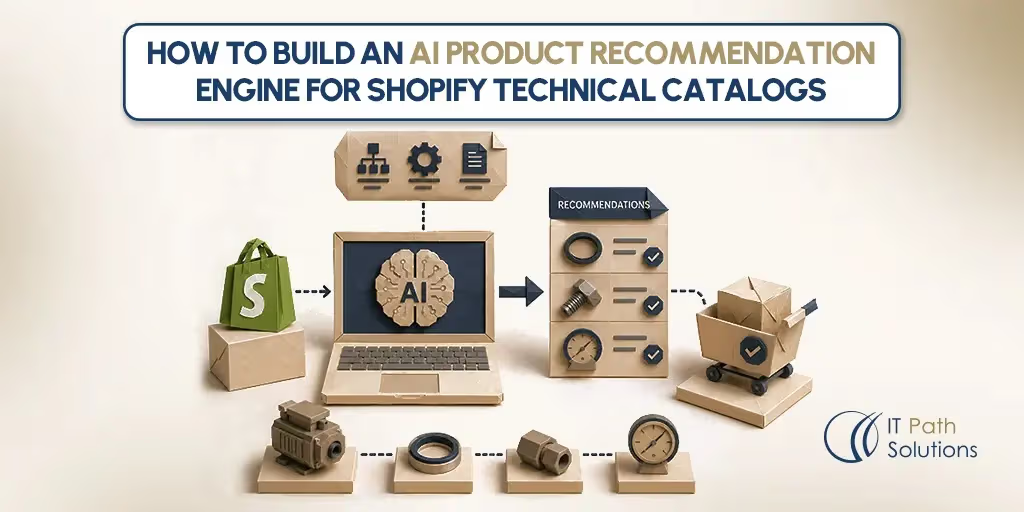
How to Build an AI Product Recommendation Engine for Shopify Technical Catalogs
Keyur Patel
July 8, 2026
23 min
Last Modified:
July 8, 2026
Shopify’s “Customers Also Bought” recommendations are built on purchase history. For consumer stores, that works perfectly. For technical catalogs selling hydraulic components, automotive parts, or electronics, it fails completely because your products have technical relationships, not purchase relationships. The recommendation a B2B buyer actually needs is “you need Seal Kit B and Bolt C to install this pump.” A custom recommendation engine built on your product taxonomy and connected to Shopify’s Storefront API delivers the same result in 6-8 weeks.
Product recommendations drive real revenue. When the right product appears at the right moment, buyers add it to their cart. Shopify knows this, which is why it has built recommendation capability directly into the platform.
For consumer stores, that built-in logic works well. A customer buying running shoes sees a suggestion for sports socks. The system learned that pattern from thousands of transactions where other customers bought both. The connection is obvious, the data is abundant, and the recommendation earns its place.
Now consider an industrial distributor selling hydraulic equipment. A buyer adds a high-pressure pump to their cart. They actually need a compatible seal kit, a specific inlet connector, and a pressure gauge rated to the pump’s operating range. Shopify’s native engine stays silent on all three, because no co-purchase history exists to reveal those relationships. The customer either already knows what they need, figures it out later, or calls your support team.
This is the core failure mode that Shopify AI product recommendations run into with technical catalogs. Behavioral signals cannot surface compatibility relationships that live in product specifications, not in order history. For B2B and industrial merchants, that gap has a direct cost.
The solution is a recommendation engine built on a different foundation, which is product taxonomy and AI embeddings rather than purchase history. This guide explains how that approach works, when it makes sense to build one, and how to scope the implementation. If you sell consumer products at high volume, Shopify’s native tools are genuinely capable for that use case and you likely do not need a custom build. But if your catalog is technical, configurable, or compatibility-dependent, this guide is written for you.
How Shopify’s Native Recommendation System Works
Shopify has invested seriously in its built-in recommendation capability, and for the right catalog type it performs well. Understanding how it works is the starting point for understanding where it breaks down.
The native system pulls from four data signals to decide which Shopify AI product recommendations to show.
- Customers Also Bought surfaces products that other shoppers purchased in the same transaction. It is the most direct behavioral signal the engine uses.
- Related Products draws on product metadata, including tags, categories, and collections, to group items with similar attributes.
- Purchase history builds individual and aggregate patterns over time, adding weight to products that repeat buyers tend to combine.
- Browsing behavior tracks which products customers view in sequence and uses that sequence data to infer relevance.
Together, these signals feed an algorithm that learns from what your customers actually do. For a consumer product catalog with high transaction volume, the model improves steadily. A fashion retailer selling athletic apparel will see the system correctly pair trail running shoes with merino socks because thousands of customers have made that exact combination. The pattern is statistically clear, the data is plentiful, and the suggestions are accurate.
This is genuinely good engineering. Shopify did not build a simple “similar tags” widget. The system adapts over time, adjusts to seasonal patterns, and handles large consumer catalogs without any configuration from the merchant.
The boundary of its usefulness is equally clear as the system can only recommend based on what other customers have already done. It cannot reason about what a product requires. For example, there’s a Shopify website that sells hydraulic pumps, now Shopify’s native product recommendation has no concept of compatibility, and it does not know that Seal Kit B only fits Pump Model A. It only knows what your previous customers ordered together, and for such technical products with sparse purchase history, that knowledge is nearly empty.
That is not a limitation Shopify can fix with a better algorithm. It is a structural constraint of behavioral machine learning. When the input data does not contain compatibility information, no amount of model sophistication produces compatibility recommendations.
You might also like – Top Shopify Developer Skills in 2026: What’s Changed With AI & Automation
The Problem with Technical and Complex Catalogs
Let’s continue with our hydraulic pump Shopify website example, to get a clear view of the challenges and how AI product recommendation is a better option for technical catalogs.
A procurement engineer at a manufacturing facility visits your Shopify store and purchases Hydraulic Pump Model A. What they actually need to complete a functional installation includes Seal Kit B, which is rated for that pump’s operating pressure. They also need Inlet Connector D, which matches the pump’s port thread specification. And they need Pressure Gauge C, which is calibrated to the pump’s output range.
None of those products appear in the recommendation widget. Why? Because your store processes forty pump orders per month. The previous buyers of Pump A either already had the accessories on hand, sourced them from a different supplier, or ordered them separately two weeks later. There is no co-purchase pattern in your transaction history linking the pump to its required accessories. The behavioral signal does not exist.
This same failure mode appears across every technical product vertical.
- Industrial equipment suppliers, where each machine model requires specific filters, belts, and replacement parts that are only compatible with that machine
- Automotive parts distributors, where compatibility depends on make, model, year, and trim level, not on what other customers bought
- Electronics component manufacturers, where pairing two components requires matching voltage ratings, pin configurations, and impedance specifications
- Medical device distributors, where accessories are determined by device class and regulatory requirements, not purchase patterns
- Construction materials suppliers, where product selection depends on load ratings, material grades, and installation standards that vary by application
- Manufacturing consumables businesses, where the correct product depends on the substrate, the process, and the specific equipment being used
In every one of these cases, the relationship between a primary product and its compatible accessories is an engineering fact. It belongs in a specification document, not in a transaction log.
There is a second problem that compounds the first: data sparsity. A consumer fashion store might generate five hundred orders in a week. A B2B industrial supplier might generate fifty orders in a month. Behavioral machine learning needs volume to find meaningful patterns. Low-volume B2B stores never accumulate enough transaction data for the model to converge, even if behavioral signals were the right foundation. This is why Shopify AI product recommendations based purely on purchase history rarely deliver value for niche industrial merchants.
Some general-purpose recommendation apps, including those offering attribute-based filtering, partially address this by letting merchants manually tag product relationships. This is a meaningful step toward compatibility-aware recommendations. The gap is that these tools typically stop short of full compatibility logic, hierarchical taxonomy matching, and structured product relationship modeling.
Why “Customers Also Bought” Does Not Work for Niche B2B Stores
Four structural problems explain why behavioral recommendation AI consistently underperforms in technical and niche B2B catalogs. Understanding these clearly makes the alternative much easier to evaluate. We have added a summarized version for you to get a quick overview about the structural problems.
| Problem | Why Behavioral AI Falls Short | What Works Instead |
|---|---|---|
| Low purchase volume | Too few transactions prevent the recommendation model from learning meaningful co-purchase patterns. | Build recommendations from structured product data and compatibility relationships instead of purchase history. |
| Long sales cycles | Infrequent purchases produce weak and outdated behavioral signals that cannot improve recommendation quality over time. | Use product specifications and taxonomy that remain accurate regardless of purchase frequency. |
| Compatibility is an engineering fact | Product compatibility exists in technical specifications, not in customer purchasing behavior, so it cannot be learned from co-purchase data alone. | Encode compatibility through structured taxonomy, specifications, and AI embeddings. |
| Large, specialized SKU catalogs | The combination of many SKUs and low order volume makes statistically significant co-purchase patterns extremely unlikely. | Retrieve related products using compatibility data and vector search instead of behavioral relationships. |
Let’s know about each challenge in detail.
Challenge 1: Low Purchase Volume
Recommendation models train on data. Consumer stores generate that data continuously. A B2B industrial distributor running forty monthly orders across two hundred product lines gives the algorithm almost nothing to work with. The model defaults to surfacing the most popular products overall, which are rarely the right accessories for any specific buyer’s purchase.
Worth noting: high-volume B2B stores, those processing thousands of orders per month across a manageable SKU range, may have enough behavioral data for these models to function reasonably well. The problem is specific to low-volume, high-SKU technical catalogs, not to B2B as a category.
Challenge 2: Long Sales Cycles
B2B procurement moves slowly. A buyer who purchases an industrial compressor this month may not return for another twelve to eighteen months. By the time a second purchase arrives, the behavioral signal from the first interaction has staled. Compare this to a consumer buying skincare monthly, where behavioral patterns reinforce continuously and the model learns quickly.
In B2B, the purchase frequency required for behavioral models to generate useful patterns simply does not exist for most product categories.
Challenge 3: Product Compatibility Is a Specification, Not a Pattern
This is the most fundamental issue. Whether Seal Kit B fits Pump Model A is an engineering fact, documented in the product specification. That fact does not emerge from observing customer behavior, and it cannot be inferred from co-purchase data. For new products, low-volume SKUs, or products sold to buyers who already know what accessories they need, the behavioral signal never develops, and the compatibility relationship is never surfaced.
Challenge 4: Large, Specialized SKU Catalogs
A catalog with five thousand specialized industrial components creates a massive co-purchase matrix. For the system to surface a meaningful recommendation between two specific SKUs, those two SKUs need to appear together in enough orders for a statistically significant pattern to emerge. With five thousand products and forty monthly orders, that probability is extremely low for any specific pairing.
The catalog breadth that defines a comprehensive technical supplier is exactly what makes behavioral recommendations unreliable.
What an AI-Powered Recommendation Engine Does Differently
A compatibility-based recommendation engine starts from a completely different question. Instead of asking “what did other customers buy alongside this product,” it asks “what products are technically related to this product.” That shift is what separates effective Shopify AI product recommendations for technical catalogs from behavioral widgets that show nothing useful. It changes the data inputs, the model logic, and the commercial usefulness of the output.
This approach unlocks five categories of recommendations that a behavioral model cannot produce.
- Compatibility recommendations: products confirmed to work with the selected item based on specification matching, not purchase history
- Required components: parts and accessories without which the primary product will not function or cannot be installed
- Installation accessories: tools, fasteners, and materials needed to complete the installation correctly
- Upgrade products: higher-specification variants or optional add-ons that enhance the primary product’s performance
- Maintenance and consumables: replacement parts, lubricants, and service items used during ongoing operation of the primary product
None of these recommendation types require historical transaction data. A store that launched last month can surface accurate compatibility recommendations on day one because the engine draws its intelligence from product attributes, not from purchase patterns. The cold-start problem that plagues every new behavioral recommendation system does not exist here.
The mechanism that makes this possible is AI embeddings. At a practical level, an embedding model takes the structured and unstructured data that describe a product, its category, subcategory, technical specifications, compatibility codes, and application notes, and converts all of that into a numerical representation. Products with related specifications end up with similar numerical representations. A seal kit engineered for a specific pump’s pressure range ends up close in this representation space to the pump itself. A connector with a matching thread specification ends up nearby as well.
Vector search then retrieves products whose representations are closest to the selected product at query time. For a buyer viewing a hydraulic pump, the system returns the items in the catalog most technically proximate to that pump. In practice, those are the compatible accessories, required components, and installation materials the buyer actually needs.
One real cost of this approach is worth naming directly. Building a compatibility-based engine requires upfront investment in product data structuring that a behavioral app does not. Taxonomy needs to be designed. Specification attributes need to be defined and populated. Compatibility relationships need to be explicitly mapped. This is an operational investment, and it does not end at launch.
As products are added, their attributes and compatibility relationships need to be maintained. Merchants who treat catalog data quality as an ongoing discipline get better recommendations over time. Those who treat it as a one-time project will see recommendation quality degrade.
For merchants whose catalogs already carry detailed technical specifications, most of this information already exists. The work is structuring it in a form the AI model can consume.
How We Built Shopify AI Product Recommendations Using Product Taxonomy
Effective AI-powered product recommendations do not begin with machine learning models. They begin with data structure.
For technical catalogs, compatibility-based recommendations are only as accurate as the product relationships that exist within the catalog itself. Before an AI model can identify which products belong together, those relationships must be organized in a structured, machine-readable format. This is where product taxonomy becomes the foundation of the entire recommendation system.
As part of our AI development services, these are the steps that we followed to execute the AI product recommendations for the client’s Shopify website.
Step 1: Analyze Existing Catalog Data
The first step is understanding the current state of the catalog.
Our team audited existing product classifications, technical specifications, compatibility information, and product documentation to identify gaps, inconsistencies, and missing relationships. This assessment helped us to determine whether the catalog contains enough structured information to support compatibility-based recommendations or whether additional taxonomy work is required before AI implementation begins.
Without a reliable data foundation, even sophisticated recommendation models will generate inaccurate results.
Step 2: Build a Product Taxonomy
Once the catalog structure was evaluated, we created a hierarchical taxonomy that organizes products from broad categories down to highly specific component types. This taxonomy becomes the data framework that allows AI systems to understand not just what a product is, but how it relates to other products in the catalog.
For example, a hydraulic equipment supplier might follow a structure such as:
Industrial Fluid Power Equipment → Hydraulic Pumps → Fixed Displacement Piston Pumps → Mounting Accessories → SAE Flange Adapters
Within that hierarchy, each product is assigned to the appropriate category and subcategory, and then enriched with the technical attributes that define compatibility, function, and intended use. These attributes help the recommendation engine distinguish between products that may appear similar at a surface level but serve different engineering requirements.
The taxonomy typically includes structured data such as:
- Operating pressure ranges
- Voltage ratings
- Flow rates
- Thread sizes
- Material grades
- Dimensions and mounting specifications
- Compatibility mappings
- Cross-reference relationships
- Application-specific requirements
- Intended use or system context
In technical catalogs, this layer is especially important because compatibility is often determined by a combination of specifications rather than a single product feature. A seal kit, adapter, connector, or mounting accessory may only be suitable for a specific pump model, pressure range, thread standard, or installation environment. By capturing these relationships in a structured taxonomy, we give the AI model the context it needs to identify products that genuinely work together.
Where compatibility knowledge exists primarily within internal teams, we worked directly with product specialists, engineers, or catalog managers to document and formalize those relationships. In many cases, this also involves extracting information from technical manuals, product datasheets, legacy cross-reference tables, and application notes so that the taxonomy reflects both explicit product data and practical field knowledge.
The result is a product structure that is consistent, machine-readable, and detailed enough to support accurate AI embeddings and recommendation logic.
Step 3: Create AI Embeddings from Product Data
After the taxonomy was established, the structured catalog data was processed through an embedding model.
The model converts each product’s specifications, compatibility relationships, application context, and classification data into dense vector representations. Instead of relying solely on keywords or manual cross-sell rules, the system learns how products relate based on their technical characteristics.
Products that naturally belong together occupy nearby positions in the vector space. A seal kit designed for a specific pressure range, for example, appears close to the pump it fits. Components with matching specifications or installation requirements also cluster together.
This vector representation becomes the intelligence layer behind recommendation generation.
Step 4: Deploy Vector Search Infrastructure
The generated embeddings are stored within a vector search index that can retrieve related products in real time.
When a buyer views a product page, the recommendation engine searches for the nearest vectors and identifies products with the strongest compatibility relationships. Because the search operates on vector similarity rather than rigid rule-based logic, recommendations can remain accurate even across large and highly technical catalogs.
The infrastructure is optimized for storefront performance and supports incremental updates, allowing newly added products to participate in recommendations as soon as their taxonomy and compatibility data are populated.
Step 5: Integrate with Shopify
As part of our Shopify eCommerce development services, we connected the recommendation engine directly to Shopify using product metafields and Shopify APIs.
Product metafields store the structured specification and compatibility data at the product level, while the storefront integration layer handles recommendation queries and result delivery.
This approach allows recommendation functionality to operate alongside the existing Shopify architecture without disrupting theme performance or requiring merchants to rebuild their storefront.
Step 6: Deploy Native Recommendation Experiences
Once the recommendation engine was connected, we built storefront widgets that surface compatible products directly within the buying journey.
Depending on the catalog structure, recommendations may include:
- Compatible accessories
- Required installation components
- Replacement parts
- Product bundles
- Cross-sell opportunities
- Alternative configurations
The recommendation widgets are designed to match the existing Shopify storefront experience and can be configured based on product type, category, or buying context.
Step 7: Measure and Refine Performance
The final stage focuses on measuring business impact.
Recommendation click-through rates, add-to-cart activity, recommendation-assisted purchases, and order value trends are tracked to evaluate effectiveness. These insights help refine recommendation logic, improve taxonomy accuracy, and identify opportunities for additional compatibility relationships within the catalog.
As part of our broader B2B eCommerce solutions engagements, we also help clients maintain and evolve their product taxonomy over time.
Why Product Taxonomy Matters Long-Term
One important operational reality is that product taxonomy is not a one-time implementation task.
As new products are introduced, specification attributes and compatibility relationships must be added to maintain recommendation accuracy. Catalog structures often evolve as businesses expand product lines, enter new markets, or introduce new technologies.
Organizations that treat catalog data as a continuously maintained business asset gain increasing value from their recommendation systems over time. The more complete and accurate the taxonomy becomes, the more effective the AI recommendation engine becomes at helping buyers discover compatible products and make confident purchasing decisions.
This is why successful Shopify AI recommendation systems are rarely standalone software deployments. They are built on a combination of structured product data, vector search technology, Shopify integration, and ongoing catalog governance, areas where IT Path Solutions brings together expertise in AI development services, Shopify eCommerce development services, and B2B eCommerce solutions to create recommendation experiences tailored to each client’s catalog and buying process.
Benefits of AI Product Recommendations for Technical Catalogs
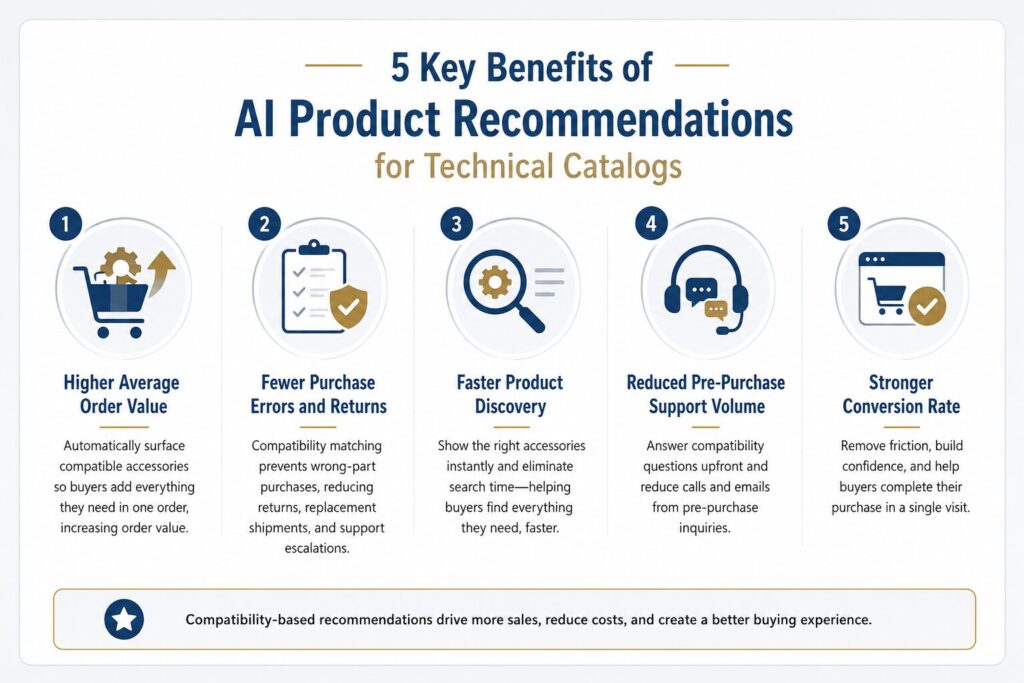
The technical case for compatibility-based recommendations is clear. The commercial case is equally direct, and it maps cleanly onto the problems that technical catalog merchants already know they have.
1. Higher Average Order Value
Buyers purchasing a primary product often need several accessories and components to complete a functional installation. When those items are surfaced automatically at the point of product selection, they get added to the order rather than sourced separately later. Compatible accessories that a buyer might not have thought to search for become part of the original purchase, which raises order value without any additional sales effort.
2. Fewer Purchase Errors and Returns
Compatibility matching prevents ordering mistakes. When a buyer can see that the seal kit shown is explicitly rated for the pump they are viewing, they order with confidence rather than guessing from product titles. Fewer wrong-part purchases means fewer returns, fewer replacement shipments, and fewer support escalations related to incompatible components. For high-value technical products, even a small reduction in return rate has a meaningful cost impact.
3. Faster Product Discovery and Lower Friction
Technical buyers often know what they need but spend significant time searching for compatible parts across a large catalog. A recommendation engine that surfaces the right accessories immediately removes that search burden. Buyers who find everything they need in one session are more likely to complete their purchase rather than abandoning to research elsewhere.
4. Reduced Pre-Purchase Support Volume
A significant share of technical support inquiries in B2B stores are compatibility questions. When recommendation widgets answer those questions before the buyer thinks to ask, call and email volume from pre-purchase compatibility inquiries drops. That reduces operational load on technical support teams without reducing the quality of the buying experience.
5. Stronger Conversion Rate
Buyers who find everything they need in a single visit are more likely to complete their purchase. Removing the friction of compatibility research, and giving buyers confidence that the recommended accessories are correct, converts more undecided browsers into completed orders.
Case study worth reading – AI-Powered Inventory Replenishment for Shopify: Forecast Demand Before You Run Out of Stock
Build Recommendations That Understand Your Products
Shopify’s native product recommendations are a well-built system. For consumer stores with high transaction volumes and straightforward product relationships, they work exactly as intended and represent a legitimate, sufficient solution. This is worth restating because the argument here is specific, not general.
Technical catalogs require a different kind of intelligence. When product relationships are governed by engineering specifications rather than purchase patterns, behavioral AI has no useful input to work with. A custom Shopify AI product recommendations engine built on taxonomy, specification metadata, and vector search reads the catalog itself, not the transaction log, and surfaces suggestions that reflect actual product compatibility.
That distinction translates directly into outcomes: fewer pre-purchase support calls, fewer ordering errors, higher average order values, and buyers who find what they need in a single session rather than calling your team or abandoning to search elsewhere.
Mid-market B2B merchants no longer need enterprise-scale infrastructure budgets to access this capability. With the right product taxonomy, an AI embedding model, a vector search index, and a clean Shopify API integration, niche industrial and technical stores can surface recommendations that genuinely help customers buy correctly.
The starting point is always the catalog data. If your product specifications and compatibility relationships are documented and structured, a custom recommendation engine is more accessible than most merchants expect.
Need smarter product recommendations for your Shopify store?
IT Path Solutions helps B2B, industrial, and niche eCommerce businesses build AI-powered recommendation engines that understand product compatibility, increase average order value, and improve customer experience.
Contact us to discuss your catalog and use caseFrequently Asked Questions
- How do AI product recommendations work on Shopify?
Shopify’s native recommendation system analyzes behavioral signals: which products customers view together, purchase in the same transaction, and browse in sequence. That behavioral data trains the model, which then surfaces suggestions based on aggregate customer patterns. Third-party apps extend this by layering in attribute matching or manually curated product relationships. For technical catalogs, IT Path Solutions builds recommendation engines that work from a different foundation entirely: product taxonomy, specification metadata, and compatibility relationships encoded using AI embeddings and vector search. The result is Shopify AI product recommendations that reflect what products technically require of each other, not what other customers happened to buy.
2. Does Shopify have built-in AI recommendations?
Yes. Shopify includes native product recommendation capability that draws on purchase history, browsing behavior, and co-purchase patterns to surface related products and “Customers Also Bought” suggestions. For consumer product stores with sufficient transaction volume, this system works well and does not require custom development. For technical or B2B catalogs where product compatibility matters more than purchase co-occurrence, Shopify’s native logic consistently underperforms, and a custom recommendation engine built on compatibility-based logic is required to surface accurate suggestions.
3. What is the best AI recommendation app for Shopify?
For consumer product stores with high transaction volume, apps like Rebuy, LimeSpot, and Algolia Recommend perform well and are the right starting point. They require no custom development, handle behavioral data effectively, and are actively maintained. For technical catalogs, including industrial equipment, automotive parts, electronics components, and medical devices, off-the-shelf apps are generally insufficient because they rely on behavioral signals rather than product compatibility logic. In those cases, a custom-built recommendation engine from a development partner like IT Path Solutions typically produces substantially more accurate and commercially useful suggestions.
4. How do I add product recommendations to my Shopify store?
For most stores, the fastest path is installing a Shopify app and configuring it against your product data. For technical catalogs, the process requires more foundational work: build a product taxonomy and populate compatibility metadata, implement AI embeddings to encode product relationships, deploy vector search to retrieve semantically related products at query time, and connect everything via Shopify’s Storefront API with custom recommendation widgets. IT Path Solutions manages this full build process for mid-market B2B merchants.
5. How does AI improve ecommerce customer experience?
AI improves ecommerce customer experience by surfacing relevant products at the moment buyers need them, reducing the time spent searching and the risk of ordering the wrong item. For technical B2B stores specifically, this means recommending compatible accessories, required installation components, and maintenance consumables alongside the primary product. Buyers get confidence that what they are seeing is actually compatible with what they are buying, which reduces purchase hesitation and the need to contact support before placing an order.
6. How do I implement AI personalization on my ecommerce site?
Implementation depends entirely on catalog type. Consumer product stores can deploy behavioral personalization through SaaS apps with minimal development effort and start seeing results quickly. Technical or B2B Shopify stores require a more structured approach: audit catalog data quality, build a product taxonomy with compatibility attributes, implement an AI embedding model to encode product relationships, deploy vector search to retrieve semantically related products, and integrate with Shopify’s Storefront API. IT Path Solutions delivers this as a managed development engagement for mid-market B2B merchants, handling the full scope from taxonomy design through frontend widget deployment and post-launch measurement.

Keyur Patel
Co-Founder
Keyur Patel is the director at IT Path Solutions, where he helps businesses develop scalable applications. With his extensive experience and visionary approach, he leads the team to create futuristic solutions. Keyur Patel has exceptional leadership skills and technical expertise in Node.js, .Net, React.js, AI/ML, and PHP frameworks. His dedication to driving digital transformation makes him an invaluable asset to the company.
Related Blog Posts

How RivalRadar Uses AI Agents to Track Competitors Automatically

Notion Client Portal: How to Build a Branded Client Experience Without Leaving Notion