
High-Code vs Low-Code Development: A Strategic Guide for Business Owners

Keyur Patel
September 12, 2025
10 min
Last Modified:
August 18, 2026
businesses must choose the right development approach to keep up with market demands. Whether you’re a startup or an enterprise, deciding between low-code vs high-code development can significantly impact your project’s success. But how do you determine the best fit for your business needs? This guide will walk you through everything you need to know about high-code vs low-code, including their benefits, key differences, and when to use each approach.
What is Low-Code?
Low-code development is a modern approach to software creation that minimizes the need for extensive coding expertise. It provides a visual interface with drag-and-drop functionalities, enabling businesses to build applications faster with less manual coding.
Key Features of Low-Code Development:
- Visual Development: Uses graphical user interfaces (GUI) rather than writing extensive lines of code.
- Pre-Built Components: Offers reusable templates and pre-configured modules.
- Rapid Deployment: Speeds up application delivery, allowing quick iterations.
- Collaboration-Friendly: Enables non-technical users (business analysts, marketers) to participate in development.
What is High-Code?
High-code development, also known as traditional or full-code development, involves writing custom code to build applications from the ground up. It requires experienced software developers and provides complete flexibility in designing, scaling, and optimizing applications.
Key Features of High-Code Development:
- Full Customization: Offers total control over application architecture and user experience.
- Scalability & Security: Ensures applications meet complex business needs with advanced security measures.
- Integration Flexibility: Easily integrates with legacy systems and third-party services.
- Longer Development Cycle: Requires thorough planning, testing, and implementation.
Differences Between Low-Code and High-Code Development Platform
The difference between low-code and high-code platforms is primarily the level of coding, customization, development speed, technical control, and resources required. Low-code platforms provide visual development environments and reusable components that reduce manual coding, whereas high-code development gives developers direct control over the application’s code, architecture, integrations, performance, and security.
The following comparison highlights the key differences between low-code and high-code platforms:
| Feature | Low-Code Development | High-Code Development |
| Development Speed | Faster, with drag-and-drop tools | Slower, due to extensive coding requirements |
| Cost | Lower cost as fewer developers are required | Higher cost due to skilled developers and longer development time |
| Customization | Limited customization options | Full customization and flexibility |
| Security | Standard security features | Advanced security capabilities |
| Integration | Limited to built-in integrations | Can integrate with any system |
| Maintenance | Easier updates and maintenance | Requires dedicated resources for updates |
When to Opt for High-Code Development
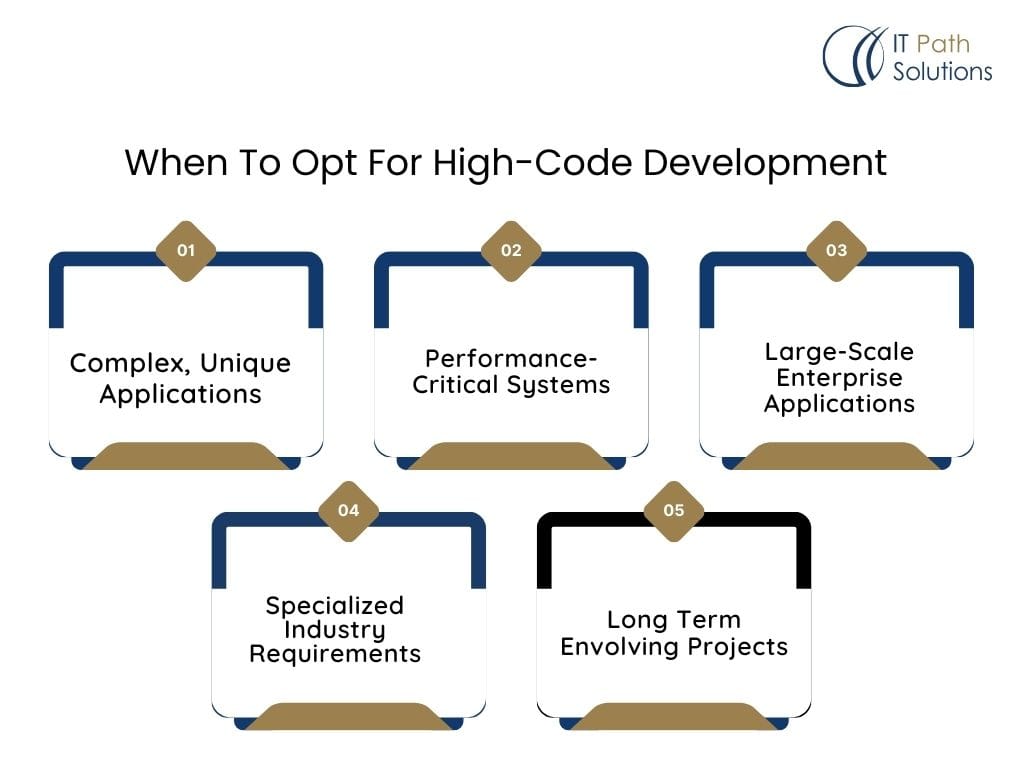
- Complex, Unique Applications: If your project requires highly specialized functionality that isn’t available in pre-built components, high-code development might be necessary.
- Performance-Critical Systems: For applications where every millisecond counts, such as high-frequency trading platforms or real-time data processing systems, high-code development allows for maximum optimization.
- Large-Scale Enterprise Applications: Very large, complex systems that need to integrate with multiple existing systems and handle massive amounts of data may benefit from the flexibility of high-code development.
- Specialized Industry Requirements: Industries with unique regulatory requirements or specific technical needs may require the precision and control offered by high-code development.
- Long-Term, Evolving Projects: If you’re building a system that will need to adapt to changing requirements over many years, the flexibility of high-code development can be advantageous.
When to Consider Low-Code Platforms
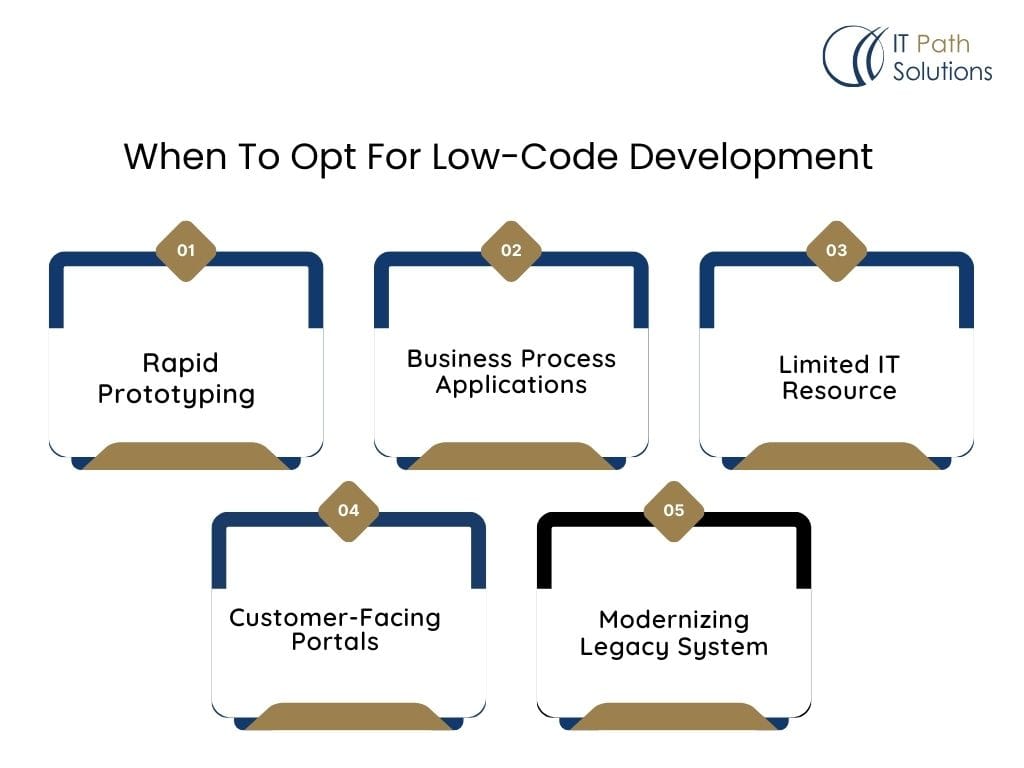
- Rapid Prototyping and MVP Development: When you need to quickly test ideas or get a minimum viable product to market, low-code platforms can significantly speed up the process.
- Business Process Applications: For automating internal processes or creating departmental applications, low-code platforms often provide the right balance of speed and functionality.
- Limited IT Resources: If your organization has a small IT team or limited access to experienced developers, low-code platforms can help bridge the gap.
- Customer-Facing Portals and Apps: Many customer portals and simple mobile apps can be effectively built using low-code platforms, especially when rapid deployment is a priority.
- Modernizing Legacy Systems: Low-code platforms can be an effective way to quickly update or replace outdated legacy systems without a complete overhaul.
- Frequent Updates and Iterations: For applications that need to be updated frequently based on user feedback or changing business needs, the agility of low-code development can be invaluable.
Low-Code vs High-Code Development: Differences and Use Cases
Low-code vs high-code development differs mainly in how applications are built, how much coding is required, the level of customization available, development speed, scalability, and the technical expertise needed. Low-code platforms use visual development tools, pre-built components, and automation to accelerate application development, while high-code development relies on traditional programming to provide greater control and customization.
The best approach depends on the project’s complexity, timeline, budget, integration requirements, security needs, scalability goals, and available technical skills. Low-code development is generally suitable for rapid application development, business process automation, internal tools, and MVPs, while high-code development is better suited to complex, highly customized, performance-critical, and enterprise applications.

Low-Code vs High-Code Development: Use Cases
Understanding low-code vs high-code development use cases makes it easier to select the right approach for a project. Neither approach is universally better; the right choice depends on application complexity, business requirements, technical resources, and long-term goals.
Common Low-Code Development Use Cases
Low-code development is commonly used for:
- Business process automation
- Internal business applications
- Customer and employee portals
- Workflow management systems
- MVP and prototype development
- Department-level applications
- Data collection and management applications
- Simple to moderately complex mobile and web applications
- Applications requiring frequent updates
- Legacy application modernization
- Applications that need rapid time-to-market
Low-code is particularly useful when a business needs to launch an application quickly while avoiding the development effort associated with building every component from scratch.
Common High-Code Development Use Cases
High-code development is commonly used for:
- Complex enterprise applications
- Highly customized software
- Performance-critical systems
- Real-time applications
- Financial and transaction-heavy systems
- Advanced AI and machine learning applications
- Complex API and legacy-system integrations
- Applications with specialized security requirements
- Large-scale customer-facing platforms
- Systems requiring complete control over architecture and infrastructure
- Long-term products with continuously evolving technical requirements
High-code is generally the stronger choice when a project requires extensive customization, advanced functionality, specialized integrations, or precise control over performance and security.
How to Choose Between Low Code and High Code Platforms for Your Projects
When deciding between low code vs high code development for your business, consider the following factors:
Project Complexity: Assess the complexity of your application. Simple to moderately complex applications are often well-suited for low-code platforms, while highly complex or unique applications may require high-code development.
Time-to-Market: If speed is a critical factor, low-code development can offer significant advantages in getting your application deployed quickly.
Available Skills: Evaluate the technical skills available within your organization. If you have a team of experienced developers, high-code development might be more appropriate. For organizations with limited technical resources, low-code platforms can be empowering.
Customization Needs: Consider how much customization your application requires. If you need a high degree of customization or unique features, high-code development might be necessary.
Scalability Requirements: Think about your long-term scalability needs. While low-code platforms have improved in this area, high-code development still offers more flexibility for large-scale growth.
Integration Requirements: If your application needs to integrate with multiple existing systems or use specialized APIs, high-code development might offer more flexibility.
Budget Constraints: Consider both the initial development costs and long-term maintenance expenses. Low-code platforms often have lower upfront costs but may have ongoing licensing fees.
Future Maintenance: Think about who will maintain the application in the future. Low-code platforms can be easier for non-technical staff to maintain, while high-code applications might require specialized developers.
Security and Compliance: If your industry has strict security or compliance requirements, ensure that your chosen approach can meet these needs.
Vendor Lock-in: Consider the potential for vendor lock-in with low-code platforms. Ensure that you’re comfortable with the long-term implications of your choice.
5-Point Checklist For Quick Decision-Making
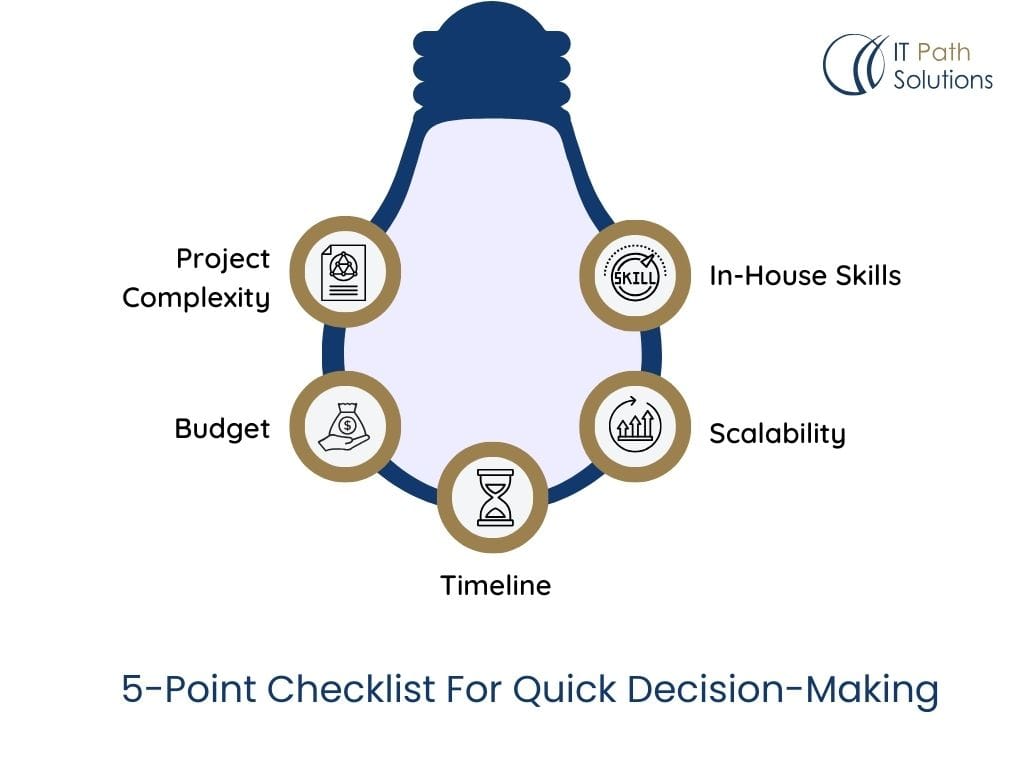
- Project Complexity: Is your app basic or highly specialized?
- Budget: Can you invest $50k+ in custom software development,or do you need a $5k solution?
- Timeline: Do you need it live in 3 months or 3 weeks?
- Scalability: Will your user base grow exponentially?
- In-House Skills: Do you have developers, or will you outsource?
Pro Tip: Hybrid approaches work too! Use low-code for front-end interfaces and high-code for complex back-end logic.
Future Trends in Low-Code and High-Code Development
As we look to the future, several trends are shaping the landscape of software development:
- Increased AI Integration: Both low-code and high-code development are likely to incorporate more AI-driven features, such as automated code generation and intelligent debugging.
- Hybrid Approaches: Many organizations are adopting a hybrid approach, using low-code for rapid development of certain applications while maintaining high-code practices for complex, mission-critical systems.
- Expansion of Low-Code Capabilities: Low-code platforms are continually expanding their capabilities, potentially narrowing the gap with traditional development in terms of what can be achieved.
- Focus on Citizen Developers: The rise of citizen developers is expected to continue, with Gartner predicting that by 2026, 80% of low-code users will be outside IT departments.
- Enhanced Security Features: As low-code platforms become more prevalent in enterprise environments, we can expect to see enhanced security features to meet the needs of large organizations.

Conclusion
The low-code vs high-code debate isn’t about which is “better”—it’s about what aligns with your business goals.
Choose low-code if you prioritize speed, cost, and simplicity.
Opt for high-code if you need control, scalability, and customization.
Evaluate your project’s needs, resources, and long-term vision. Sometimes, starting with low-code to validate an idea and scaling with high-code later is the smartest path.
By understanding these differences, you’ll avoid costly missteps and invest in a solution that drives growth—without overengineering or cutting corners.
Frequently Asked Questions
What is the difference between low-code and high-code platforms?
The main difference between low-code and high-code platforms is how applications are developed. Low-code platforms use visual tools, pre-built components, and automation to reduce manual coding, while high-code development relies on traditional programming and provides greater control over application architecture, customization, integrations, performance, and security.
What are the use cases for low-code vs high-code development?
Low-code development is commonly used for MVPs, internal tools, business process automation, workflows, portals, and applications that need rapid deployment. High-code development is better suited for complex enterprise applications, highly customized systems, performance-critical applications, advanced integrations, AI/ML solutions, and projects requiring extensive technical control.
Is low-code better than high-code development?
Neither approach is universally better. Low-code is generally better when development speed, simplicity, and rapid deployment are priorities. High-code is better when a project requires extensive customization, complex functionality, performance optimization, or complete control over the technology stack.
When should a business choose high-code development?
A business should consider high-code development when its application requires complex business logic, specialized functionality, advanced integrations, high scalability, strict security requirements, or detailed control over performance and architecture.
When should a business choose low-code development?
A business should consider low-code development when it needs to build an application quickly, automate business processes, develop an MVP, create internal tools, or deliver a moderately complex application with limited development resources.
Can low-code and high-code development be used together?
Yes. A hybrid approach can combine low-code and high-code development. For example, a business may use low-code components for standard workflows and interfaces while using custom high-code development for complex business logic, specialized integrations, or performance-critical functionality.

Keyur Patel
Co-Founder
Keyur Patel is the director at IT Path Solutions, where he helps businesses develop scalable applications. With his extensive experience and visionary approach, he leads the team to create futuristic solutions. Keyur Patel has exceptional leadership skills and technical expertise in Node.js, .Net, React.js, AI/ML, and PHP frameworks. His dedication to driving digital transformation makes him an invaluable asset to the company.
Related Blog Posts
TypeScript 7.0 Migration Guide: What Changed, What Can Break, and Should You Upgrade?

How We Built a Fully Offline GDPR-Compliant Transcription System