
Cybersecurity Best Practices for Web and Mobile Apps in 2026
Keyur Patel
March 12, 2026
9 min
Last Modified:
March 12, 2026
All contemporary web and mobile applications are in an open environment. This transparency is not by chance, neither is it the consequence of poor security choices. It is an immediate consequence of the current way applications are being constructed and presented.
Cloud native applications, API-based applications, continuous deployment, and global accessibility are the new norm. Together with them, applications are expected to be available at any time and location and connected with numerous external systems.These expectations influence the way software works and it is exposed.
The modern application is interacting with users, the backend services, APIs, and third-party platforms all the time. These interactions play a crucial role in scale, performance and experience. Simultaneously, every connection carries with it a new point of exposure, which needs to be comprehended and to be regulated.
In such a setting, cybersecurity has ceased to be a question of prevention of all possible intrusions. Such a requirement is not consistent with the way modern systems work. The actual difficulty lies in making sure that the applications become predictable and safe under circumstances of their testing, abuse or exploitation of their nature.
This differentiation in 2026 will either make an application resilient or fragile.
Learning the attack surface of contemporary applications
The contemporary applications are not one system. They are distributed systems or systems which consist of many components interacting with each other.Each component increases capability. And,any interaction increases risk.
All these points of interaction are referred to as the attack surface. An attack surface is all locations on which an application can be accessed, requested, or affected either with or without an intended purpose.This surface increases in size as applications become more complex and teams are not always aware.
Where the attack surface comes from
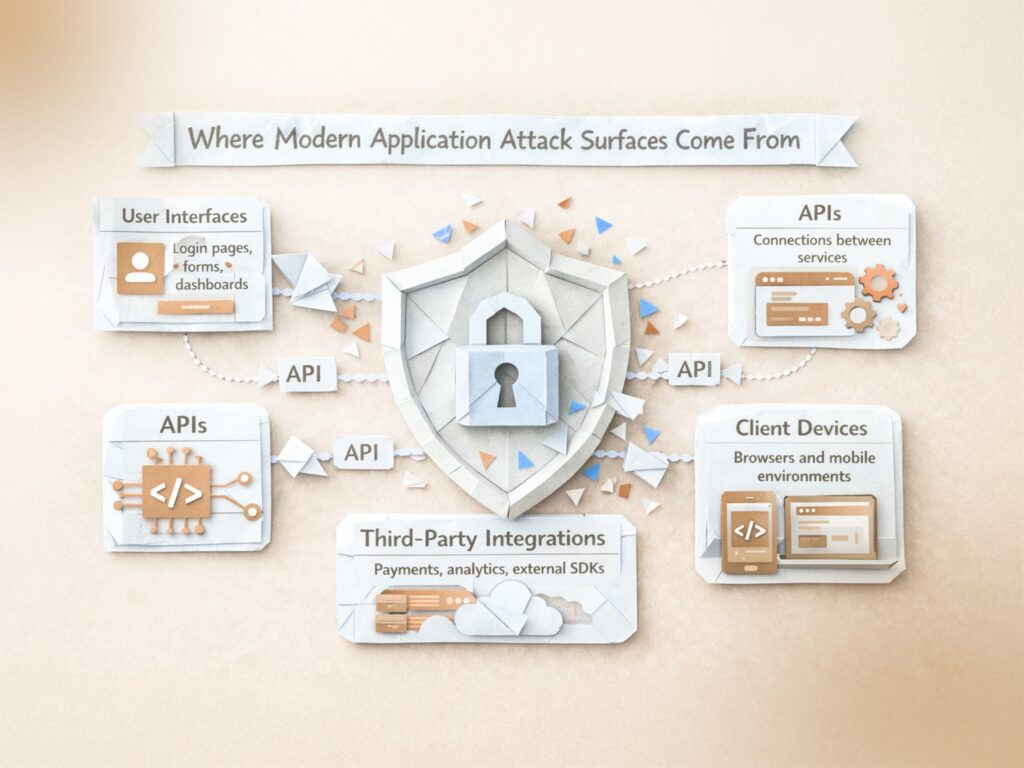
The attack surface is created by both architectural choices and operational realities.
Key contributors include:
- Public-facing interfaces :- Login screens, forms, dashboards, and user-facing features that accept direct input at scale.
- APIs and backend services :- APIs are essential foundations of the current web and mobile applications, which bind clients, services, and third-party platforms.
- Third-party integrations :- Payment providers, analytics software, authentication and external SDKs add additional functionality but also add external trust.
- Cloud computing and architecture :- Storage buckets, access roles, environment variables and deployment settings often pose a risk when configured improperly.
- Client-side environments :- There is no organizational control over browsers and mobile devices, and therefore they are prone to manipulation and abuse
All these are not optional elements. There is a security problem in the event that they are not managed properly because of overestimating their combined risk.
The reason why attackers target applications, and not networks
The traditional security models focused on network boundaries. Perimeter defenses and firewalls were the areas of major concern. That strategy had it that once within the network, systems could trust each other to a great extent. Newer assailants act in a different manner.
They are also business-oriented because they deal with applications directly since business logic and valuable data are located there.
Applications offer attackers:
- On-demand access to sensitive user and business information.
- Predictable interfaces that can be tested repeatedly
- Automated entry points through APIs
- Opportunities to exploit logic flaws rather than infrastructure weaknesses
From an attacker’s perspective, applications provide faster feedback loops and higher returns than attempting to breach hardened networks.
Web and mobile apps: different exposure patterns
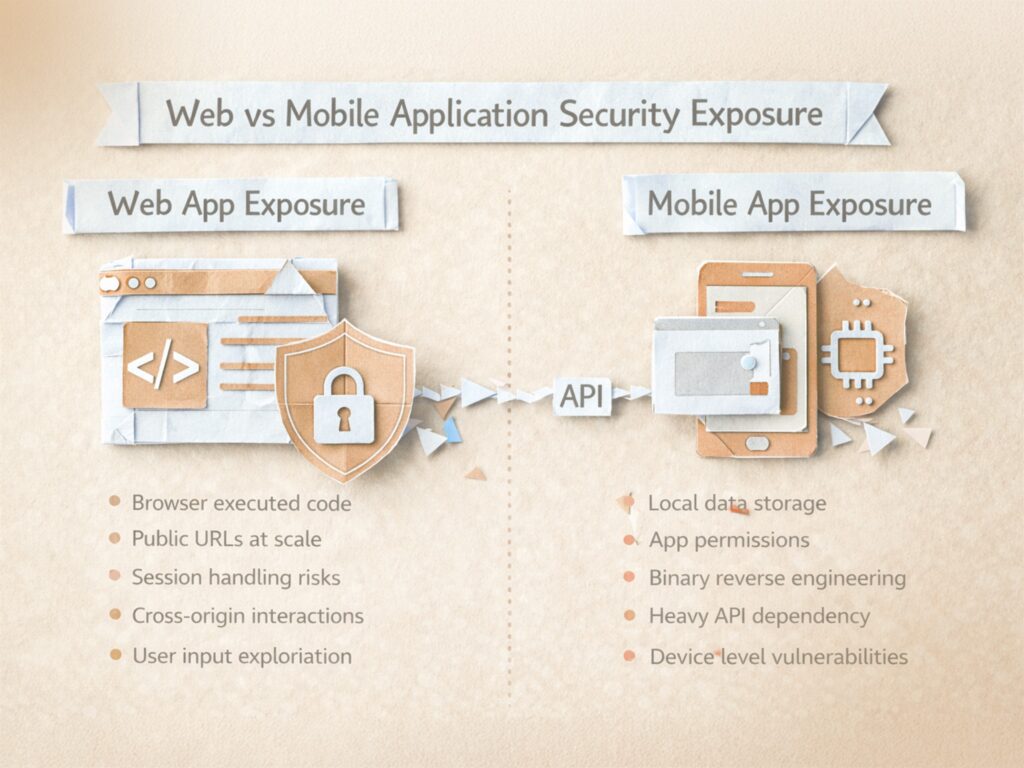
While web and mobile applications often share backend systems, their exposure profiles differ in important ways.
Web application exposure
Web applications are commonly exposed through:
- Browser-executed client-side code
- Public URLs accessible at scale
- Session handling and cross-origin interactions
- User-generated input across multiple entry points
A single weak validation layer can be exploited repeatedly across thousands of requests.
Mobile application exposure
Mobile applications introduce additional considerations:
- Sensitive data stored locally on devices
- App permissions that may be over-granted
- Reverse engineering of application binaries
- Extensive use of APIs to almost all functions.
Although a mobile application might seem safe on the surface level, insecure APIs communication can compromise the whole system.
Being exposed does not mean being insecure.
An increase in the attack surface does not imply that an application is insecure in nature. It implies that security has to be deliberate.
Applications become vulnerable when exposure exists without:
- Clearly defined access boundaries
- Strong and consistent validation mechanisms
- Reliable authentication and authorization controls
- Continuous monitoring and response processes
In 2026, exposure is expected. Poor control is not.
How vulnerabilities emerge in modern applications
Security vulnerabilities rarely appear suddenly. More often, they accumulate through normal product decisions made under time, delivery, and business pressure.
Common sources include:
- Over-trusting client-side behavior
- Assuming APIs will only be used in “expected” ways
- Expanding features without revisiting access controls
- Reusing components without reassessing their security context
These assumptions are tested continuously in production environments.
Where vulnerabilities are introduced
- Design stage :- Unclear trust boundaries, overly broad permissions, and missing abuse scenarios are often embedded early.
- Development stage :- Inconsistent input validation, weak session handling, insecure defaults, and hardcoded secrets.
- Configuration and deployment :- Public storage, excessive cloud permissions, exposed admin endpoints, and configuration drift.
- Third-party dependencies :- Outdated libraries, unmonitored transitive dependencies, and over-privileged integrations.
Effective security vulnerabilities prevention depends on visibility across all of these layers, not just the codebase.
What “best practices” mean in 2026
The cybersecurity best practices,in 2026, are not just static checklists or one-time audits,but they are adaptive principles embedded into how systems are designed, deployed, and operated.
Modern app security strategies focus on control rather than assumption.
Core principles shaping 2026 security
- Security as architecture :- Controls are built into system design, not added later.
- Assumed exposure :- Systems are designed with the expectation of probing and misuse.
- Continuous verification :- Access and behavior are validated repeatedly, not trusted indefinitely.
- Controlled failure :- When something is broken, the effect is constrained.
The rules are applicable in both web app security and mobile app security although the implementations are different
Implementing security throughout the life-cycle
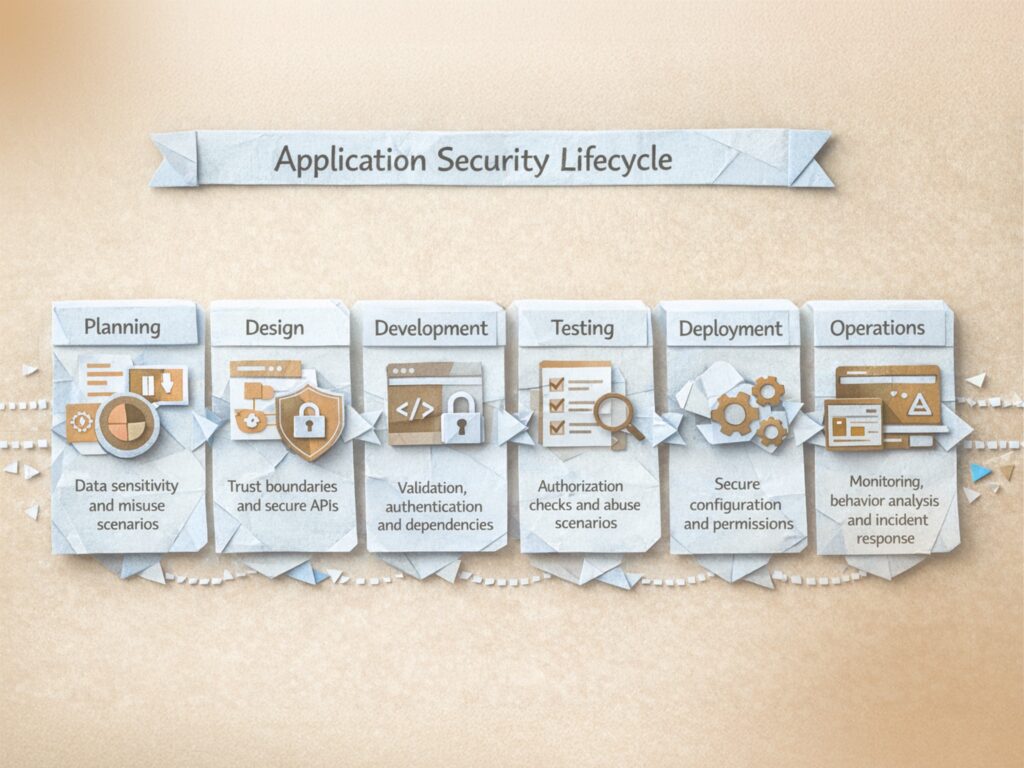
Security must remain consistent as applications evolve.
- Planning :- Define data sensitivity, access models, and misuse scenarios early.
- Design :- Establish trust boundaries, isolate critical services, and secure APIs.
- Development :- Enforce consistent validation, secure authentication, and dependency hygiene.
- Testing :- Check authorization paths, edge cases and abuse
- Deployment :- Keep configuration, permissions, and secrets under control
- Operations :- Track behavior, check access, and respond in real time
This lifecycle-oriented strategy is representative of key 2026 cybersecurity trends, where security maturity is assessed based on prevention, not response
The business impact of weak application security
Security failures are not just technical incidents. They are business events.
Weak application security can result in:
- Deprivation of customer trust
- Penalties of regulations and compliance.
- Operational downtime
- Long-lasting brand destruction that may continue even after the event.
Security is another differentiator in competitive markets. Good security may not be ever noticed by users, but lack of it is felt immediately.
Who owns application security in 2026?
Cybersecurity does not belong to one team anymore.
Responsibility is shared:
- Leadership determines the issue of risk tolerance and priorities of investments.
- Architects design secure foundations and trust boundaries
- Developers implement controls and validations
- Operations teams maintain visibility and response readiness
- Product teams balance usability with protection
Where ownership is not clear, loopholes exist. In case there is no coordination in sharing responsibility, security is not consistent.
The crux
In the year 2026, cybersecurity would not be about being exposure-free. It is all about intelligent management.
The most resilient applications are not the ones with the least integrations or features.They are those that are planned to take exposure, impose limits and evolve.
This is what good cybersecurity best practices, effective web app security, and trustworthy mobile app security will be based on in 2026.
Questions that keep arising
Do web and mobile applications appear to be less secure nowadays compared to previous times?
There is no real difference between modern applications being less secure, but much more exposed through cloud deployments and API-based architectures. The isolation or perimeter defenses alone are no longer sufficient to provide security results because intentionally applied access controls, architecture and verification mechanisms determine the security outcomes.
Is it possible to add security to an application once it has been constructed?
Security is something that can be enhanced later, but this is generally more expensive and ineffective. Several vulnerabilities are caused due to initial vulnerability in architecture, which is challenging to undo once launched. This is the reason why secure-by-design methods are put into focus in current cybersecurity planning.
Is user experience always traded off in favour of stronger application security?
Not necessarily. Security that is poorly implemented creates friction but security that is well designed is the one which goes invisible to the users. The trust can be improved by having clear access limits and uniform authorization without impacting negatively on usability.
Who is supposed to lead the application security decisions in an organization?
Application security is a collective responsibility. Setting risk tolerance is the work of leadership, exposure is the work of product teams, trust boundaries are developed by architects, controls are built by developers, and visibility is ensured by operations teams.Lack of alignment between these positions can easily generate security lapses.
What are the primary strengths of organizations that should be considered when it comes to strengthening app security in 2026?
The visibility should be the first thing. Before introducing new tools or controls, teams must have a clear knowledge of their attack surface, data flows, and their access models. In the absence of this understanding, security endeavors have been known to treat symptoms but not the causes.

Keyur Patel
Co-Founder
Keyur Patel is the director at IT Path Solutions, where he helps businesses develop scalable applications. With his extensive experience and visionary approach, he leads the team to create futuristic solutions. Keyur Patel has exceptional leadership skills and technical expertise in Node.js, .Net, React.js, AI/ML, and PHP frameworks. His dedication to driving digital transformation makes him an invaluable asset to the company.
Related Blog Posts

How RivalRadar Uses AI Agents to Track Competitors Automatically

Notion Client Portal: How to Build a Branded Client Experience Without Leaving Notion