
How to Build an AI-Powered Dynamic Pricing Engine in WooCommerce
Keyur Patel
August 19, 2026
23 min
Last Modified:
August 19, 2026
A competitor drops their price on your best-selling SKU at 2 a.m., and by the time you notice at your desk the next morning, you’ve already lost a day of sales at the wrong price point. This is the reality for many WooCommerce store owners: pricing sits static in the backend until someone remembers to change it, while competitors selling the same products may be adjusting several times a day using automated systems.
Pricing is one of the biggest levers a store has over margin and conversion, yet it’s usually one of the last things to get automated. WooCommerce ships with fixed prices, scheduled sales, and product variations, all of which require someone to log in and make a change by hand. None of these options reacts to what’s actually happening in the market: a competitor’s price move, a sudden spike in demand, or inventory that’s running low.
That gap is where an AI-powered dynamic pricing WooCommerce engine comes in. Instead of prices sitting fixed until a person updates them, the engine pulls in live data, such as competitor prices, inventory levels, sales velocity, and cost, then recalculates and pushes new prices automatically.
At IT Path Solutions, we view dynamic pricing as more than a faster way to change product prices. It is a connected decision system that brings together ecommerce data, operational information, market signals, and business-defined profitability rules. This guide walks through why native WooCommerce pricing falls short, what AI-powered dynamic pricing actually means, and how such a system can be built step by step.
Why Native WooCommerce Pricing Falls Short
WooCommerce is a capable platform for running an online store, but its pricing tools were built for stability, not for reacting to a market that changes by the hour. Understanding exactly where the built-in options stop is the first step toward seeing why dynamic pricing in WooCommerce setups exists at all.
Fixed Product Pricing
Every product in WooCommerce starts with a single price field. That price stays exactly where it’s set until someone opens the product editor and changes it manually. There’s no mechanism for the price to respond to anything happening outside the store: not a competitor’s discount, not a drop in stock, and not a surge in demand. For a handful of products, this is manageable. For a catalog running into the thousands, it becomes a full-time job nobody has time for.
Sale Pricing
WooCommerce’s sale price field adds a second price and a start and end date, which covers scheduled promotions well enough. But every sale still has to be planned, entered, and removed by a person. If a competitor undercuts a price outside that schedule, or a sale needs to end early because inventory is selling faster than expected, someone has to notice and step in.
Variable Product Pricing
Variable products let a store set different prices for each variation, such as size or color, which solves a real problem for catalogs with multiple options. What it doesn’t solve is market responsiveness. A variation’s price is just as fixed as a simple product’s price; it simply gives you more fixed prices to manage instead of one.
The Real Problem
None of WooCommerce’s native pricing tools were built to answer the question that actually matters to a growing store: what should this product cost right now, given what competitors are charging, how much stock is left, and how fast it’s selling?
Rule-based dynamic pricing plugins get partway there by automating discounts based on conditions a store sets in advance. But they still don’t look outside the store. They can’t see a competitor’s price, they can’t read sales velocity in real time, and they can’t weigh several variables against a margin target the way a purpose-built pricing engine can.
This is usually the point where businesses realize that adding more pricing rules is not enough. From IT Path Solutions’ perspective, the problem is rarely the absence of one more discount condition. The real challenge is connecting the store’s products, costs, inventory, market data, and business rules in a way that produces reliable pricing decisions without creating another system the team has to manage manually.
That is why a custom pricing engine should be designed around the store’s existing WooCommerce ecosystem rather than forcing every business into the same generic plugin logic.
What Is AI-Powered Dynamic Pricing?
Dynamic pricing WooCommerce discussions get confusing fast because the term gets used for several different things. It helps to separate the concepts clearly before going further, especially the rule-based vs. AI pricing distinction that trips up most people comparing options.
Dynamic pricing means adjusting prices in response to data, whether that data comes from inside the business, such as cost or inventory, or outside it, such as competitor prices or demand. It’s the opposite of a fixed price that sits untouched until someone changes it.
Rule-based pricing is one way to implement dynamic pricing. A store sets a condition and an action in advance: if inventory falls below 20 units, raise the price by 10 percent; if a product hasn’t sold in 30 days, apply a 15 percent discount.
These rules run automatically once configured, which is a real improvement over manual pricing, but they only ever do exactly what they were told to do. They can’t easily weigh multiple signals against each other, and they can’t adjust when a scenario the rule didn’t anticipate comes up.
AI-assisted pricing works differently. Instead of a single condition triggering a single action, the engine looks at several data signals at once, including competitor prices, inventory, sales velocity, cost, and any business constraints such as a minimum margin. It then generates a price recommendation, or an automatic update, based on how those signals interact.
It is still governed by rules the business sets, most importantly a margin floor, but it can weigh competing factors in a way a static if/then rule cannot.
An AI-powered dynamic pricing WooCommerce engine sits at this second level. It doesn’t replace the business’s pricing strategy; it executes that strategy continuously, using live data instead of a person checking a spreadsheet once a week. In our view, this distinction matters: AI should support a clearly defined commercial strategy, not become an uncontrolled replacement for one.
Key Data Sources Used by a WooCommerce Pricing Engine
Building an AI-powered dynamic pricing WooCommerce engine starts with the data it consumes. The engine is only as good as the signals feeding it, and each source plays a distinct role in the final price.
Competitor Pricing Data
Competitor prices can come from official APIs where a competitor offers one, third-party price monitoring services, or other compliant data collection methods. Whichever method a store uses, competitor pricing should be treated as one input among several, not the only factor driving a price change.
At IT Path Solutions, we would not recommend building a pricing strategy around competitor matching alone. A price that matches or beats a competitor but ignores margin, inventory, or demand isn’t necessarily a good price; it is simply a reaction to one external signal.
Inventory Levels
Stock levels push pricing in two directions. When inventory is high and a product isn’t moving, a lower price can help clear stock before it ties up warehouse space or becomes obsolete. When inventory is low, raising the price slightly can slow down sales just enough to avoid running out before the next shipment arrives, while also protecting margin on the units that are left.
Sales Velocity
How fast a product is selling tells the engine something inventory levels alone can’t. A fast-moving product usually doesn’t need aggressive discounting, since demand is already strong, so the engine can hold the price steady or nudge it up slightly. A slow-moving product is a signal to consider a discount before it becomes dead stock.
Cost Price Data
Cost is the one input that isn’t optional. Every recommended or automated price needs to be checked against the product’s cost before it’s applied, so the engine never generates a price that loses money or falls below a business’s minimum acceptable margin.
We treat this as a non-negotiable guardrail when planning pricing automation. It keeps competitor-matching, inventory-based, or demand-based rules from cutting into profitability when market conditions change unexpectedly.
Demand Signals
Beyond day-to-day sales velocity, broader demand patterns matter too: seasonal spikes around holidays or industry-specific events, and time-based patterns such as higher weekend traffic in some categories. Feeding these patterns into the engine lets it anticipate demand shifts rather than only reacting after they’ve already happened.
Bringing all of these data sources together is often the most challenging part of a pricing project. Before defining the AI logic, our approach at IT Path Solutions would be to map where pricing, inventory, cost, customer, supplier, and market data currently lives. Depending on the store, that may involve connecting WooCommerce with ERP systems, inventory platforms, supplier databases, CRM software, and external pricing data so decisions are based on complete business information rather than isolated datasets.
How an AI Pricing Engine Works in WooCommerce
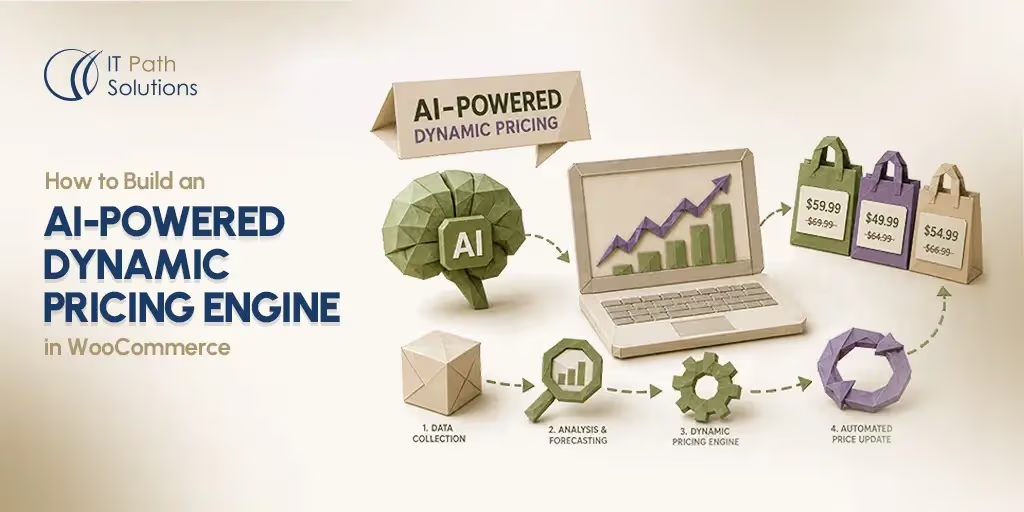
Once the data sources are in place, the actual mechanics of an AI-powered dynamic pricing WooCommerce engine follow a repeatable four-step cycle.
Step 1: Collect Market Data
On a scheduled basis, whether that’s hourly, daily, or some other interval that fits the store’s catalog size and hosting resources, the engine pulls in competitor prices, current inventory counts, and recent sales metrics for each product it’s tracking.
Step 2: Evaluate Pricing Rules
The collected data gets checked against the constraints the business has configured. These might include instructions such as matching the lowest tracked competitor price, undercutting that competitor by 2 percent, maintaining a minimum 25 percent margin, or raising prices when inventory drops below a set threshold.
Step 3: Generate Recommended Prices
Based on that evaluation, the engine produces a proposed price for each SKU. Depending on how a store wants to run the system, that recommendation can go straight to an automatic update, or it can sit in a review queue for a person to approve before anything changes on the live site.
For many businesses, we would recommend starting with a review-and-approval workflow rather than moving immediately to complete automation. This gives the team time to validate how the engine behaves across different product groups and market conditions before allowing it to publish every change automatically.
Step 4: Update WooCommerce Automatically
Approved prices get pushed to the store through the WooCommerce REST API, which allows external systems to read and update product data, including price, without anyone touching the WordPress admin panel. This is what WooCommerce REST API pricing updates look like in practice: no manual entry required.
Update frequency is configurable and should be set according to how often the store’s market actually moves and what the hosting environment can handle. A system updating thousands of SKUs every few minutes has very different infrastructure requirements from one reviewing a smaller catalog once a day.
Building the pricing logic is only one part of the solution. The implementation also needs reliable update handling, activity logs, error alerts, and a way to review or roll back unexpected price changes. At IT Path Solutions, we consider these controls part of the pricing system itself, not secondary features to be added after launch.
The part that trips up most rule sets is what happens when two rules point in different directions. Matching the lowest competitor’s price sounds simple until that price would fall below the store’s minimum margin. This is exactly why margin protection needs to be built in as the overriding guardrail, not just one rule among many.
Whatever else the engine is weighing, competitor price, inventory, or demand, the margin floor should always win.
A pricing engine that occasionally reprices too high because it played it safe is a minor inconvenience. One that quietly sells below cost because a rule conflict wasn’t resolved correctly is a real financial problem.
Not sure whether your pricing process is ready for automation?
IT Path Solutions can review your current WooCommerce pricing workflow, available data sources, business rules, and integration requirements to help determine whether a rule-based plugin is sufficient or a custom pricing engine would be more appropriate.
Common Dynamic Pricing Strategies for WooCommerce Stores
Most AI-powered dynamic pricing WooCommerce engines are built from a small set of strategies, mixed and weighted according to what a business actually needs. Every strategy does not need to be active at once; most stores can start with two or three and add more as they validate the results.
At IT Path Solutions, we would first identify which strategies fit the store’s business model and pricing objectives, then translate those strategies into automated workflows with clearly defined limits and exceptions.
Price Matching Strategy
The engine tracks a defined competitor, or set of competitors, and adjusts the store’s price to match theirs. This works well for commodity products where customers are comparing prices directly across sites, but it needs a margin floor underneath it so a competitor’s aggressive discount doesn’t force an unprofitable match.
Margin Protection Strategy
Rather than reacting to any external signal, this strategy sets a hard rule: never price a product below a defined margin, regardless of what any other strategy suggests. It functions less as a pricing tactic and more as a constraint that every other strategy has to respect.
Lowest Competitor Minus X%
Instead of matching a competitor exactly, this strategy undercuts the lowest tracked price by a fixed percentage, say 2 or 3 percent, to consistently appear as the cheaper option for price-sensitive shoppers. Like price matching, it depends on a margin floor to stay sustainable.
Inventory-Based Pricing
Price moves in response to how much stock is left. High inventory on a slow-moving product can trigger a discount to move it faster; low inventory on a fast-moving product can trigger a modest increase to slow demand and protect the remaining units’ margin.
Demand-Based Pricing
This strategy watches sales velocity and demand signals rather than stock counts. A product selling faster than usual might hold its price or increase slightly; one selling slower than usual might trigger a discount to bring demand back up.
Hybrid AI Pricing Model
Most stores that go past the planning stage end up here: several of the strategies above running together, weighted and arbitrated by the engine, with margin protection always sitting underneath as the hard floor no other rule can cross.
For stores with complex catalogs and multiple pricing signals, this is often the model we would consider most practical. It allows the system to respond to market conditions without letting any single signal dictate the final price. This is also what separates an AI-powered dynamic pricing WooCommerce system from a single-purpose rule.
Exploring AI automation for Shopify as well?
Real-World Use Cases
The scenarios below are illustrative examples of how these strategies could play out across different verticals. They are not case studies drawn from specific past projects, but they show how IT Path Solutions would approach the pricing logic for different business models.
Electronics Accessories Store
Problem: A mid-sized store selling phone cases, chargers, and accessories competes against several other sellers on the same marketplaces, all of whom adjust prices frequently.
Pricing challenge: Keeping prices competitive without someone manually checking dozens of competitor listings every day, and without eroding margin in the process.
AI automation solution: An AI-powered pricing engine could track competitor prices across the relevant SKUs and apply a lowest-competitor-minus-X% strategy, bounded by a margin floor, so pricing stays competitive without a person checking prices by hand. Inventory-based rules could kick in separately once specific SKUs run low.
For this type of store, we would typically begin with a limited group of high-volume or price-sensitive SKUs before expanding the automation across the entire catalog.
Fitness Equipment Retailer
Problem: Demand for this store’s products swings sharply around predictable periods, including January fitness resolutions and specific promotional windows, then drops off in between.
Pricing challenge: Prices need to respond quickly to these swings, both to capture demand during peak periods and to move inventory that’s overstocked once demand cools.
AI automation solution: Demand-based pricing, informed by historical sales patterns for the same seasonal windows, could let the engine anticipate the spike rather than reacting to it after inventory has already run short. Once the peak passes, inventory-based rules could help clear remaining stock at a controlled discount instead of relying on a steep clearance sale.
Industrial Supplies Supplier
Problem: Costs for this supplier’s products shift regularly, tied to raw material prices and supplier changes, sometimes with very little warning.
Pricing challenge: Margins need protecting even as the underlying cost of goods moves, especially on bulk orders and contract pricing where a small margin error multiplies quickly.
AI automation solution: Cost data could feed into the engine continuously, allowing margin protection rules to recalculate the price floor automatically whenever a cost update comes in, rather than relying on a person to notice a supplier price change and manually reprice the affected SKUs.
In this scenario, our first priority would be validating the quality and timing of supplier cost data, because even well-designed pricing logic will produce unreliable results if the underlying cost information is outdated.
B2B WooCommerce Stores
Problem: As this store’s customer base grows, it is managing a mix of negotiated and role-based pricing tiers alongside a market that keeps moving on its own.
Pricing challenge: Customer-specific pricing agreements need to stay intact even as the engine adjusts base prices in response to cost or competitor changes.
AI automation solution: The pricing engine could apply its rules to the base price while leaving negotiated customer-specific pricing structures untouched, so automated adjustments happen without overriding agreements a sales team has already made with specific accounts.
These examples illustrate how pricing automation changes depending on the business model. Rather than applying one pricing formula everywhere, IT Path Solutions would design the engine around each company’s products, operational processes, competitive landscape, existing systems, and profitability goals.
Using HubSpot to Manage Leads?
AI can optimize more than your WooCommerce store. If you use HubSpot for sales and marketing, learn how to build an AI-powered lead scoring system that automatically prioritizes high-value prospects without requiring an Enterprise subscription.
Benefits of WordPress Pricing Automation
Pull all of the above together and the case for WordPress pricing automation comes down to five practical outcomes.
- Faster market response. Prices adjust as soon as new data comes in, instead of waiting for someone to notice a competitor’s move and act on it.
- Better protected margins. A margin floor built into the engine means pricing decisions are checked against profitability automatically, rather than depending on someone remembering to do the math before a price goes live.
- Less manual repricing work. Nobody on the team needs to spend part of their day checking competitor listings, inventory reports, and sales dashboards to decide what to change today.
- Stronger competitiveness. Prices stay aligned with tracked competitors and market conditions more consistently, rather than only at whatever point someone last got around to checking.
- Pricing that scales with the catalog. An AI-powered dynamic pricing WooCommerce setup can manage a larger number of SKUs far more efficiently than a manual process. The technical workload still needs to be planned around data volume, API limits, update frequency, and hosting capacity, but the pricing team no longer needs to grow in direct proportion to the catalog.
These outcomes are only possible when pricing automation is built around accurate data, well-defined rules, and transparent controls. At IT Path Solutions, our focus would not be simply to automate more price changes. It would be to build a pricing system the business can understand, monitor, maintain, and refine as its market and catalog evolve.
Taken together, these five outcomes are why WordPress pricing automation tends to deliver the clearest value at stores with large or fast-moving catalogs, where the manual alternative simply isn’t sustainable.
When Does a Store Need AI Dynamic Pricing?
One of the most common questions businesses ask is whether they actually need a custom pricing engine or whether existing WooCommerce pricing plugins are enough. The answer depends less on company size and more on how complex the pricing process has become.
An AI-powered dynamic pricing WooCommerce engine isn’t the right investment for every store, and it’s worth saying that plainly rather than pretending everyone needs one.
When IT Path Solutions assesses whether custom pricing automation makes sense, we would look at factors such as pricing frequency, catalog size, data availability, competitive pressure, margin complexity, and the amount of manual intervention currently required.
A few signals suggest a store has outgrown rule-based plugins and manual pricing: a catalog running into the thousands of SKUs, a highly competitive market where competitor prices are visible and change often, competitors who reprice multiple times a day, margins that keep shrinking even though sales volume is holding steady, and a pricing workflow that’s become genuinely unmanageable for the team handling it.
If a store doesn’t see most of these signals, a rule-based dynamic pricing plugin is often enough. Bulk discounts, role-based pricing, and scheduled sales cover a lot of ground for smaller catalogs or markets where competitor pricing isn’t as visible or volatile. Building a custom AI-powered pricing engine for a 200-SKU store in a stable market may be more infrastructure than the problem calls for.
The threshold isn’t about revenue or company size on its own. It’s about whether manual or rule-based pricing can still keep up with how often the market actually changes. Once that stops being true, an AI-powered dynamic pricing WooCommerce engine moves from a nice-to-have to something closer to an operational requirement.
How IT Path Solutions Builds Custom WooCommerce Pricing Automation
Once a store reaches this stage, success depends less on choosing another plugin and more on designing the right pricing architecture. At IT Path Solutions, pricing automation projects bring together WooCommerce expertise, AI development, API integrations, and business-specific pricing logic to create systems that support long-term growth instead of temporary workarounds.
- Discovery and requirements analysis. The starting point is a review of the store’s current pricing workflow, its WooCommerce setup, the business rules already in place, and the data sources actually available to work with.
- Pricing strategy planning. From there, the right mix of strategies is identified, whether competitor-based pricing, inventory-based pricing, cost-plus pricing, customer-specific pricing, or a hybrid model, based on what the business is trying to solve.
- Data source integration. Relevant pricing, inventory, ERP, CRM, supplier, and competitor data sources are connected so the engine has real business data to work from rather than assumptions.
- AI pricing logic development. This is where the pricing rules and constraints are translated into working logic that can generate recommendations or automated adjustments based on the business’s objectives and guardrails.
- WooCommerce integration. The pricing engine connects to the store through the WooCommerce REST API or another suitable method, so approved prices flow through to the live site without manual entry.
- Testing, monitoring, and continuous optimization. Pricing behavior is validated before the system goes live, then monitored against actual business outcomes. Rules, data sources, and thresholds can be refined over time as the market and catalog change.
This kind of build draws on both WooCommerce development services and AI app development, since it sits at the intersection of ecommerce infrastructure and applied AI logic rather than fitting neatly into either category on its own.
Conclusion
Static pricing made sense when markets moved slowly and competitors didn’t have automated tools of their own. That’s no longer the environment many WooCommerce stores are competing in. Rule-based dynamic pricing plugins help, but they only ever do what they’re told, without broader awareness of what’s happening across the market and the business.
An AI-powered dynamic pricing WooCommerce engine closes that gap. It pulls in competitor prices, inventory, sales velocity, and cost, weighs them against the rules a business has set, and keeps a margin floor in place so speed never comes at the expense of profitability.
For stores dealing with thousands of SKUs in a competitive vertical, that shift, from manual repricing to a system that turns market data into pricing decisions, is often what keeps margins intact while staying priced to compete.
At IT Path Solutions, our view is that an effective pricing engine is not simply WooCommerce connected to an AI model. It requires a clear pricing strategy, reliable integrations, accurate business data, defined approval and safety controls, and continuous monitoring. That combination is what allows a business to move beyond manual repricing toward intelligent pricing automation that can support long-term growth.
Looking to implement WooCommerce custom pricing and AI-powered pricing automation?
IT Path Solutions can design a pricing engine around your products, data sources, margin requirements, and existing WooCommerce ecosystem, helping your team automate pricing decisions without losing visibility or control.
Frequently Asked Questions
1. Can WooCommerce automatically change product prices based on competitor pricing?
Yes, but not with WooCommerce’s built-in pricing features. Native WooCommerce supports fixed prices and scheduled sales, but it cannot monitor competitor pricing or adjust prices automatically. A custom AI-powered pricing engine can collect competitor data, evaluate business rules, and update product prices through the WooCommerce REST API while protecting profit margins.
2. Is AI-powered dynamic pricing suitable for every WooCommerce store?
Not necessarily. Small stores with a limited catalog and stable pricing can often manage with rule-based pricing plugins. AI-powered dynamic pricing becomes valuable when a store has a large product catalog, frequent market changes, competitive pricing pressure, or manual pricing updates that consume significant time.
3. How does AI-powered pricing prevent products from being sold below cost?
A well-designed pricing engine includes margin protection rules. Before applying any price change, it checks the product cost and predefined minimum profit margins. Even if competitors reduce their prices aggressively, the engine will not recommend or apply prices that violate the business’s profitability requirements.
4. Can IT Path Solutions build a pricing engine tailored to our WooCommerce store?
Yes. IT Path Solutions develops custom AI-powered pricing solutions around a business’s specific requirements. Instead of relying on generic pricing rules, the team can integrate inventory systems, competitor data, ERP or CRM platforms, supplier information, and WooCommerce to build an automated pricing engine aligned with the store’s pricing strategy and business goals.
5. Why choose IT Path Solutions for WooCommerce pricing automation?
IT Path Solutions combines WooCommerce development expertise with AI application development to build scalable pricing automation solutions. From strategy and data integration to AI logic development, WooCommerce API integration, testing, and ongoing optimization, the team develops custom pricing systems around the business rather than relying on a one-size-fits-all plugin.

Keyur Patel
Co-Founder
Keyur Patel is the director at IT Path Solutions, where he helps businesses develop scalable applications. With his extensive experience and visionary approach, he leads the team to create futuristic solutions. Keyur Patel has exceptional leadership skills and technical expertise in Node.js, .Net, React.js, AI/ML, and PHP frameworks. His dedication to driving digital transformation makes him an invaluable asset to the company.
Related Blog Posts
B2B eCommerce Development Strategies To Drive Sales Growth In 2025
How To Customize The WooCommerce Checkout Process