How to Build AI-Powered Lead Scoring in HubSpot Without Upgrading to Enterprise
Keyur Patel
June 25, 2026
17 min
Last Modified:
June 25, 2026
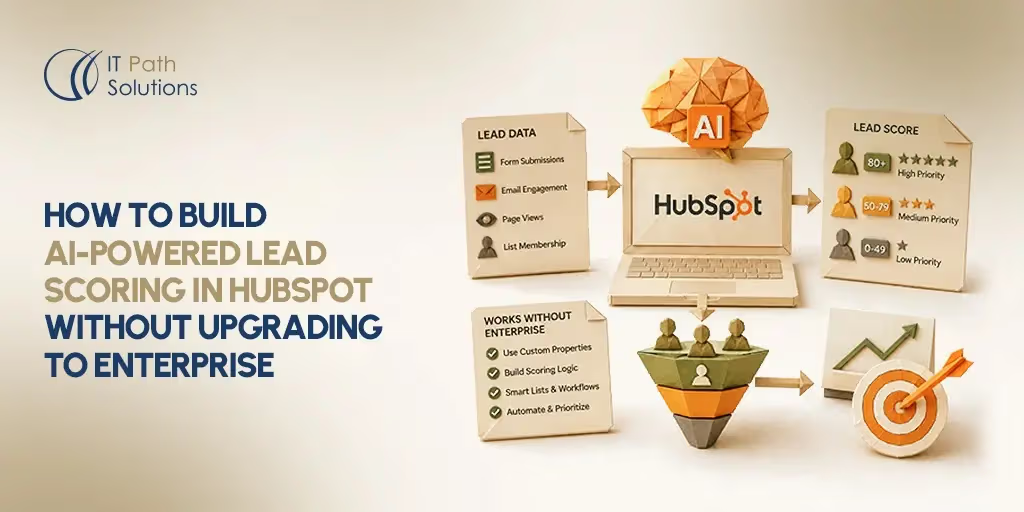
You don’t need a HubSpot Enterprise plan to get AI-quality lead scores. By training a custom machine learning model on your own closed-won and closed-lost data, including product usage, billing history, and support activity that HubSpot will never see and pushing the results back into HubSpot as a custom contact property, your sales team gets accurate, continuously updated scores inside the tool they already use. No new dashboards. No plan upgrade. Just better prioritisation.
Most B2B sales teams are sitting on a frustrating problem. They have hundreds, sometimes thousands, of leads in HubSpot, and no reliable way to tell which ones are actually ready to buy.
The numbers reflect this. Research from HubSpot found that 61% of marketers say generating high-quality leads is their biggest challenge. Both problems trace back to the same root cause: lead scoring that doesn’t reflect what actually drives conversion.
If you’re on HubSpot Starter or Professional, your only real option for automated scoring is manual, rule-based HubSpot Score, a system where your team assigns point values to actions like visiting the pricing page or opening an email. If you want HubSpot’s predictive lead scoring which calculates a “Likelihood to close” percentage using machine learning, you’re looking at a plan upgrade to a higher tier, which comes with a significant cost jump.
But here’s what doesn’t get talked about enough, no matter on which plan you are, HubSpot’s predictive scoring has a hard ceiling. It can only see data that lives inside HubSpot. Product usage, billing history, customer success health scores, support ticket trends. None of that factors in. Which means a contact who has been actively using your product five days a week, upgraded their subscription last month, and completed onboarding might score lower than someone who simply clicked a few emails.
That’s the gap this guide fills. HubSpot AI lead scoring built on your own proprietary data closes that gap, and it doesn’t require an Enterprise upgrade to get there.
Why Traditional HubSpot Lead Scoring Falls Short
1. Manual Scores Depend on Static Rules
Manual lead scoring in HubSpot works the same way it has for years. You assign positive or negative points to specific behaviours and attributes: +10 for visiting the pricing page, +5 for opening an email, +15 for a company size that matches your ICP, -20 for a free email domain. Combine enough of these rules and you end up with a score between 0 and 100 that’s supposed to tell your reps who to call first.
It’s a reasonable starting point, and for early-stage teams with a small, manageable contact database, it works. The problems start as your business grows.
Rules go stale. Buyer behaviour changes. The pricing page that used to be the strongest purchase signal in 2022 might have been replaced by a product trial page in current situation. But no one updated the scoring model, so your old rules are still running.
Beyond staleness, manual scoring is built on assumptions. Your team decides which behaviours predict conversion, not actual conversion data. You’re essentially guessing at patterns that could be confirmed with data, and those guesses gradually drift further from reality the longer they go unchallenged.
And at scale, manual models become impossible to maintain. Once you’re managing 15,000 contacts and 40 scoring rules, auditing and updating that system requires hours that no one has. Most teams end up leaving the model untouched for months, or years, and simply stop trusting the scores.
Enterprise Predictive Scoring Has Visibility Limits
HubSpot’s Predictive Lead Scoring is a genuinely well-built tool. It uses machine learning to analyse behavioural and firmographic patterns across your closed-won and closed-lost deals, then assigns each contact a probability score for conversion within the next 90 days. For teams whose entire customer journey lives inside HubSpot, it can add real value.
The limitation isn’t the technology. It’s the data boundary.
HubSpot’s model can only analyse data stored inside HubSpot. Full stop. It can see page views, form submissions, email engagement, deal stages, company properties, and CRM interactions. What it cannot see is everything that happens outside the CRM.
That includes:
- Product engagement data: logins, feature adoption, session frequency, trial depth. This typically lives in your product database or in an analytics platform like Mixpanel, Amplitude, or Segment.
- Customer success interactions: onboarding completion rates, health scores from Gainsight or Totango, escalation history.
- Billing and subscription data: plan upgrades, seat expansion, payment consistency.
- Data warehouse insights: cohort analyses, usage trends, revenue patterns from Snowflake, BigQuery, or Redshift.
To be direct about this: if your entire customer journey is genuinely captured in HubSpot, the native predictive model may be all you need. The case for custom HubSpot AI lead scoring is specifically for companies where the most predictive conversion signals live outside the CRM.
HubSpot Predictive Scoring vs. Custom AI Lead Scoring
| Criteria | HubSpot Predictive Scoring | Custom AI Lead Scoring |
|---|---|---|
| Plan required | Higher-tier HubSpot plans [verify current plan availability with HubSpot documentation] | No HubSpot plan upgrade required |
| Data sources | HubSpot CRM data only | HubSpot + product usage + billing + support + data warehouse |
| Model training | HubSpot trains automatically on your CRM data | Trained on your proprietary closed-won/closed-lost outcomes |
| Score transparency | Limited. HubSpot doesn’t fully explain individual score factors | Configurable. Top contributing factors can be surfaced |
| Maintenance | Automatic model updates | Requires periodic retraining and monitoring |
| Data volume requirement | Approximately 20+ closed deals/year (confirm with HubSpot documentation) | Flexible, can be calibrated for smaller datasets |
| Time to implement | Immediate (feature toggle) | Typically 6 to 12 weeks depending on data complexity |
| Cost | Included in qualifying plan pricing | Custom development cost |
| Best for | Companies with clean HubSpot data and sufficient deal volume | Companies with external data signals and/or below the Enterprise pricing threshold |
The Signals That Often Predict Revenue Better Than CRM Data
Before building anything, it helps to understand which external signals actually matter. Here are the four categories that consistently show up as strong conversion predictors in B2B and SaaS businesses, and HubSpot’s scoring will never see any of them.
1. Product Usage Behaviour
Product usage data is often the single strongest predictor of purchase intent for SaaS and subscription businesses, and it’s entirely invisible to HubSpot’s scoring engine.
The signals that matter most are:
- Number of active users on the account: a company with 12 users actively in your product is different from one with 1.
- Feature adoption rate: are they using core features, or only the surface-level ones that every free user touches?
- Session frequency and recency: daily active users close at dramatically different rates than users who logged in twice last month.
- Trial engagement depth: how much of the product has a free user actually explored?
A prospect who uses your product five days a week is expressing intent through behaviour, not words. That signal should carry more weight than a single visit to a pricing page. Without custom HubSpot AI lead scoring, it never reaches your reps. This is one of the most common data gaps IT Path Solutions helps businesses address when designing custom lead intelligence systems.
2. Support and Customer Success Activity
Support data tells you two different stories simultaneously: where a customer is struggling, and how invested they are in making your product work for them.
Key signals include:
- Support ticket volume and severity: frequent, low-severity tickets often indicate an engaged power user; unresolved high-severity tickets can indicate churn risk.
- Onboarding completion percentage: in SaaS, onboarding completion is one of the most reliable early predictors of long-term retention and expansion revenue.
- Customer health scores from platforms like Gainsight or Totango: these synthesize multiple engagement signals into a single number your CS team already trusts.
A contact at a company that has completed 90% of onboarding and has a strong health score is much more likely to buy than someone from a company with only a few support interactions. IT Path Solutions can help include these customer success signals in HubSpot lead scoring to give sales teams a clearer view of buying intent.
3. Payment and Billing Data
Billing data is blunt, unambiguous signal. A company’s payment behaviour tells you exactly how much they’re investing in your product, and whether that investment is growing.
Watch for:
- Subscription upgrade history: a company that upgraded from a Starter plan to a Growth plan last quarter is already demonstrating willingness to pay for more.
- Seat expansion: adding users is one of the clearest indicators of increasing organizational adoption.
- Invoice payment consistency and timing: reliable, on-time payment patterns tend to correlate with financially healthy companies that are stable buying prospects.
A contact at a company that just added 10 seats to their subscription is a fundamentally different lead than one at a company that hasn’t changed their plan in 18 months.
4. Data Warehouse Insights
For mid-market and enterprise B2B companies, the most sophisticated customer intelligence often already exists. It’s just sitting in a data warehouse that the sales team never sees.
Data warehouse signals worth surfacing include:
- Internal scoring models built by your data team: if your analysts have already built churn models or expansion propensity scores, those insights should reach sales.
- Customer cohort performance: which customer profiles close fastest, expand most, and retain longest?
- Usage trend direction: is a company’s engagement with your product accelerating or declining over the last 90 days?
Companies running Snowflake, BigQuery, or Redshift often have a richer picture of customer behaviour than their CRM ever will. Custom HubSpot AI lead scoring is how that intelligence finally reaches a rep’s call queue. IT Path Solutions frequently helps organizations bridge this gap by connecting warehouse data and operational systems directly into HubSpot scoring workflows.
How IT Path Solutions Builds Custom HubSpot AI Lead Scoring
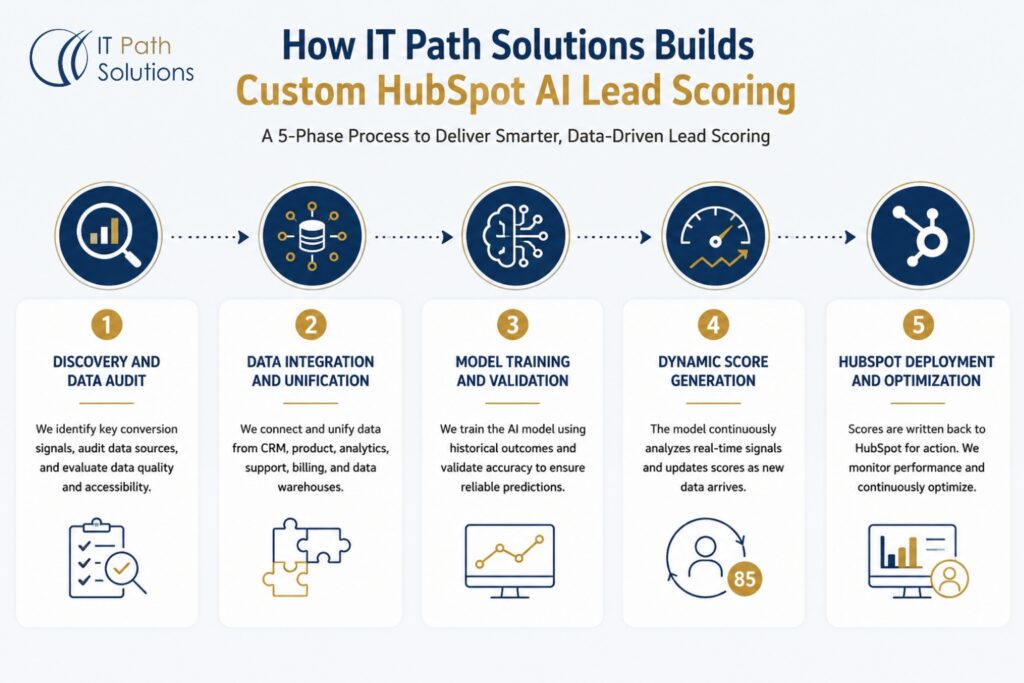
Unlike HubSpot’s native scoring tools, custom HubSpot AI lead scoring is built around the data that actually drives conversions in your business. Rather than relying solely on CRM activity, the model learns from customer outcomes across your entire revenue ecosystem and continuously improves as new data becomes available.
At IT Path Solutions, we implement custom HubSpot AI lead scoring through a structured five-phase process designed to deliver accurate predictions without disrupting existing sales operations.
Phase 1: Discovery and Data Audit
Every successful HubSpot AI lead scoring project starts with understanding what actually predicts conversions in your business.
Our team works with stakeholders across sales, marketing, customer success, and product teams to identify meaningful buying signals, audit available data sources, and compare the characteristics of your highest-converting customers against the broader lead database.
We also assess the quality and accessibility of the data available to the model. Before moving forward, we identify which systems can be connected, where data gaps exist, and what additional tracking may be required.
Phase 2: Data Integration and Unification
Once the discovery phase is complete, we connect the systems that contain valuable conversion signals.
Typical data sources include:
- HubSpot CRM: contact properties, deal history, lifecycle stages, email engagement, and sales activities
- Product databases: user logins, onboarding milestones, feature adoption, and usage frequency
- Analytics platforms: Mixpanel, Amplitude, Segment, or similar behavioural analytics tools
- Support platforms: Zendesk, Intercom, and customer service systems
- Billing platforms: Stripe, Chargebee, and subscription management tools
- Data warehouses: Snowflake, BigQuery, Redshift, or equivalent environments
These integrations are implemented through APIs or ETL pipelines to create a unified data layer that serves as the foundation for the HubSpot AI lead scoring model.
Phase 3: Model Training and Validation
With data consolidated, we train the model using historical business outcomes.
Closed-won opportunities become positive training examples, while closed-lost opportunities become negative examples. The model analyses thousands of behavioural, firmographic, engagement, product usage, support, and revenue signals to identify which combinations most accurately predict conversion.
Before deployment, we validate model accuracy using a holdout dataset to ensure the predictions generalize beyond the training data.
It’s important to note that reliable AI scoring requires sufficient historical outcomes. Organizations with only a small number of closed deals may need to use a longer historical timeframe or begin with a hybrid scoring approach while additional data accumulates.
Phase 4: Dynamic Score Generation
After validation, the model begins generating scores for every contact in the database.
Unlike static rule-based systems, HubSpot AI lead scoring continuously recalculates as new data arrives. Product logins, onboarding completion, feature adoption, support interactions, billing events, and engagement activity can all influence a contact’s score in real time.
For example, a trial user who completes onboarding, invites teammates, and reaches a product usage milestone may see their score increase automatically without requiring any manual intervention.
As new customer outcomes are recorded, the model continuously refines its understanding of which signals truly indicate purchase intent.
Phase 5: HubSpot Deployment and Ongoing Optimization
The final step is making the scoring model fully usable inside HubSpot.
Scores are written back to HubSpot as a custom contact property, allowing sales and marketing teams to use them just like any native HubSpot field.
The score can then be used to:
- Trigger automated workflows and lead routing
- Alert sales representatives when high-intent prospects emerge
- Prioritize outreach queues based on conversion likelihood
- Segment contacts for personalized nurture campaigns
- Build reporting dashboards that measure conversion performance by score tier
From the sales team’s perspective, the process is intentionally simple. They see a score on each contact record and use it to prioritize their efforts, while the AI model operates behind the scenes.
After deployment, IT Path Solutions continuously monitors model performance, retrains the system as new closed-won and closed-lost outcomes become available, and refines predictions to ensure the HubSpot AI lead scoring model evolves alongside your business.
Benefits of Custom Lead Scoring for B2B Companies
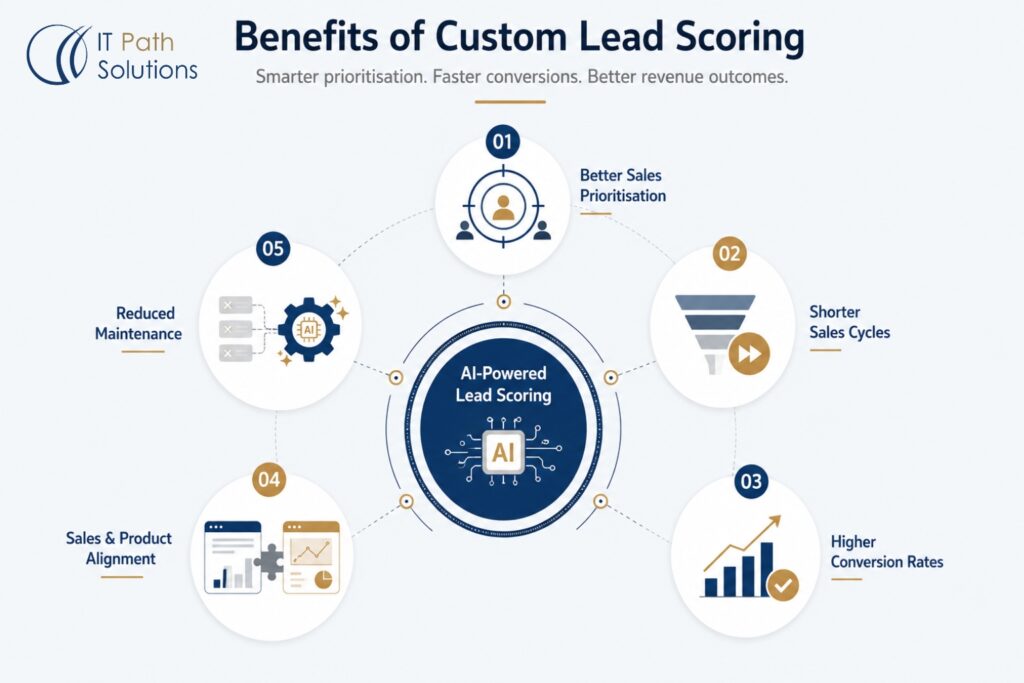
Teams that make this investment see practical improvements across the sales process, not just in score accuracy.
- Better sales prioritisation is the most immediate benefit. Reps stop spending time on recently active contacts who aren’t actually close to buying, and start focusing on accounts with genuine multi-signal intent, specifically the ones using the product, expanding their seats, and completing onboarding.
- Shorter sales cycles follow from earlier engagement. When high-intent signals surface in real time, reps can reach out before a prospect has started evaluating alternatives. Speed to contact matters, and accurate scoring creates speed.
- Higher conversion rates come from better resource allocation. When your most skilled reps are working the accounts most likely to close, close rates improve. This isn’t about working harder. It’s about working on the right leads.
- Improved sales and product alignment is an underrated benefit. When lead qualification reflects actual product engagement rather than just marketing touchpoints, sales reps start developing a more accurate intuition for what a high-intent prospect looks like. That feedback loop between product behaviour and sales conversation makes every rep better over time.
- Reduced scoring maintenance overhead rounds out the operational case. A trained model that updates itself automatically is significantly easier to maintain than a rule set that requires ongoing human review and updates.
Ready to uncover the signals behind your highest-converting customers?
IT Path Solutions can build a custom AI lead scoring system that combines HubSpot data with product usage, support activity, and billing insights and pushes actionable scores directly back into HubSpot.
Contact us to discuss your use caseBetter Lead Prioritization Starts with Better Data
The challenge with lead scoring is not identifying which contacts engage with your marketing. It’s identifying which contacts are most likely to become customers.
For many B2B companies, the strongest buying signals never reach HubSpot. Product adoption, onboarding progress, support interactions, subscription growth, and usage trends often reveal far more about purchase intent than email opens or page views. When those signals live outside the CRM, even sophisticated scoring models are working with an incomplete picture.
That’s why companies with valuable proprietary data increasingly look beyond standard lead scoring. By combining HubSpot data with product, support, billing, and operational data, a custom AI scoring model can learn from the characteristics of your actual closed-won customers and continuously prioritize the leads most likely to convert.
The result is simple. Sales teams continue working in HubSpot, but the scores they rely on are based on the signals that truly drive revenue for their business. No new platform. No change to existing workflows. Just a clearer view of which opportunities deserve attention first.
Frequently Asked Questions
1. When should a company consider custom HubSpot AI lead scoring?
Custom HubSpot AI lead scoring becomes valuable when the signals that predict revenue live outside HubSpot. This is common for SaaS, subscription, and product-led businesses where product usage, onboarding progress, support interactions, billing activity, or data warehouse insights are stronger indicators of buying intent than CRM engagement alone. IT Path Solutions typically recommends exploring a custom scoring model when sales teams no longer trust existing lead scores or when important customer data is spread across multiple systems.
2. What types of data can IT Path Solutions include in a custom HubSpot AI lead scoring model?
In addition to HubSpot CRM data, IT Path Solutions can incorporate signals from product databases, analytics platforms such as Mixpanel or Amplitude, customer support tools like Zendesk and Intercom, billing systems including Stripe and Chargebee, and data warehouses such as Snowflake, BigQuery, and Redshift. The objective is to train the scoring model on the signals that actually influence conversions rather than limiting it to CRM activity alone.
3. Can custom AI lead scores be displayed directly inside HubSpot?
Yes. One of the key goals of our implementation approach is to keep the experience simple for sales teams. IT Path Solutions pushes AI-generated scores back into HubSpot as custom contact properties, allowing teams to view scores, build reports, trigger workflows, create lists, and prioritize outreach directly within HubSpot without learning a new platform.
4. How long does it take IT Path Solutions to implement custom HubSpot AI lead scoring?
Implementation timelines depend on the complexity of the data environment and the number of systems involved. For most organizations, a custom HubSpot AI lead scoring project takes between six and twelve weeks, including discovery, data integration, model development, validation, deployment, and testing. Projects involving multiple data warehouses, complex product usage data, or extensive historical datasets may require additional time.
5. Does a business need HubSpot Enterprise to use a custom AI lead scoring model?
No. Because the scoring model is built externally and the resulting scores are written back into HubSpot, organizations can use custom HubSpot AI lead scoring without upgrading to HubSpot Enterprise solely for predictive scoring functionality. This approach is often attractive for companies that want AI-driven lead prioritization while continuing to use their existing HubSpot subscription.
6. How much historical data is needed to build an effective AI lead scoring model?
The ideal amount of data varies by business model, sales cycle, and deal volume. Generally, the more closed-won and closed-lost opportunities available, the more accurately a model can identify conversion patterns. During the discovery phase, IT Path Solutions evaluates available historical data and determines whether the dataset is sufficient for AI training or whether a phased approach would be more appropriate.
7. Will the lead scoring model continue to improve after deployment?
Yes. Customer behavior, product adoption patterns, and buying journeys evolve over time. To maintain accuracy, IT Path Solutions monitors model performance, retrains the scoring system using new outcome data, and refines prediction logic as the business grows. This helps ensure that the scoring model remains aligned with the factors that actually drive revenue.
8. What industries benefit most from custom HubSpot AI lead scoring?
Custom HubSpot AI lead scoring is particularly valuable for SaaS companies, subscription businesses, B2B technology providers, product-led growth organizations, and companies with complex customer journeys that generate meaningful behavioural data outside the CRM. Any organization that relies on product usage, onboarding milestones, customer success metrics, or billing activity to understand buyer intent can potentially benefit from a more comprehensive scoring approach.

Keyur Patel
Co-Founder
Keyur Patel is the director at IT Path Solutions, where he helps businesses develop scalable applications. With his extensive experience and visionary approach, he leads the team to create futuristic solutions. Keyur Patel has exceptional leadership skills and technical expertise in Node.js, .Net, React.js, AI/ML, and PHP frameworks. His dedication to driving digital transformation makes him an invaluable asset to the company.
Related Blog Posts
Beyond Basic RAG: Building a More Reliable Retrieval Pipeline With Hybrid Search

LLM Inference on Limited GPU Memory: What We Learned From Layer-Wise Model Streaming