Home
»Blog Insights
»Why AI Integration Services are No Longer Optional for Modern Enterprises in 2026
Why AI Integration Services are No Longer Optional for Modern Enterprises in 2026
Keyur Patel
December 29, 2025
7 min
Last Modified:
January 3, 2026
Focus keyword: Al integration services
Search intent: Informational/Commercial companies exploring automation and Al solutions.
Keywords: Artificial Intelligence Solutions Ai for Business Automation Machine Learning Integration Ai Development Company Digital Transformation with Ai
It is Monday morning, December 2025.
CEO A (The Traditionalist) walks into his office. His inbox is overflowing with 200 unread emails. His supply chain manager is waiting outside to report a surprise stockout that will delay shipments by three weeks. His marketing director is asking for more budget to hire copywriters because they can’t keep up with the content demands of the holiday season. The business is growing, but it feels like the wheels are coming off.
Everything is manual. Everything is reactive. Everything is slow.
CEO B (The Modernist) walks into her office. She doesn’t check her email first. Instead, she looks at a dashboard generated by her Artificial Intelligence Solutions suite.
- Insight: Her inventory system already predicted the stockout 4 days ago and automatically re-routed orders to a secondary warehouse.
- Action: Her marketing team is currently reviewing, not writing, 50 variations of a campaign generated overnight by their custom LLM, tailored to five different customer personas.
- Result: She isn’t putting out fires. She is planning for Q1 2026.
In 2025, this isn’t science fiction. This is the Great Divergence. For the last five years, pundits have warned that AI is coming. That warning is expired. AI is here. And the gap between companies that treat it as a cool toy and those that treat it as oxygen is no longer about competitive advantage, it is about survival.
If you are still asking “Do we really need AI?,” you are asking the wrong question. The question is, “How fast can we catch up?”

Part 1: The Silent Revolution (AI for Business Automation)
When people hear about new technology, they often think of tools that simply generate text. Inside a company, the real change is happening in everyday tasks that used to drain time and attention. This quiet shift is where the real value is created.
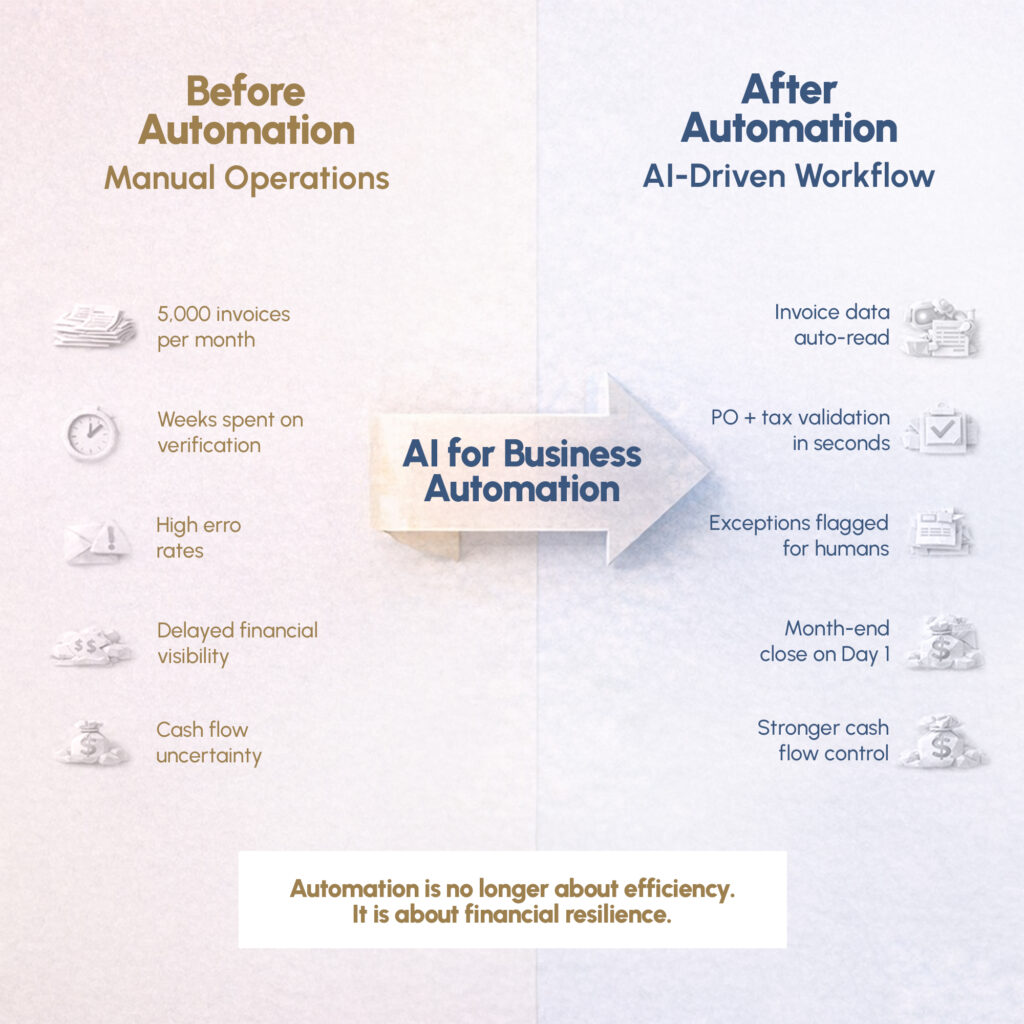
The Scenario: The Invoice Nightmare: Imagine a mid sized logistics company handling 5000 invoices each month. Without automation, a team spends entire weeks matching purchase orders with receipts, and mistakes add up to around 50000 dollars every year. With automation, a system reads the invoice, checks it against the purchase order, verifies the tax amount and completes the approval in less than a second. It asks for human help only when something looks unusual. This is not a small improvement in efficiency. Finishing monthly books on Day 1 instead of Day 15 gives the company a stronger position and better control of its cash flow. In a high interest environment, faster movement of money becomes a real advantage. Business automation has moved from simply saving time to strengthening financial stability.
Part 2: The Mind Reader Effect (Customer Experience)
Traditional companies try to guess what their customers want. Modern digital systems help them understand customer needs with far more clarity.
The Old World Banking Experience: A business owner applies for a loan and fills out long forms. Several days later, a request for a missing document arrives. The wait continues and the process feels slow and tiring.
The New World Fintech Experience: A customer logs in and the system has already studied their spending patterns, vendor payments and seasonal cash flow. Before they even start the application, the system knows they qualify for a credit line and presents the offer instantly. The customer feels understood instead of feeling processed in a queue.
The Opinion: In 2025, personalisation is not about adding a{First Name}to an email. It means responding to the user in real time based on their actions and needs. A website or app that does not adjust itself feels like a static brochure in a world where people expect a living experience.
Part 3: The Plumbing Problem (Why You Can’t Just Buy AI)
Here is the hard truth that most AI development companies won’t tell you in the first meeting: Your data is probably a mess.
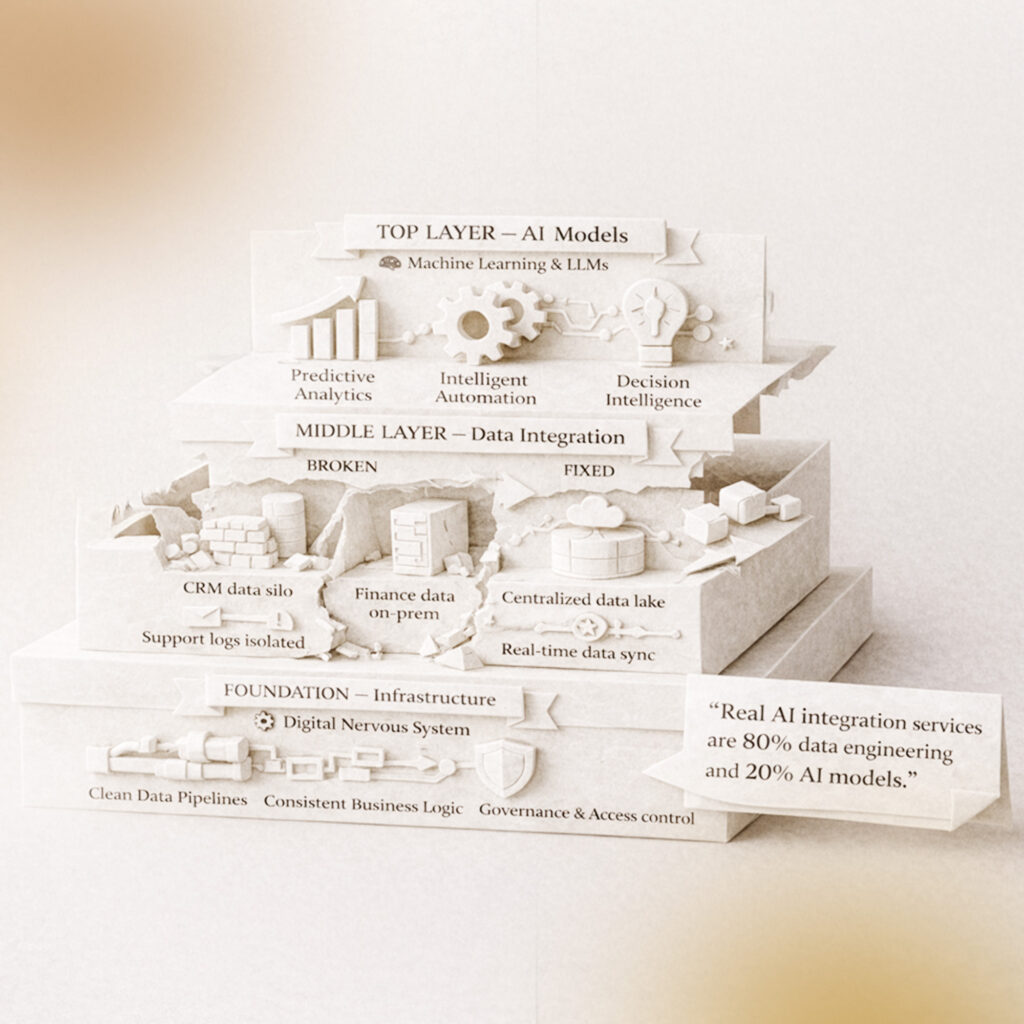
We often see enterprises try to bolt on AI like a spoiler on a rusty car. They buy an expensive license for Copilot or Salesforce Einstein, but it fails. Why? Because their data is trapped in silos.
- Sales data is in the CRM.
- Financial data is in an on-premise server.
- Customer support logs are in a separate cloud tool.
“If the foundation is shaky, the entire structure fails.”
The same applies to AI – inconsistent data will always lead to inconsistent results. When your systems hold conflicting facts, the AI can’t give you a reliable answer. Ask it about your top-selling product while departments report different numbers, and the output collapses under mixed signals.
The Strategic Shift: Real AI integration services are 80% data engineering and 20% AI models. Before you build the brain (the AI), you must fix the nervous system (the APIs and Data Lakes). This is why the role of the CIO has shifted from Keeper of Servers to Architect of Intelligence.
Part 4: The Human Element (Augmentation, Not Replacement)
There is a palpable fear in boardrooms and breakrooms: Will this replace us? This fear is the single biggest blocker to adoption. If your employees think the AI is there to fire them, they will sabotage it. They will refuse to feed it good data.
- For the Content Writer: AI isn’t here to replace your voice. It drafts the first version so you can refine the tone, strengthen the message, and make it truly resonate.
- For the Developer: AI doesn’t replace you; it writes the boring boilerplate code so you can focus on the complex system architecture.
The Stat: Gartner predicts that by 2026, organizations that focus on AI with human-in-the-loop will outperform those focusing on full automation by 30% in customer satisfaction. Why? Because humans still crave connection. AI handles the math; humans handle the meaning.
Part 5: The Buy vs. Build Dilemma
So, you are ready to start. Do you buy an off-the-shelf tool, or do you hire a custom software development company to build a proprietary model?
The Commodity Trap: If you just use the same ChatGPT wrapper as your competitor, you have zero advantage. You just leveled the playing field. To win, you need Vertical AI, which are models trained on your proprietary industry-specific data.
- Don’t build: A general chatbot (Use OpenAI/Gemini).
- Do build: A pricing engine that uses your 10 years of historical sales data to predict exactly how much discount to offer a specific client to close the deal.
This is where an AI development company earns its keep. They don’t just give you a model; they fine-tune it on your secret sauce, your institutional knowledge.
The 2026 Roadmap
The Kodak Moment wasn’t when digital cameras were invented; it was when Kodak executives looked at them and said, That’s cute, but it won’t affect our film business.
In 2025, Generative AI is the digital camera. You have two choices:
- Wait and See: Continue with your manual workflows, your data silos, and your reactive decision-making.
- Integrate and Evolve: Start small. Pick one burning platform problem, like customer support response times or inventory forecasting, and solve it with AI.
The Final Word: The future doesn’t belong to the companies with the most data. It belongs to the companies that can speak to their data.
At IT Path, we don’t sell magic boxes. We build the digital nervous systems that allow modern enterprises to think, react, and grow at the speed of AI. We have helped legacy giants clean their data pipelines and build custom models that turned gut feelings into guaranteed predictions.
Stop guessing. Start knowing. Let’s audit your data readiness today.
[Review your organisation’s readiness today]

Keyur Patel
Co-Founder
Keyur Patel is the director at IT Path Solutions, where he helps businesses develop scalable applications. With his extensive experience and visionary approach, he leads the team to create futuristic solutions. Keyur Patel has exceptional leadership skills and technical expertise in Node.js, .Net, React.js, AI/ML, and PHP frameworks. His dedication to driving digital transformation makes him an invaluable asset to the company.
Related Blog Posts
Beyond Basic RAG: Building a More Reliable Retrieval Pipeline With Hybrid Search

LLM Inference on Limited GPU Memory: What We Learned From Layer-Wise Model Streaming