Why Cloud & DevOps Services Are Essential for Scalable Business Growth
Keyur Patel
March 23, 2026
7 min
Last Modified:
March 23, 2026
What breaks first when a business starts scaling?
It is rarely sales. It is rarely demand. More often, it is infrastructure.
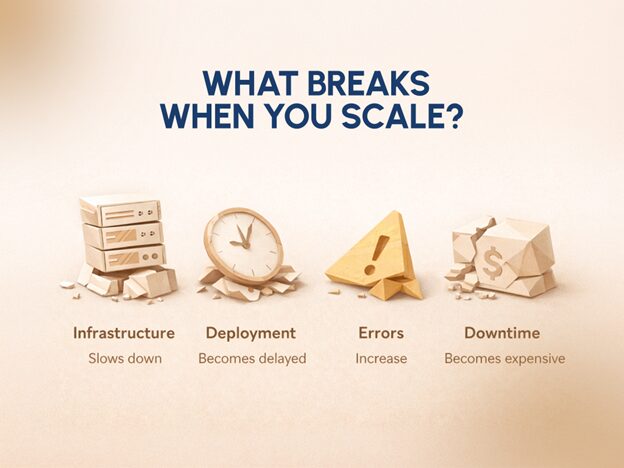
Growth often reveals weaknesses that once seemed hidden. Systems that handled moderate traffic begin slowing under pressure. Deployment cycles stretch longer. Small technical glitches become expensive downtime. Teams that once moved quickly now struggle. They find it hard to keep pace with rising customer expectations.
Revenue increases. Complexity increases. But the systems underneath often stay the same.
That is where Cloud Computing and DevOps Consulting Services move from being technical considerations to strategic imperatives.
Cloud Migration and DevOps are not just upgrades. They redefine how businesses run. They are redesigning the foundation. This foundation ensures growth over the long term.
Let’s examine why.
Cloud Computing as a Growth Infrastructure
In early stages, infrastructure decisions are usually driven by convenience and cost. On-premises servers feel manageable. Manual deployments feel acceptable. Small inefficiencies go unnoticed.
But scaling changes the equation.
As traffic grows, applications demand elasticity. As teams expand, deployments require coordination. As customer bases widen, downtime becomes financially and reputationally damaging.
Infrastructure that was once “good enough” becomes a constraint.
Cloud Computing addresses this constraint at its root.
Cloud Computing as a Growth Enabler
Modern Cloud Computing is not simply about hosting applications remotely. It is about creating a digital environment that adapts to demand in real time.
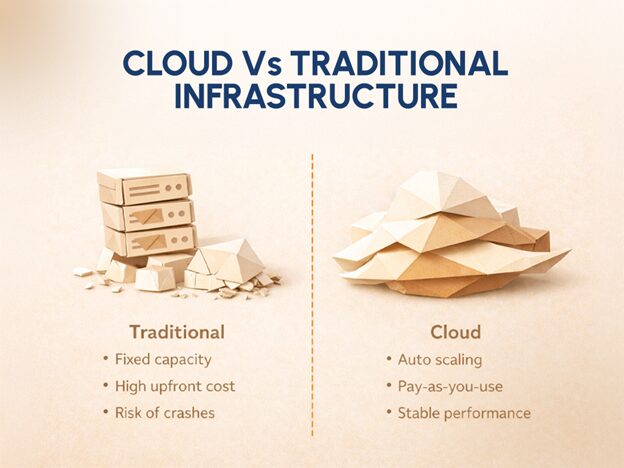
Instead of purchasing hardware, companies prepare for peak traffic. That hardware may sit idle for months. Cloud infrastructure avoids this waste. It scales dynamically. Resources expand during high usage. They contract when demand drops. Businesses pay for what they use and not what they predict.
Think of an e-commerce company that faces seasonal spikes. Under traditional hosting, peak periods risk crashes or sluggish performance. Under Cloud Computing Solutions, infrastructure scales automatically to absorb the surge. Customers experience smooth transactions. Revenue remains protected.
The difference is not technical. It is strategic.
Cloud infrastructure allows growth without fragility.
Why Structured Cloud Migration is important for Business Growth
Migrating to the cloud is not merely a relocation task.
A rushed migration may slow systems down. It can also trigger surprise expenses and disrupt operations. That is why structured Cloud Migration Services matter.
First comes analysis of the infrastructure. Next, dependencies and risks are uncovered. Then optimization opportunities are revealed. It means connecting technology decisions directly to business goals.
Consider a mid‑sized enterprise operating legacy applications. These are hosted on on‑premises servers. The organization struggles with mounting maintenance costs. It also experiences uneven uptime. A phased migration modernizes workloads while ensuring continuity and reliability.
The outcome is not just a new hosting. It has improved scalability, lower maintenance overhead and faster deployment capability.
Migration, when executed properly, is modernized.
Why DevOps is the Other Half of the Equation
Cloud infrastructure creates flexibility. DevOps Consulting Services create speed and stability.
Without DevOps, scaling often introduces chaos. Deployments become manual and error prone. Teams operate in silos. Emergency fixes create instability. As complexity grows, release cycles slow down.
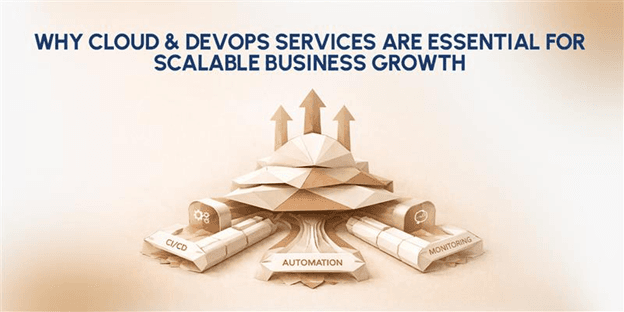
DevOps integrates development and operations. This integration produces a continuous workflow. CI/CD ensures smooth delivery. Automation and monitoring reinforce reliability. Software delivery becomes organized and consistent.
Consider a SaaS platform facing delayed releases. It also struggles with recurring production bugs. CI/CD pipelines increase deployment frequency. Automation secures stability. Infrastructure as code standardizes environments. Monitoring detects problems early.
Innovation accelerates. Risk decreases.
DevOps does not just improve development. It strengthens organizational agility.
The Connection between Cloud and DevOps
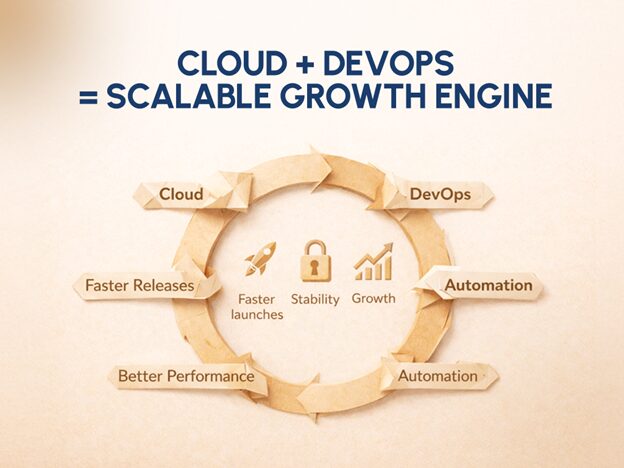
Cloud and DevOps are often discussed separately. In reality, their value multiplies when combined.
Cloud provides scalability and resilience. DevOps provides operational discipline and release velocity.
A business using cloud infrastructure without DevOps may still face deployment bottlenecks. DevOps alone is not enough. Traffic spikes cause chaos without scale.
When they come together, they build a balanced ecosystem. This makes growth sustainable.
Faster launches. Reduced downtime. Confident scaling. Predictable performance.
That synergy defines modern digital resilience.
How Cloud Computing Solutions Save Money
Scalability is not only about performance. It is also about cost structures.
Traditional infrastructure requires capital expenditure by purchasing hardware based on projected demand. If projections miss the mark, businesses either over-invest or underperform.
Cloud Computing Solutions shift infrastructure into an operational expense model. Businesses scale spending alongside usage. Flexibility cuts risk. It opens the door to experimentation.
Financial elasticity enables innovation in growing organizations. It simultaneously sustains their expansion efforts.
Risk Control and Business Stability
As businesses grow, the cost of failure increases. Outages affect more customers. Security risks multiply. Compliance requirements intensify.
Cloud environments improve resilience through redundancy. They also provide automated backups. Disaster recovery planning further strengthens reliability. DevOps practices add stability with monitoring systems. Rollback mechanisms and structured incident response complete the framework.
Growth introduces complexity. Cloud and DevOps introduce control.
Recognizing the Need for Transformation
Organizations often realize the need for Cloud Migration Services and DevOps Consulting Services when patterns begin repeating:
- Release cycles slow down.
- Downtime becomes frequent.
- Infrastructure reaches capacity limits.
- Maintenance costs rise.
- Market expansion feels technically constrained.
These problems cannot be dismissed as minor. They are signals that infrastructure is limiting strategy.
Addressing them early prevents growth from becoming operational strain.
Long-Term Competitive Advantage
Businesses that invest in Cloud Computing and DevOps do not improve IT performance simply. They position themselves for sustained competitiveness.
- They launch products faster.
- They enter new markets confidently.
- They scale without service disruption.
- They innovate without destabilizing operations.
In today’s environment, agility is not optional. It defines survival.
Conclusion
Scalable growth requires more than demand and ambition. It requires systems designed to handle expansion without breaking.
Elasticity in cloud computing supports growing demand. Resilience safeguards operations. Together, they create a stable foundation. DevOps consulting accelerates delivery. Consistency enables ongoing innovation. Migration services ensure sustainable transformation.
This is where IT Path Solutions aligns its approach. Not around isolated services but around engineering scalable, secure and connected infrastructures built for long-term performance.
Because transformation is not just about moving systems. It is about strengthening them while they evolve.
Infrastructure may not drive revenue directly. But without scalable infrastructure, revenue cannot grow safely.
And in a competitive landscape, sustainable scalability is not just operational hygiene. It is a strategic advantage.
FAQs
What does Cloud Computing actually mean for a business?
Cloud Computing keeps data on external servers. Applications run outside physical office hardware. It delivers computing power on demand. Storage scales automatically. Networking adapts seamlessly. Businesses gain flexibility. Costs drop and growth happens without hardware investment.
How do DevOps Consulting Services improve software delivery?
DevOps Consulting adds automation. And structured workflows like CI/CD. Teams push updates faster with fewer mistakes. For business leaders, that means quicker features. And more stable, dependable apps.
Is Cloud Migration risky for an existing business?
Cloud migration can be risky if done without planning. Professional services assess application dependencies. They plan phased transitions. They test performance before full deployment. When executed correctly, migration reduces downtime. It also improves reliability and lowers long‑term costs.
Do small and mid-sized companies really need Cloud and DevOps?
Yes. Scaling is not only tough for big companies. Smaller ones hit performance issues too. Releases slow down. Maintenance costs climb. Cloud and DevOps help them grow smoothly. That also without spending too much on hardware or extra staff.
How can businesses measure the success of Cloud and DevOps implementation?
Faster deployment cycles signal success. Downtime is reduced. Applications perform better. Infrastructure costs are lowered. Market changes are met more quickly. Technical teams monitor deployment frequency. They even observe reliability. Leadership focuses on revenue and customer satisfaction.

Keyur Patel
Co-Founder
Keyur Patel is the director at IT Path Solutions, where he helps businesses develop scalable applications. With his extensive experience and visionary approach, he leads the team to create futuristic solutions. Keyur Patel has exceptional leadership skills and technical expertise in Node.js, .Net, React.js, AI/ML, and PHP frameworks. His dedication to driving digital transformation makes him an invaluable asset to the company.
Related Blog Posts

How RivalRadar Uses AI Agents to Track Competitors Automatically

Notion Client Portal: How to Build a Branded Client Experience Without Leaving Notion