MCP Development Guide: How to Design Production-Ready MCP Servers
Keyur Patel
August 27, 2026
19 min
Last Modified:
September 3, 2026
A production-ready MCP server should give models a small set of task-oriented tools, return only the information needed for reasoning, keep orchestration inside the server, and enforce safety independently of the host.
That is the bottom line.
Protocol compliance alone does not make an MCP server reliable. A server can implement the Model Context Protocol correctly and still fail in production because its tools are difficult to distinguish, its responses consume too much context, or its risky operations depend on the model behaving cautiously.
The best architecture also depends on the problem being solved. An operations copilot needs strong cross-system composition. A database assistant needs governed access. A DevOps server needs graduated autonomy. A multi-tenant SaaS integration needs strict identity and tenant isolation.
This guide explains how to make those decisions when taking MCP from a working prototype to a dependable enterprise system.
It is intended for backend and platform teams that already understand the basics of MCP. If the protocol is new to you, start with the official MCP documentation before continuing.
Start with These Five MCP Server Design Rules
Before getting into the protocol mechanics, the five most important design rules are:
- Design tools around complete tasks rather than individual API endpoints.
- Return concise information shaped for model reasoning.
- Write errors that tell the model how to recover.
- Keep pagination, filtering, retries, and orchestration inside the server.
- Enforce permissions, limits, and confirmations server-side.
Everything else in this guide follows from these rules.
The Server Is Responsible for Safety
Do not rely on the MCP host to enforce your security rules.
MCP defines three primary roles: the host, client, and server.
The host is the AI application, such as an IDE agent, chat application, or custom enterprise assistant. The client is the protocol connection that the host maintains for each connected server. The server exposes the tools, resources, and prompts.
The server does not communicate directly with the model. The host sits between them and determines how server capabilities are presented and used.
MCP annotations can tell the host that a tool is read-only, destructive, or idempotent. However, these annotations describe intended behaviour; they are not guaranteed security controls.
If a refund requires a spending limit, the server must check that limit. If a rollback requires approval, the server must enforce the approval. If a user has read-only access, the server must reject mutation requests even if the host mistakenly presents those tools.
The host can improve safety, but the server must guarantee it.
Tool Names Must Remain Clear in a Crowded Context
Name tools as if they will appear beside tools from several other servers—because they probably will.
An MCP host can connect to multiple servers simultaneously. Tools from different systems may therefore appear in the same model context.
A generic name such as search, get_data, or update_record may be understandable when tested alone. It becomes ambiguous when several connected servers expose similar operations.
Domain-specific names are easier for both the model and developers to interpret:
orders_searchwarehouse_querybilling_issue_refund
The name should make it clear what the tool does and which system or domain it affects. This reduces tool-selection errors and makes failed interactions easier to debug.
Use Tools, Resources and Prompts for Different Jobs
Use a tool when the model should make a dynamic decision; use a resource when the application already knows which context is needed.
Tools are model-controlled. The model decides when to call them to retrieve information, perform calculations, or take actions.
Resources provide contextual data, such as files, schemas, metric definitions, or application records. The host or application decides when to make that information available.
Prompts are reusable workflow templates that users invoke explicitly.
Treating everything as a tool forces the model to make retrieval decisions that the application could have handled deterministically. Every unnecessary decision consumes tokens and creates another opportunity for failure.
Suppose an analytics application always needs the company’s metrics catalogue before answering a business question. That catalogue is better exposed as a resource than as a tool the model must remember to call.
By contrast, if the model needs to decide whether to query revenue, retrieve an order, or update a support case based on the conversation, those operations belong in tools.
MCP also supports capabilities such as sampling, elicitation, roots, logging, and progress reporting. Sampling lets a server request model-dependent work through the client. Elicitation lets it request structured user input or confirmation. Roots define the filesystem or URI areas in which a server may operate.
These capabilities reduce guesswork. A server that explicitly asks which environment the user means is more dependable than one that allows the model to infer it.
Design New Remote Servers Around Stateless Requests
New remote MCP servers should be stateless at the protocol layer and store any required application state explicitly.
Stdio remains suitable for local, single-user integrations such as IDEs and desktop applications. Streamable HTTP is the appropriate transport for most remote servers. The older HTTP+SSE transport is deprecated and should not be used for new development.
The 2026-07-28 MCP specification changed the protocol core to use stateless, self-contained requests. It removed the protocol-level initialization exchange and the Mcp-Session-Id header.
Each request now carries the protocol version, client identity, and capabilities needed to process it. Streamable HTTP requests also include Mcp-Method and, when applicable, Mcp-Name headers. Gateways can use these headers for routing, authorization, and metering without inspecting the request body.
In practice, this allows remote MCP servers to operate more like conventional web services. They can run behind standard load balancers and scale horizontally without depending on sticky sessions.
A stateless protocol does not prevent an application from maintaining workflow state. If information must persist between tool calls, the server can issue an explicit handle and require it in later requests. State can also be stored in Redis, DynamoDB, or another system and keyed to an authenticated identity or explicit application handle.
The server should not infer context merely because two requests arrived over the same connection.
MCP specifications are date-versioned. Pin the supported specification revision and SDK version in both code and documentation so compatibility problems can be reproduced and future migrations planned.
Five Principles for Designing Model-Friendly MCP Tools
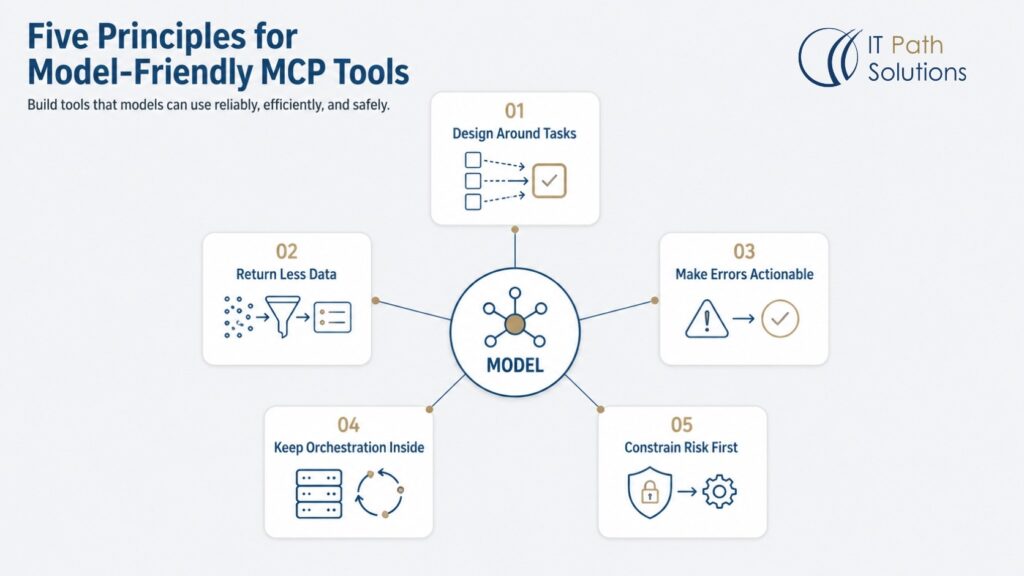
1. Design Tools Around Complete Tasks
Do not mirror every REST endpoint as a separate MCP tool.
A one-to-one translation of an API produces many small tools that the model must distinguish and combine correctly.
Consider a support assistant investigating a delayed order. It may require customer information from a CRM, order data from an e-commerce platform, payment status from a payment provider, and tracking information from a shipping system.
If each endpoint becomes a separate MCP tool, the model must determine the correct sequence, pass identifiers between calls, and join the results. Every additional call introduces another possible failure.
A task-oriented tool such as resolve_customer_context is more dependable. The server performs the underlying API calls in deterministic code and returns one coherent summary.
Mutations such as refunds, cancellations, and address changes should normally remain separate because they carry different risks and permissions. The purpose is not to combine everything into one enormous tool, but to avoid making the model coordinate operations that always belong together.
A useful test is simple: if two tools are almost always called together, they should probably be one tool.
2. Return Less Data
Return the smallest response that gives the model enough information to complete the task.
Every field returned by a tool occupies space in the context window. Complete database records and raw third-party API responses often contain far more information than the model needs.
An order-support tool may only need to return the order status, payment state, delivery estimate, customer details, eligible actions, and relevant warnings. It does not need to return every field from the customer, payment, shipment, and order objects.
The MCP server should transform those raw payloads into a concise operational view.
If complete records are occasionally required, expose them through a separate tool and clearly state when it should be used. This preserves access without imposing the cost on every request.
Response design directly affects context use, latency, cost, and the model’s ability to focus on the relevant information.
3. Make Errors Actionable
Every error should tell the model what failed and what it should do next.
A message such as Invalid ID gives the model no useful recovery path. It often produces another attempt with the same incorrect input.
Instead of returning:
Invalid charge ID.
Return:
No charge was found for this ID. Call
resolve_customer_contextto retrieve the customer’s valid charge IDs, then retry the refund.
The second response identifies the problem and provides a corrective action. The model can recover without requiring a developer or user to intervene.
Tool errors are instructions returned to the model. They should be written with the same care as tool descriptions.
4. Keep Loops and Orchestration Inside the Server
Pagination, retries, filtering, ranking, and deduplication belong in deterministic server code.
A model should not have to request page after page of search results or decide how many retries a failed downstream API deserves.
A search tool can instead filter and rank the available records, return the ten most relevant results, and explain:
Showing 10 of 214 matching orders. Add a date range or order status to narrow the search.
The model knows the result has been truncated and has a clear way to refine it. It does not need to manage a potentially expensive pagination loop.
The same principle applies to multi-system workflows. If a human developer would normally write a loop or orchestration function in application code, it should generally remain inside the server.
5. Constrain Risk Before the Tool Runs
Do not ask the model to compensate for an overly permissive tool.
Risk controls should appear in the tool description, input schema, authorization logic, execution limits, confirmation workflow, and audit logs.
Use enums when the accepted values are known. Use integer minor-currency units instead of decimal monetary amounts. Avoid model-supplied tenant identifiers, permission scopes, or unrestricted execution targets.
Consider this simplified refund tool:
server.tool(
  "issue_refund",
  "Issue an irreversible refund. Before calling, verify the charge " +
    "and confirm the amount with the user.",
  {
    chargeId: z.string(),
    amountMinorUnits: z
      .number()
      .int()
      .positive()
      .describe("Amount in the smallest currency unit, such as cents"),
    reason: z.enum([
      "duplicate",
      "fraudulent",
      "requested_by_customer",
    ]),
  },
  {
    readOnlyHint: false,
    destructiveHint: true,
    idempotentHint: false,
  },
  async (args, extra) => {
    const auth = await authorize(extra, "refunds:write");

    if (args.amountMinorUnits > auth.refundLimitMinor) {
      return err(
        `Amount exceeds the operator's refund limit of ` +
        `${auth.refundLimitMinor}. Reduce the amount or call ` +
        `request_refund_approval.`
      );
    }

    // Execute the refund and record the action.
  }
);
The description states the precondition. The schema limits the valid inputs. The annotations declare the risk. The server verifies authorization and the error provides an approved recovery path.
The system does not depend on the model remembering to be cautious.
Choosing the Right Production Architecture
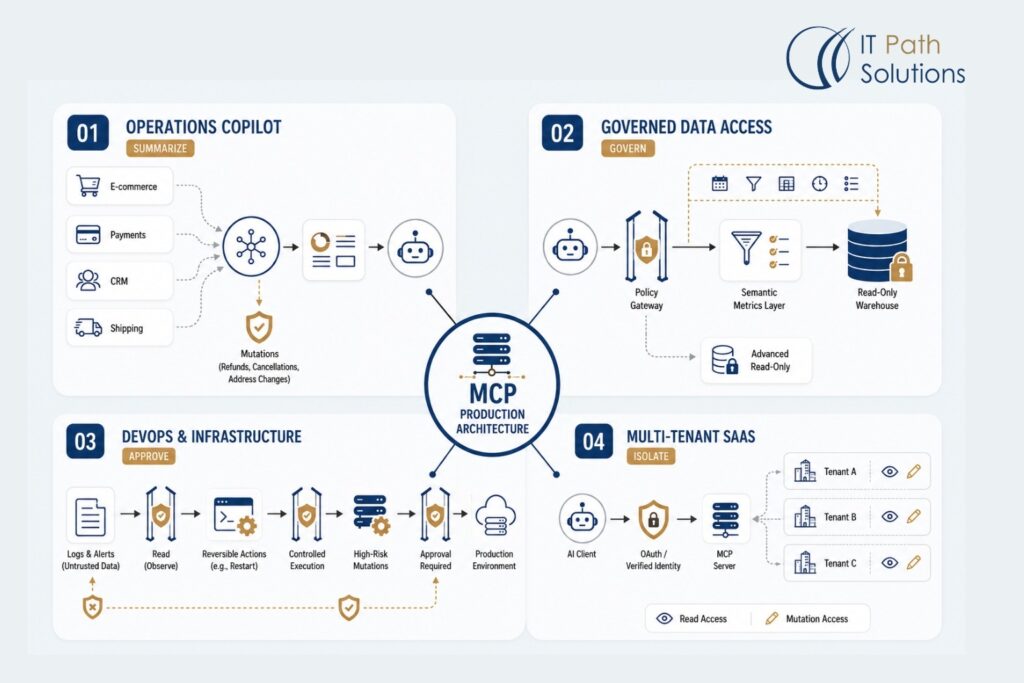
Choose the architecture according to the dominant risk in the use case, not according to a generic MCP template.
The same design does not suit every server. Four patterns cover many enterprise MCP implementations:
| Use case | Primary architectural priority |
|---|---|
| Operations copilot | Cross-system composition |
| Governed data access | Query governance |
| DevOps automation | Graduated autonomy |
| Multi-tenant SaaS | Identity and tenant isolation |
Pattern 1: Operations Copilot
An operations copilot should combine related system data before returning it to the model.
This pattern appears in e-commerce, logistics, ERP, and customer-support workflows. Answering one user request may require data from several internal and external systems.
A customer asking why an order is delayed may require information from an e-commerce platform, payment processor, CRM, and shipping provider. The MCP layer adds value by joining that data predictably.
A tool such as resolve_customer_context can query the required systems in parallel and return one summary containing the order, payment, fulfilment, and support state.
The tool surface should remain relatively small. Read operations should return compact summaries. Refunds, cancellations, address changes, and other mutations should have separate tools because their permissions and risks differ.
The main mistake to avoid is returning raw platform objects. Transforming those payloads into a useful operational summary is not merely presentation work; it is one of the server’s primary responsibilities.
Pattern 2: Governed Data Access
A data-access MCP server should expose approved business questions, not unrestricted database access.
This pattern applies to analytics warehouses, business intelligence platforms, and applications that allow teams to ask questions about company data.
A general run_sql tool creates a broad and potentially dangerous execution surface. A safer design exposes approved measures, dimensions, filters, and date ranges through a constrained schema.
The model can request revenue by region for the last 90 days, for example, but it cannot access arbitrary tables or construct unrestricted joins.
Queries should run against a semantic layer or read replica with enforced timeouts and row limits. A metrics catalogue can be exposed as a resource so the model understands what terms such as “active user,” “conversion,” or “revenue” mean within the business.
If advanced users genuinely need raw SQL, provide it through a separate, tightly controlled tool. Restrict it to approved read-only systems, limit the schemas it can access, cancel long-running statements, cap results, and log every query against the authenticated user.
Large result sets should be aggregated before they enter model context. If a person needs the complete dataset, save it as a downloadable file rather than making the model consume thousands of rows.
Pattern 3: DevOps and Infrastructure Automation
A DevOps MCP server should grant autonomy in proportion to the reversibility and risk of each action.
Reading logs or checking deployment health carries less risk than changing configuration or rolling back production. These operations should not share the same execution controls.
Read operations can be relatively open within the operator’s authenticated scope. Reversible actions, such as restarting a worker, may be allowed with server-side rate limits and idempotency controls.
Destructive or difficult-to-reverse operations should begin with a plan, diff, or dry-run result. The server should then obtain explicit approval before executing the change.
Sampling can help with incident triage. A server may collect a limited log bundle and ask the client’s model to cluster or summarize it without maintaining a separate model dependency.
The most distinctive risk in this pattern is prompt injection through tool results. Logs, alerts, and support tickets contain arbitrary external text that may attempt to instruct the model.
Treat that text as untrusted data. A model should not be able to move directly from reading external content to performing a high-risk mutation without a separate authorization and confirmation boundary.
Pattern 4: Multi-Tenant SaaS Integration
A multi-tenant MCP server must derive tenant identity from verified authentication, not from model input. This pattern applies when a SaaS company allows customers to connect their own AI clients and operate within their accounts.
The MCP server should validate access tokens as an OAuth resource server, including issuer, expiry, audience, signature or introspection result, and required scopes.
Tenant identity must come from the verified authentication context. A tool should never allow the model to choose an arbitrary tenant_id.
That tenant boundary must be enforced through every part of the request, including the tool, database query, storage operation, and downstream API call.
Authorization scopes should also determine which tools are visible. A read-only client should not see mutation tools when retrieving the server’s capabilities.
The greatest danger is cross-tenant leakage through composition. A customer-search tool that is appropriate for an internal operations team may be unsafe in an externally accessible SaaS integration.
The protocol is the same in both cases. The trust model—and therefore the correct tool design—is not.
What Production Readiness Requires
1. Scale the Server Like a Stateless Web Service
A production MCP server should not depend on a specific connection or server instance.
Remote servers should operate behind standard load-balancing infrastructure. State required across calls should be stored explicitly and connected to authenticated identities or application-issued handles.
Long-running operations should expose progress or use an asynchronous task pattern rather than holding a request open until an infrastructure timeout occurs.
2. Treat All External Text as Untrusted
Text returned by a tool does not become trustworthy simply because it did not come directly from the user.
Third-party tool descriptions may contain malicious instructions. Logs, tickets, documents, and scraped pages may carry prompt injection. Servers may also become confused deputies if they use elevated internal credentials for callers who do not possess equivalent permissions.
Effective permissions should always derive from the authenticated caller and be enforced independently of anything the model says or reads.
The official MCP documentation provides further security best practices for authorization and server implementations.
3. Test Model Behaviour, Not Only Tool Code
Unit tests prove that a tool works; evaluations show whether a model can use it.
A unit test can verify that a refund is processed correctly when valid arguments are supplied. It cannot prove that a model will select the refund tool at the correct moment, retrieve the right charge, confirm the amount, or recover from a failed request.
Production MCP systems need an evaluation harness containing representative user tasks executed through a real model.
The team should measure whether the model selects the right tools, provides valid arguments, completes tasks efficiently, recovers from errors, and avoids unsafe or unnecessary calls.
Tool names and descriptions should be treated as versioned interface contracts. A wording change can alter model behaviour even when the schema and implementation remain unchanged. Description changes therefore require the same evaluation discipline as code changes.
4. Measure Context Use
Log tool-result size in tokens alongside standard infrastructure metrics.
Tool invocations should record the authenticated caller, tool name, redacted arguments, authorization outcome, latency, error class, and result size.
Result size in tokens is particularly important because context bloat often develops gradually. A new response field may quietly increase the size of every interaction without triggering an ordinary application error.
Tracking token size makes those regressions visible before users experience slower or less reliable model behaviour.
When MCP Is the Wrong Tool
Use MCP when interoperability and governance justify the protocol—not simply because MCP is widely adopted.
If one team controls both the AI application and the integration, and no external client needs to connect, direct function calling may be simpler. MCP would add protocol and discovery requirements in exchange for flexibility the application does not need.
A capable coding agent working with one well-documented API may also be able to create and run its own client code. In that case, a maintained MCP tool layer may provide limited additional value.
MCP can also be excessive for a single read-only lookup that a conventional API or function could handle easily.
It becomes more valuable when one integration must serve several AI clients, capabilities need to be discovered dynamically, models outside your control require structured access, or standardized authorization and consent solve a real product or governance problem.
Building Production MCP Systems with IT Path Solutions
The objective of MCP development should be a server models can use reliably, not simply one that passes protocol checks.
That requires tool boundaries, response design, authentication, authorization, observability, and failure handling to be designed as one system.
IT Path Solutions builds MCP systems for operations copilots, governed data access, infrastructure automation, and multi-tenant SaaS applications through our AI app development services and custom software development services.
We help teams define the right tool surface, connect existing enterprise systems, and apply the controls required to operate MCP reliably at production scale.
Frequently Asked Questions
What is the difference between an MCP tool and an MCP resource?
A tool is used when the model should decide dynamically; a resource is used when the application already knows which context is required. Tools allow models to retrieve information, perform calculations, or take actions. Resources provide contextual data such as files, schemas, or metric catalogues that the host or application makes available.
Is MCP the same as function calling?
No. Function calling is a model capability, while MCP is an integration protocol. Function calling lets a model return a structured request for an application-defined function. MCP standardizes how AI applications discover and communicate with external tools, resources, and prompts. An MCP client may use function calling to select and invoke tools exposed by an MCP server.
What is the difference between an MCP server and an MCP client?
The server exposes capabilities; the client connects those capabilities to the host application. An MCP server provides tools, resources, and prompts. An MCP client maintains the protocol connection to that server on behalf of the host. The host mediates the interaction between the model and the server.
What changed in the 2026-07-28 MCP specification?
The protocol moved to stateless, self-contained requests that are easier to scale through conventional HTTP infrastructure. The specification removed the protocol-level initialization exchange and Mcp-Session-Id header. It also introduced header-based routing, cache information for list responses, and Multi Round-Trip Requests for sampling, elicitation, and roots.
The full changes are available in the official MCP specification changelog.
How should a multi-tenant MCP server handle authentication?
The server should derive tenant identity from a verified access token and enforce it across every layer. Each token’s issuer, expiry, audience, signature or introspection result, and required scopes should be validated. Tenant identity should never be accepted as an unrestricted model-supplied parameter.
Do I need MCP if I control both the AI agent and the API?
Not necessarily. Direct function calling may be simpler when one team owns both sides and no external clients need to connect. MCP is most valuable when multiple clients need to discover and use the same capabilities or when standardized interoperability, authorization, and governance provide a genuine advantage.

Keyur Patel
Co-Founder
Keyur Patel is the director at IT Path Solutions, where he helps businesses develop scalable applications. With his extensive experience and visionary approach, he leads the team to create futuristic solutions. Keyur Patel has exceptional leadership skills and technical expertise in Node.js, .Net, React.js, AI/ML, and PHP frameworks. His dedication to driving digital transformation makes him an invaluable asset to the company.
Related Blog Posts

How RivalRadar Uses AI Agents to Track Competitors Automatically

Notion Client Portal: How to Build a Branded Client Experience Without Leaving Notion