
Home
»Blog Insights
»How We Shipped a Full Stripe Integration in 3 Days Using Cursor (And What We Would Do Differently)
How We Shipped a Full Stripe Integration in 3 Days Using Cursor (And What We Would Do Differently)

Keyur Patel
April 1, 2026
17 min
Last Modified:
May 20, 2026
A seed stage SaaS team had a working product, active users, and an investor demo approaching. What they did not have was a way to charge for the product.
Their B2B project management tool had been in development for eight months on a TypeScript and Next.js stack. The product was live, pilot users were engaged, and the pricing page was ready. But the core billing flow did not exist. Clicking “Start Free Trial” led to a waitlist form. Every customer had been onboarded manually because the Stripe integration kept getting pushed to a later sprint.
Four days before a Series A prep demo with two institutional investors, their lead developer had already spent two weeks attempting the integration. It was partially built and actively broken.
They reached out with a simple message. Billing needed to exist, and there were 72 usable hours to make it happen.
We took the engagement.
Using Cursor alongside two senior engineers and applying the same rapid iteration mindset we use in our vibe coding development expertise with which we have shipped a complete Stripe integration in that window. Subscriptions, webhooks, proration, a billing portal, and access control were all implemented, tested, and running in production before the demo.
This kind of outcome is exactly where hands-on vibe coding support becomes critical, not just accelerating development, but stepping into partially built systems and getting them across the finish line under real constraints.
It worked. But the speed came with tradeoffs. There were decisions we made under pressure that we would not repeat in a standard engagement.
This post covers both sides. What it takes to ship a production ready Stripe integration in 72 hours, where AI tooling actually helps, where it does not, and the four decisions we would approach differently today.
Why Stripe Integrations Are Harder Than They Look
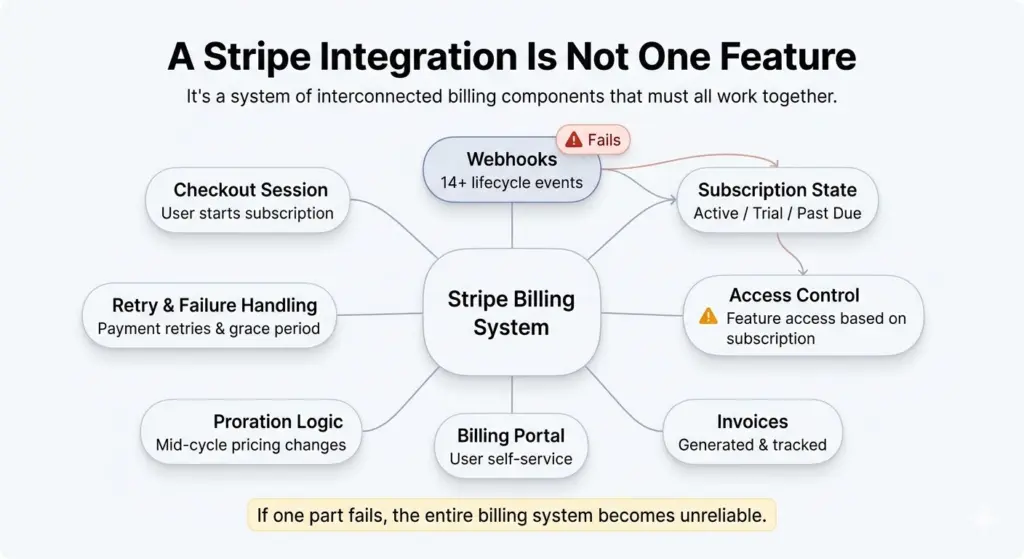
Every developer has a story about underestimating Stripe. Not because Stripe is badly documented, the documentation is actually excellent, but because a billing integration is not one feature. It is eight or nine features that have to behave correctly together, under conditions that are impossible to fully simulate in a development environment.
What the pilot developer had built covered the happy path: a checkout session that creates a Stripe customer and redirects to a success URL. What was missing was everything that happens after:
- Webhook handling for the 14 events that matter in a subscription lifecycle (payment succeeded, payment failed, subscription cancelled, trial ending, invoice created, and so on)
- Idempotency makes sure that if Stripe sends the same webhook twice, your database only processes it once
- Proration what happens to a customer’s invoice if they upgrade from a monthly Starter plan to an annual Pro plan on the 14th of the month
- The billing portal, the Stripe-hosted UI that lets customers update their card, view invoices, and cancel without you building any of that yourself
- Subscription status gating ensuring that users on cancelled or past-due subscriptions can’t access paid features
- A grace period logic giving users with a failed payment 72 hours to update their card before their access is cut
These are not optional features for a product going in front of investors. They are the product. An investor asking “how does a customer update their credit card?” needs a real answer, not a “we’re building that.”
The integration we needed to ship had to handle all of it.
The Stack and the Constraints
Before writing a single prompt, we ran a 30-minute scoping call.
The stack: Next.js 14 with App Router, TypeScript, Prisma as the ORM (Object-Relational Mapper the library that translates between TypeScript objects and database rows), and a Postgres database on Railway. Supabase handled authentication.
The constraints: No new dependencies without explicit approval from the lead developer (the codebase had a brittle dependency graph that had already caused one major incident), all webhook processing had to be synchronous and logged to a dedicated table, and no changes to the authentication layer.
The existing Stripe code: A half-built checkout.ts route handler, a stripe.ts client file, and a stripe_customers table in the schema with three columns. The webhook route existed but returned a 200 with no body and did nothing.
We had 72 hours.
How We Used Cursor — The Honest Account
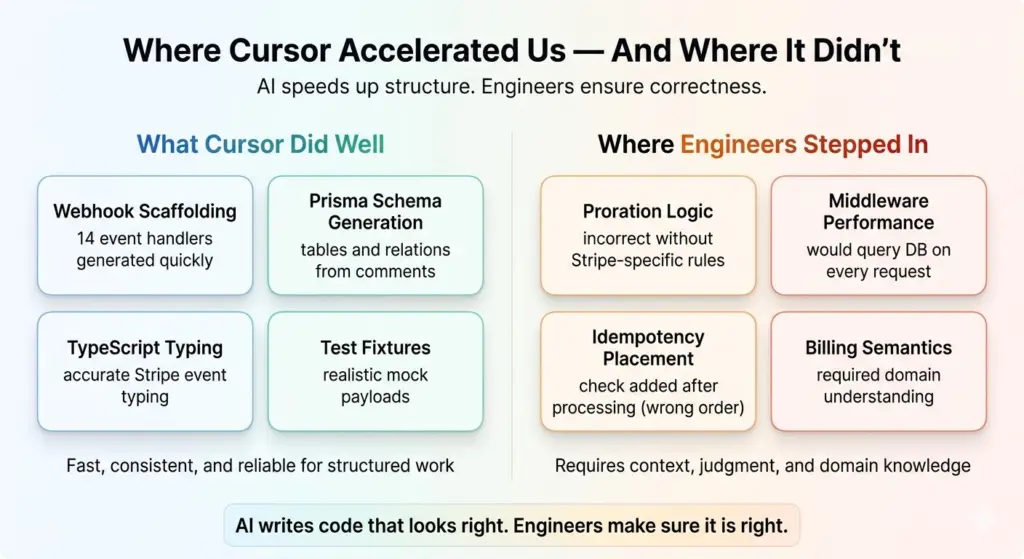
Cursor was the primary IDE for both engineers on this engagement. Here is an account of where it added genuine speed, where it created extra work, and what we learned about prompting for a complex integration rather than a simple feature.
What Cursor Did Well
Scaffolding the webhook handler. The Stripe webhook handler is structurally repetitive: a large switch statement that routes on event.type, with a handler function for each case. This is exactly the kind of code where Cursor’s autocomplete is fast and reliable.
We wrote the first two cases invoice.payment_succeeded and invoice.payment_failed and Cursor completed the next six cases correctly with minimal correction. Thirty minutes of work executed perfectly that would have taken two hours manually.
- Generating the Prisma schema additions. We needed four new tables:
subscriptions,invoices,webhook_events(for idempotency logging), andbilling_portal_sessions. We described each one in a comment and let Cursor generate the Prisma schema blocks. Every generated block was correct on the first attempt. We added two missing indexes by hand, but the field definitions and relation syntax were accurate. - TypeScript type generation from Stripe objects. Stripe’s TypeScript SDK is comprehensive but the event objects are deeply nested. Writing the type assertions narrows
Stripe.EventtoStripe.InvoicePaymentSucceededEventbefore accessing event-specific fields which is tedious and error-prone. Cursor handled this reliably once we gave it the first example and asked it to follow the same pattern for each subsequent event type. - Writing test fixtures. We had a policy on this engagement of writing tests before shipping any webhook handler. Cursor was fast at generating realistic Stripe event fixture objects mock payloads that replicate what Stripe actually sends once we pasted in one real example from the Stripe CLI output.
Where Cursor Needed More Direction
1. Proration logic
We asked Cursor to generate the proration calculation for mid-cycle plan changes. It produced code that was logically reasonable and factually wrong because it calculated proration based on calendar months rather than on the actual billing period start and end dates that Stripe uses.
This would have resulted in incorrect invoice amounts for any customer who upgraded between the 1st and the 28th of a month. We caught it in testing. If we had shipped it without running the proration test suite, it would have been live.
This is not a Cursor failure. It is a reminder that billing logic requires domain knowledge, not just code generation. The correct approach, which we used after catching the error was to prompt Cursor with the explicit Stripe proration formula and ask it to implement that formula, not infer it.
Shipping fast with AI coding tools is easy. Shipping production-safe billing logic is harder.
If your team is stuck debugging webhook failures, broken Stripe flows, or AI-generated technical debt, our vibe coding support team is here to help you stabilise and ship production-ready systems without rebuilding from scratch.
2. The subscription status gating middleware.
We needed a Next.js middleware function that checks a user’s subscription status on every protected route and redirects or shows an upgrade prompt based on the result.
Cursor generated a working first draft that had a subtle bug: it fetched the subscription status from the database on every request, with no caching.
Under the load pattern this product would see with 50 concurrent users, that would have been 50 database queries per page load per second on the subscriptions table.
We replaced the database fetch with a check against the session object, which already contained the subscription status after we added it at login time. Three lines of code. Not something Cursor would have caught on its own.
3. Idempotency handling.
We asked Cursor to add idempotency checking to the webhook handler, specifically, to check the webhook_events table for a duplicate stripe_event_id before processing. It generated the query correctly but placed it after the event processing logic, not before.
An idempotency check placed after processing is not an idempotency check but a log. We moved it to the top of each handler function and added the unique constraint on stripe_event_id in the migration.
A Replicable Framework for Stripe Integrations With Cursor
Based on this engagement and the ones before and after it, here is the sequence that produces reliable results.
| Phase | What to Do | Where Cursor Helps | Where it Needs Direction |
|---|---|---|---|
| Schema design | Define tables: subscriptions, invoices, webhook_events, portal_sessions | Generates Prisma schema blocks from comments | Won’t add indexes it doesn’t know you need |
| Stripe SDK setup | Configure client, set API version, type the client | Fast and accurate for boilerplate | n/a |
| Checkout session | Create session endpoint, success/cancel handlers, customer creation | Reliable for standard checkout flow | Will miss edge cases like existing customers |
| Webhook handler | Switch statement routing on event.type | Excellent for repetitive handler scaffolding | Place idempotency check before processing, not after |
| Proration logic | Mid-cycle plan changes, invoice calculations | Fast — but only if you specify the Stripe formula | Will infer incorrectly from vague prompts |
| Status gating | Middleware to protect routes by subscription state | Generates working draft | Will query DB on every request — add session caching |
| Billing portal | Customer portal session creation, redirect handling | Fast and accurate | n/a |
| Test fixtures | Mock Stripe event payloads for each handler | Accurate after you paste one real example | n/a |
| Production config | Environment variables, webhook secret, URL configuration | n/a | Do this manually — no shortcuts |
No AI tool should be configuring production credentials. The webhook secret, the Stripe API keys, the production endpoint URL, these are set manually, verified manually, and tested manually with the Stripe CLI before any real traffic touches them.
The 72-Hour Breakdown
| Hour | Work Completed | Engineers |
|---|---|---|
| 0–2 | Scoping call, architecture review, existing code audit | Both |
| 2–6 | Prisma schema additions, database migration, Stripe SDK configuration | Engineer 1 |
| 6–12 | Webhook handler scaffold (14 event types), event routing, idempotency table | Engineer 2 |
| 12–18 | Checkout session flow, success/cancel handlers, customer creation logic | Engineer 1 |
| 18–22 | Subscription status gating middleware, session enrichment on login | Both |
| 22–28 | Billing portal integration, customer portal session creation endpoint | Engineer 1 |
| 28–36 | Proration logic, plan change flow, upgrade/downgrade UI integration | Engineer 2 |
| 36–42 | Test suite: webhook fixtures, checkout flow tests, middleware tests | Both |
| 42–50 | Stripe CLI end-to-end testing: 14 webhook events replayed against staging | Engineer 2 |
| 50–58 | Edge case fixes: grace period logic, failed payment retry, trial expiry | Engineer 1 |
| 58–64 | Production environment configuration, environment variables, webhook secret | Both |
| 64–70 | Full end-to-end test on production: sign up, subscribe, upgrade, cancel | Both |
| 70–72 | Handoff documentation, post-launch debt list, team walkthrough | Both |
The integration was live at hour 70. The remaining two hours were documentation.
The Four Things We Did Differently
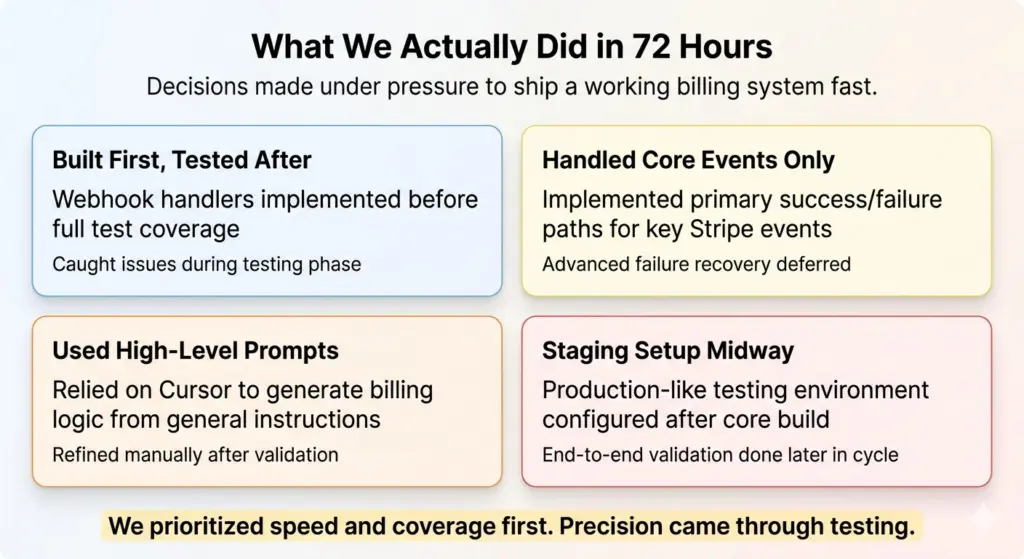
This is the part of the post that took us the longest to write, not because we couldn’t think of the answers, but because a genuine post-mortem requires honesty about decisions that felt right at the time.
1. We Wrote the Test Suite First
We wrote tests after building the webhook handlers, not before. In a 72-hour window, this felt like the pragmatic call, get the handlers working, then validate them. The problem is that “working” and “correct” are not the same thing, and we only discovered the proration bug because our test suite caught it. If we had written the proration test first, we would have caught the bug before writing the handler, not after.
2. We Spent More Time on the Webhook Failure Mode
We built webhook handling for the happy path of every event and the primary failure path (payment failed, subscription cancelled). What we did not build, and noted in the debt list was a dead-letter queue for webhook events that failed processing entirely.
Stripe retries failed webhooks up to 72 hours with exponential backoff. If your handler throws an uncaught exception, Stripe will retry. But if the retry also fails, the event is gone. For a payment integration, a dropped event can mean a user’s access is not revoked after cancellation, or a successful payment is not credited. Neither is acceptable in production.
We recommended the team implement a dead-letter queue, a separate table that captures any webhook event that fails processing three times, with an alert to the engineering channel, within the first week after launch. It should have been in the initial scope.
3. We Underspecified the Proration Prompts
When we asked Cursor to generate the proration logic, we asked it to handle “mid-cycle plan upgrades.” That prompt was too vague.
Stripe’s proration calculation has specific rules: it uses the current period start and end from the subscription object, not the calendar month. We knew this. We did not include it in the prompt.
The lesson is not that Cursor got it wrong. The lesson is that domain-specific billing logic requires domain-specific prompts. A prompt that is vague about Stripe semantics will produce code that is plausible but wrong.
The fix is straightforward: before prompting for any billing calculation, include the Stripe documentation excerpt that defines the formula. Cursor implements what you give it. Give it the right specification.
4. We Should Have Pushed for a Staging Environment Earlier
The team did not have a staging environment that mirrored production closely enough to run the full Stripe CLI test suite until hour 42 of the engagement. We spent hours 42 to 50 replaying 14 webhook events against staging. Two of those events produced bugs we had to fix on the spot.
Having a production-mirrored staging environment set up at hour zero and not hour 42 it would have let us catch those bugs ten hours earlier, when we had more time and less pressure.
If you are starting a Stripe integration today, set up staging first. Configure your Stripe test mode webhook endpoint against staging, not localhost. Run the CLI event replay before you write a line of handler code. Know that your infrastructure works before you build on top of it.
What the Demo Looked Like
The investor demo happened 20 hours after we handed off the integration.
The co-founder ran through the product, and at the billing section, she showed three things: a subscription checkout that completed in Stripe’s hosted UI, a billing portal where she updated the payment method, and a plan upgrade that produced a prorated invoice in real time.
One of the investors asked: “What happens if a payment fails?” She showed the grace period email, the retry logic in the Stripe dashboard, and the access gate that triggers after 72 hours. It was a real answer to a real question, not a promise.
We do not know if the integration was the reason for the subsequent conversations they had with those investors. We do know that it was a feature that existed instead of a feature that was promised, and that the difference was visible in the room.
The Post-Launch Debt List
Every engagement we close produces two documents: the fixes for today and the list of things that are real but not emergencies. Here is what we left for this team.
- Dead-letter queue for failed webhook events. Covered above. Priority one after launch.
- Subscription status cached in session, not just on login. We added subscription status to the session object at login. If a customer’s subscription is cancelled while they are logged in, their session will not reflect the change until they log out and back in. For most SaaS products, this is acceptable for a 24-hour session window. For anything that has real-time compliance requirements, it needs a session refresh on subscription state change.
- No invoice PDF generation. Stripe can generate PDF invoices automatically. The billing portal shows them, but the product had no ability to programmatically generate or send invoice PDFs outside the portal. Some B2B customers need this for their own accounting.
- The webhook handler has no alerting. If the webhook handler throws an uncaught exception, it fails silently. Add a Sentry integration or at minimum a Slack alert via webhook on any unhandled exception in the billing layer. Billing failures should never be silent.
- Trial-to-paid conversion tracking. We built the trial expiry logic. We did not instrument it for analytics. The co-founder cannot currently see how many trial users convert to paid without querying the database directly. Add a conversion event to Mixpanel or PostHog.
None of these would have stopped the demo. All of them will matter within 60 days.
When Three Days Is Not the Right Answer
Three days worked here because the underlying stack was solid, the existing Stripe code was salvageable, and both engineers on this engagement had shipped Stripe integrations before. We knew where the edge cases lived before we found them.
That combination does not always exist.
If your Stripe integration has been partially built and rebuilt multiple times, if the webhook handler has accumulated layers of fixes that contradict each other, or if the codebase it lives in has broader architectural debt that bleeds into the billing layer three days will not fix that. What fixes it is a structured codebase audit, followed by targeted refactoring, followed by a clean integration built on a stable foundation.
That is a longer engagement. Not weeks-longer. But longer than 72 hours.
If that sounds more like your situation than the one described in this post, the Fix It Fast service handles it either way. We scope it honestly on the first call. If it is a three-day sprint, we say so. If it is a two-week engagement, we say that too before any work starts.
The Honest Assessment of Cursor on This Engagement
Cursor accelerated this engagement by roughly 30 to 40 percent compared to doing it without AI tooling. That is a real number, not a marketing claim. It was fastest on scaffolding and slowest on anything that required billing domain knowledge. It never produced a bug that testing did not catch but it also never caught a bug on its own.
The mental model that produced the best results: treat Cursor as a very fast junior developer who writes clean TypeScript and has never worked on a billing system before. Give it explicit specifications, not vague goals. And most importantly, you need to make sure to review the developed agentic AI app, for semantic correctness, not just syntactic correctness. Use it for the scaffolding. Bring
Review everything it writes for semantic correctness, not just syntactic correctness. Use it for the scaffolding. Bring the judgment yourself.
That review process matters more than the code generation itself, especially in billing systems where small semantic mistakes create production issues later. The practice of reviewing the AI-generated code can help you with the validation patterns.
That combination of AI tooling plus engineers who know where the sharp edges are what produced a working integration in 72 hours. Neither alone would have.
Closing Note
Shipping a Stripe integration in 72 hours is possible, but only when the fundamentals are solid and the team knows where the risks are.
AI tools like Cursor can speed up execution, especially for repetitive and structural work. They do not replace judgment. The parts that matter most, billing logic, webhook reliability, and edge cases, still depend on clear thinking and thorough testing.
The real goal is not speed. It is correctness under real conditions. Payments should work, failures should be handled, and access should always reflect the true subscription state.
If your integration is partially built or behaving inconsistently, it is rarely a rebuild problem. It is a matter of fixing the right pieces and validating them properly.
Do that well, and billing becomes what it should be. Invisible when it works, and reliable when it matters.
If you built a Stripe integration and it is partially working, checkout completes, but webhooks aren’t updating your database, or proration is calculating incorrectly, or the billing portal link is broken — that is a scoped, solvable problem.
Book a Free Session → or email us directly.

Keyur Patel
Co-Founder
Keyur Patel is the director at IT Path Solutions, where he helps businesses develop scalable applications. With his extensive experience and visionary approach, he leads the team to create futuristic solutions. Keyur Patel has exceptional leadership skills and technical expertise in Node.js, .Net, React.js, AI/ML, and PHP frameworks. His dedication to driving digital transformation makes him an invaluable asset to the company.
Related Blog Posts

AI Helped You Create An App — So Why Is Your Team Slowing Down Now?