
How Much Does It Cost To Hire A Shopify Developer?

Keyur Patel
September 17, 2026
13 min
Last Modified:
September 17, 2026
If you’re planning to hire a Shopify developer, the honest answer is: it depends, but not in a way that leaves you guessing. Hourly rates for Shopify developers span roughly $15 to $200 or more, and full projects can run anywhere from $500 for a small theme tweak to well over $100,000 for a custom enterprise build. That gap exists because “hire a Shopify developer” covers wildly different jobs, from swapping out a product gallery to rebuilding a checkout flow with custom logic.
What actually decides where your project lands on that scale comes down to a short list of factors: the developer’s experience level, where they’re based, how you choose to hire them, and how much custom work your store genuinely needs. This guide walks through each of those, with current rate ranges, so you can hire a Shopify developer with a realistic budget instead of a guess.
Shopify Developer Hourly Rates by Experience Level
Most Shopify hiring decisions come down to matching the developer’s skill level to the actual difficulty of the work, and that’s where hourly rates start to make sense.
| Experience Level | Typical Hourly Rate (USD) | What They Typically Handle |
|---|---|---|
| Junior (0–2 years) | $15 – $40 | Store setup, product uploads, basic theme edits, app installation and configuration |
| Mid-level (2–5 years) | $35 – $80 | Theme customization, custom sections, standard app integrations, checkout adjustments |
| Senior (5+ years) | $70 – $150 | Custom app development, complex integrations, performance and conversion work |
| Shopify Plus / specialist | $120 – $250+ | Headless storefronts, Shopify Functions, enterprise B2B setups, large-scale migrations |
A junior developer can competently handle a store that just needs a live product catalog and a clean design. The moment your project needs custom logic, a subscription model, a loyalty program tied to a CRM, or a checkout rule Shopify doesn’t support out of the box, you need someone who can write and test code against Shopify’s APIs, not just configure existing settings. That jump in required skill is most of the reason rates climb from junior to senior.
Rates on open freelance marketplaces tend to sit at the lower end of each band, while vetted talent networks and development companies price toward the higher end for the same experience level, since they add screening, project management, and accountability on top of the coding work itself.
How Location Affects Shopify Developer Rates
Location is the second biggest swing factor after experience, and the gaps are large enough to matter for any real budget.
| Region | Junior | Mid-Level | Senior |
|---|---|---|---|
| India / South Asia | $10 – $25 | $25 – $50 | $45 – $90 |
| Eastern Europe | $20 – $40 | $40 – $70 | $70 – $120 |
| Latin America | $20 – $35 | $35 – $60 | $55 – $100 |
| UK / Western Europe | $40 – $70 | $70 – $110 | $100 – $180 |
| US / Canada | $50 – $90 | $90 – $140 | $130 – $220 |
| Australia / New Zealand | $45 – $80 | $75 – $120 | $110 – $180 |
These differences come from cost of living, local demand for developers, agency overhead, and how much time-zone overlap a client needs, not from any difference in the quality of work a developer can produce. A senior developer in India and a senior developer in Canada are being paid for the same level of skill against very different local costs of doing business. Location tells you about the market a developer works in, not how good they are at their job.
If your project needs a specific kind of specialization, such as a Shopify Plus migration or a headless build, it’s often worth hiring Shopify experts who work in that niche specifically, rather than a generalist, regardless of which region they’re based in.
Which Hiring Model Should You Choose?
The hiring model you pick changes both the hourly math above and how the work actually gets managed.
| Model | Typical Cost Structure | Best For | Watch Out For |
|---|---|---|---|
| Freelancer | Hourly, roughly $15–$150+/hr, no long-term commitment | Small, well-defined tasks and one-off fixes | Availability gaps, inconsistent quality control, no backup if they become unavailable mid-project |
| Dedicated developer / team | Fixed monthly retainer or hourly block through a development company | Ongoing development, medium-to-large projects needing consistent output | Higher entry cost than a single freelancer, needs clear scope to stay efficient |
| Shopify development agency | Project-based fee or hourly, often $5,000–$50,000+ per engagement | Full builds, migrations, projects needing design, development, and QA together | Costs more per hour than an individual contractor, some communication overhead |
| Full-time in-house hire | Annual salary plus benefits, varies heavily by region | Businesses with continuous, long-term Shopify development needs | Slow to hire, expensive for short-term or seasonal work, idle time between projects |
None of these is universally right. A freelancer is often the more efficient choice for a contained task with a clear end point. A full-time hire only pays off once Shopify work is a steady, ongoing part of the business rather than an occasional need. For businesses that want consistent development capacity without building an internal team from scratch, hiring a dedicated developer through a development company often lands in the middle, offering agency-level accountability with a more predictable monthly cost than piecing together several freelancers.
What Does Shopify Development Cost by Project Type?
Hourly rates only tell part of the story. What most business owners actually want to know is what a given project costs from start to finish.
| Project Type | Typical Cost | What Pushes It Higher |
|---|---|---|
| Basic store setup (existing theme, no custom code) | $500 – $2,500 | More products and collections to configure, multiple markets or currencies |
| Theme customization (custom sections, branded styling) | $1,000 – $8,000 | Custom product-page layouts, animation, mobile-specific redesign |
| Custom theme built from scratch | $5,000 – $25,000+ | Complex navigation, multi-brand templates, heavy use of Shopify Functions |
| Third-party integration (CRM, ERP, marketing tools) | $1,000 – $15,000 per integration | Bidirectional sync, custom field mapping, older systems without modern APIs |
| Custom Shopify app | $5,000 – $40,000+ | Number of features, App Store distribution requirements, ongoing support needs |
| Platform migration to Shopify | $2,000 – $20,000 for small and mid-sized stores, $20,000 – $100,000+ for large catalogs | SKU volume, historical order data, SEO redirect mapping, custom checkout logic |
| Ongoing maintenance | $300 – $5,000/month | Update frequency, monitoring, feature requests bundled into the retainer |
If you’re starting from zero rather than upgrading an existing store, our guide to building a Shopify ecommerce store walks through what that build process typically involves before you get into the cost conversation.
Businesses building something closer to a multi-vendor marketplace on Shopify, rather than a single-brand storefront, tend to sit toward the top of the app and integration ranges above, since that kind of build usually needs custom vendor management, split payments, and commission logic that Shopify doesn’t offer natively. If that’s closer to your project, see our breakdown of building an ecommerce marketplace on Shopify.
What Type of Shopify Developer Do You Actually Need?
Before requesting quotes, it helps to know which kind of developer your project actually calls for, since that decision affects both the rate you should expect and who you should be interviewing.
- Front-end / theme developers work in Liquid, HTML, CSS, and JavaScript, focused on how the store looks and behaves. The right fit for redesigns, branded styling, and mobile responsiveness.
- Back-end / integration developers work with Shopify’s Admin and Storefront APIs, webhooks, and third-party systems. The right fit for CRM or ERP integration, custom order logic, and app development.
- Full-stack developers cover both. Useful when you want a single point of contact on a mid-sized project that touches design and backend logic together.
A theme customization project doesn’t call for the same skill set, or the same budget, as a project connecting your store to a warehouse management system. Paying senior rates for front-end-only work, or hiring a front-end specialist for a complex integration, are both common ways projects go over budget or fall short of what was promised.
What Drives Shopify Developer Cost Up or Down
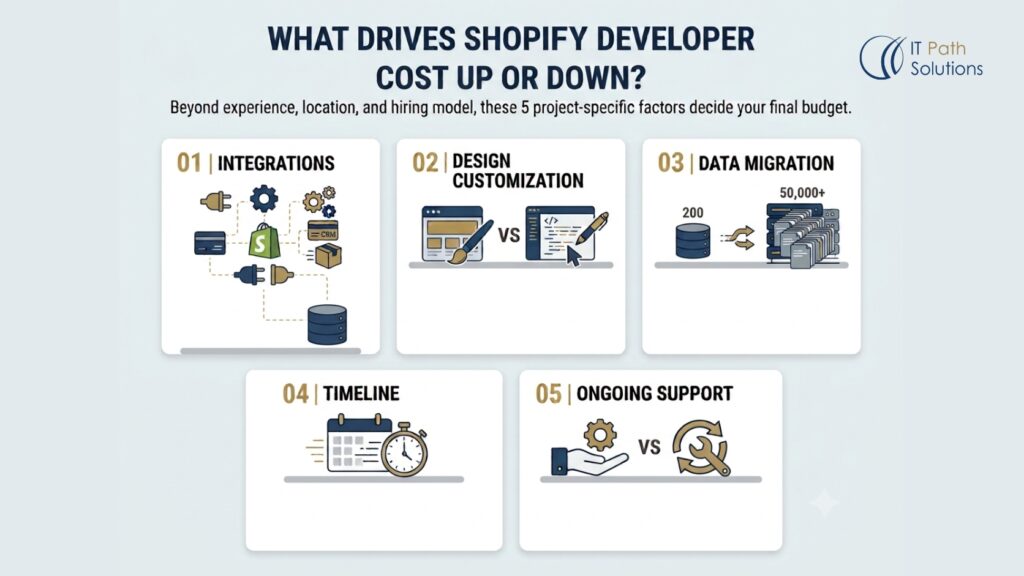
Beyond experience, location, and hiring model, a handful of project-specific factors decide exactly where you land within any given range.
- Number and complexity of integration – Each additional system you connect, a payment gateway, a CRM, a fulfillment platform, adds development and testing time on top of the base build.
- Design customization depth – A store using standard theme sections costs less than one with fully custom layouts, animations, and bespoke product-page design.
- Data migration volume – Moving 200 products is a different job than moving 50,000 products with years of order history attached.
- Timeline – A compressed deadline usually means paying a premium for a developer to prioritize your project ahead of others on their schedule.
- Ongoing support expectations – A one-time build is priced differently than a build that comes bundled with a maintenance retainer.
These factors compound rather than stack neatly. A senior developer working against a tight deadline with three integrations and a fully custom theme lands near the top of every range in this article. A mid-level developer handling a single integration and a theme refresh on a normal timeline lands closer to the middle.
How to Estimate Your Own Shopify Development Budget
A workable starting point is simple: estimated cost equals estimated hours multiplied by the hourly rate for your chosen experience level and location.
To get a realistic hour estimate, break your project into pieces (theme work, each integration, custom features) and ask a developer or agency for a rough hour range on each piece, rather than accepting a single blended number for the whole project.
Once you have that base figure, build in room for the costs that often sit outside the headline quote:
- Project management, if you’re working with a team rather than a single freelancer
- QA and testing, especially for integrations and checkout changes
- Design work, if the project needs more than styling an existing theme
- Revisions, since first drafts of custom features rarely ship unchanged
- A contingency of roughly 10–20%, for scope that surfaces once development actually starts
Two $10,000 quotes aren’t the same thing if one already includes QA and revisions and the other doesn’t. Ask what’s included before comparing numbers side by side.
How to Reduce Shopify Development Costs Without Cutting Corners
- Define scope before requesting quotes. A written list of what the store needs to do, not just look like, prevents the mid-project scope creep that drives most cost overruns.
- Use Shopify’s built-in features first. Plenty of stores pay for custom development to solve problems that Shopify’s native settings, or a well-reviewed app, already handle.
- Match the developer level to the task. Hiring a senior developer for basic theme edits, or a junior developer for a complex integration, both waste money in different directions.
- Limit custom functionality to what the business needs at launch. Features can be added later, once the store is generating revenue and you know what customers actually use.
- Bundle related work into a single engagement rather than hiring separately for each small task. Most developers price a bundle of related work more efficiently than a string of one-off requests.
- Prepare requirements, brand assets, and product data before hiring. Time a developer spends waiting on you is still billable time in most hourly and retainer arrangements.
- Avoid choosing purely on the lowest hourly rate. A developer at $20 an hour who needs 40 hours to finish what a $60-an-hour developer finishes in 10 costs more overall, and the cheaper option often needs rework later.
How to Hire the Right Shopify Developer
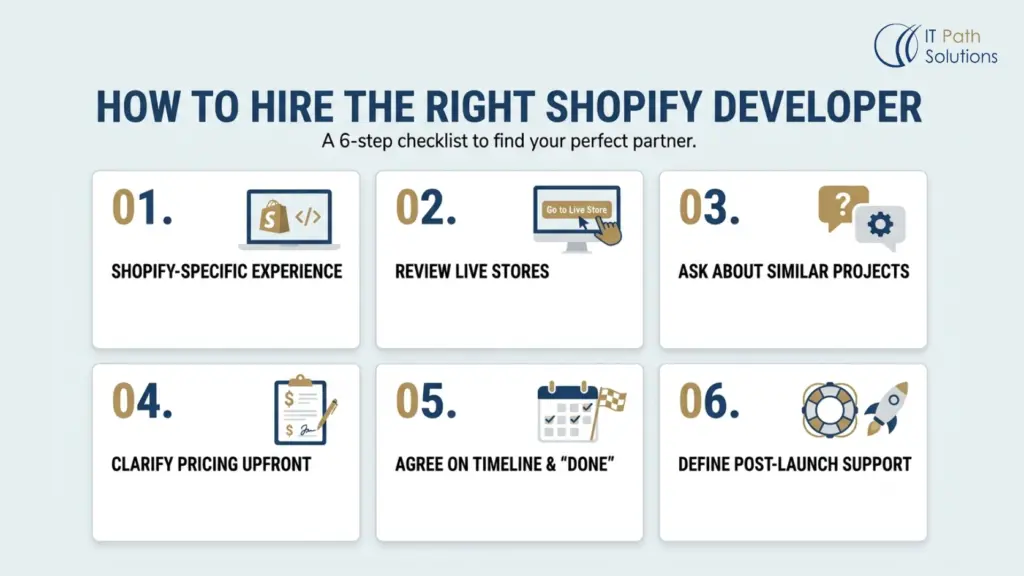
Once you know roughly what your project should cost, the hiring process itself comes down to a few checks:
- Confirm Shopify-specific experience, not just general web development. Liquid, Shopify’s theme architecture, and its API limits are specific enough that general experience doesn’t always transfer cleanly.
- Review live stores from their portfolio, not just screenshots. A working store tells you more about real-world performance than a case study page does.
- Ask about a project similar in scope to yours, and how they handled the parts that didn’t go as planned. Every project has some of those.
- Clarify the pricing model upfront, hourly, fixed project fee, or retainer, and get it in writing before work starts.
- Agree on a realistic timeline and what “done” looks like for each milestone.
- Clarify what happens after launch. Confirm whether bug support is included, and for how long, before it becomes a separate maintenance cost.
For a fuller walkthrough of vetting candidates and structuring the hiring process itself, our guide on how to hire a Shopify expert goes deeper into each of these steps.
When Does It Make Sense to Work With a Shopify Development Company?
An individual freelancer is often the right call for a small, contained task. A development company tends to become the more efficient choice once a project involves several integrations, custom app development, a need for design and development working from the same team, or a business that expects ongoing Shopify work rather than a single project.
IT Path Solutions works with businesses in that second category, building custom Shopify functionality, integrating third-party systems, and providing dedicated development capacity for stores that need more than a single freelancer can reliably deliver.
If your project involves custom development, multiple integrations, or long-term support rather than a one-off fix, get in touch with IT Path Solutions for a scope-based estimate rather than a blended hourly guess.
Conclusion
There’s no single price tag for hiring a Shopify developer, and that’s not a dodge, it’s the actual shape of the market. Experience level, location, hiring model, and project scope each move the number independently, which is why the same job can cost $2,000 from one developer and $20,000 from another, and both prices can be fair for what’s actually being delivered.
The lowest hourly rate rarely produces the lowest total cost once rework, missed deadlines, and unclear scope get factored in. The more useful question isn’t “what does a Shopify developer cost per hour,” it’s “what does my specific project actually need, and what should that realistically cost.” A scope-based estimate answers that far better than any rate chart, including this one.
Frequently Asked Questions
How much does a Shopify developer charge per hour?
Rates typically range from $15 to $40 for junior work up to $150 or more for senior and specialist work, with location and hiring model shifting those numbers further in either direction.
How much does it cost to hire a Shopify developer for a full project?
Most projects land between $500 for small tasks and $25,000 for a fully custom build, with migrations and enterprise-scale projects running well beyond that depending on catalog size and complexity.
Is it cheaper to hire a freelance Shopify developer than an agency?
Usually yes on an hourly basis, though agencies bundle project management, QA, and design work that a freelancer often bills separately or skips entirely, so the gap in total project cost is frequently smaller than the hourly rate gap suggests.
How much does a Shopify developer cost in India compared to the US?
Indian Shopify developers commonly charge $10 to $65 per hour depending on experience, versus roughly $50 to $200 or more per hour in the US. The difference reflects cost of living and local market conditions, not a difference in skill.
What’s the real difference between hiring a freelancer and a development company?
A freelancer is usually the more cost-efficient choice for a single, well-defined task. A development company adds accountability, backup coverage, and a broader range of skills for projects with multiple moving parts or ongoing needs.
How much should I budget for custom Shopify development?
For a typical mid-sized custom project, such as a custom theme paired with a couple of integrations, a realistic budget sits between $8,000 and $30,000. The exact number should always come from a scope-based estimate rather than a rate multiplied by a guess at hours.

Keyur Patel
Co-Founder
Keyur Patel is the director at IT Path Solutions, where he helps businesses develop scalable applications. With his extensive experience and visionary approach, he leads the team to create futuristic solutions. Keyur Patel has exceptional leadership skills and technical expertise in Node.js, .Net, React.js, AI/ML, and PHP frameworks. His dedication to driving digital transformation makes him an invaluable asset to the company.
Related Blog Posts

Top Shopify Developer Skills in 2026: What’s Changed With AI & Automation

B2B eCommerce Development Strategies To Drive Sales Growth In 2025