Home
»Blog Insights
»AI-Powered Fraud Detection and Personalization in FinTech: How to Build Smarter, Safer Digital Banking Platforms
AI-Powered Fraud Detection and Personalization in FinTech: How to Build Smarter, Safer Digital Banking Platforms
Keyur Patel
October 23, 2026
14 min
Last Modified:
October 27, 2026
A customer buys a new phone. That evening, she opens her banking app and pays a supplier she has never paid before.
To her, it is an ordinary transaction. To the bank, several things have changed at once: the device, the recipient and perhaps the size of the payment.
A few seconds later, she is either looking at a confirmation screen or wondering why her own bank will not let her use her money.
That moment captures a difficult problem in digital banking. The bank needs to recognize danger without treating every change in a customer’s life as suspicious. It also wants to understand that customer well enough to offer something useful, whether that is a warning about upcoming bills or a clearer picture of monthly spending.
Two Different Jobs, Some of the Same Foundations
For the customer with the new phone, the immediate question is whether the payment should proceed. Later, the app might notice that the payment leaves little room for bills due next week. That second observation could be helpful, but it serves a different purpose.
Fraud detection assesses risk. Personalization makes an experience more relevant. They may draw on some of the same transaction records, but they should not automatically receive the same information or permissions.
A bank can build a dependable foundation for both: consistent customer identifiers, accurate transaction records and a clear account of when events occurred. Separate models and policies can then use the information approved for each task.
Shared infrastructure can still have separate datasets, access controls and retention periods. Fraud investigators may need details that marketing has no reason to see.
In May 2026, the Monetary Authority of Singapore announced a trial bringing together data from five banks to test whether AI could identify higher-risk transactions and accounts earlier. It is an evaluation, rather than proof of a particular reduction in fraud. For teams considering AI development services, it offers a concrete example of why the data available to a model matters.
Why a New Phone Should Not Automatically Mean Fraud
A rule can flag the customer’s unfamiliar device. Another can flag the new supplier. Neither fact tells the whole story.
Rules remain valuable. They can enforce transaction limits, identify known attack patterns and give teams a transparent starting point. A bank with limited confirmed fraud examples may get more value from well-maintained rules than from rushing to train its own model.
Machine learning adds another way to examine the evidence. A supervised model learns from past activity labeled as confirmed fraud or legitimate behavior. It can weigh combinations of signals that would be cumbersome to express as individual rules. But those labels need care: a payment blocked by the bank is not automatically a fraudulent payment.
Unsupervised methods look for unfamiliar patterns without requiring every example to be labeled. Unusual activity still needs investigation: customers travel and make exceptional purchases.
Relationships matter, too. A transfer may look ordinary until investigators discover that several unrelated accounts are sending money to the same suspicious destination. Graph-based methods examine those connections. BIS research on financial infrastructure discusses network patterns alongside customer and transaction information.
There is a trap when judging the results. Because most transactions are legitimate, a system that approves almost everything can appear highly accurate while missing the fraud it was built to detect. Teams need to examine confirmed detection alongside false alarms and customer disruption.
For many platforms, rules and models work together. The model contributes evidence; the bank’s approved policy determines what happens next.
What Happens Between Pressing Pay and Seeing a Confirmation
The customer presses Pay. There is a narrow opportunity to assess the request before the money moves. An overnight report may help an investigation, but it cannot intervene in that moment.
Content/SEO team note: Replace this placeholder flowchart with an internally designed image before publishing. Preserve the decision sequence and feedback loop shown below.
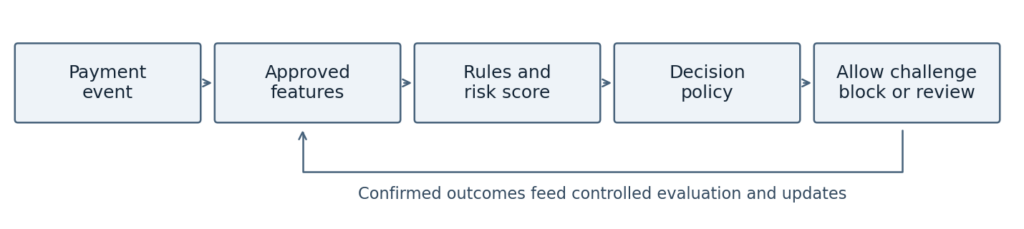
Behind the screen, the platform needs to complete a short sequence reliably.
First, it records the payment request, including its identifier, time and relevant context. If the customer taps twice or the app retries after a connection problem, the system must recognize the repeated request without accidentally creating another payment.
Next, it gathers the information needed for the decision. Has this customer paid the recipient before? How many payments have happened recently? Is the device familiar? These derived facts are often called features. Their age matters: yesterday’s account activity may be inadequate for a decision about what is happening now.
Rules and a model or specialist provider then assess the risk. A separate decision service translates that evidence into an action: allow the payment, ask for verification, block it or send it for review.
That service also needs an answer for less convenient circumstances. What happens if the scoring provider is unavailable? Which requests can wait? Who approves the fallback? Those decisions should be settled before an outage forces the issue.
Finally, the platform records what it decided and what actually happened. A favorable score does not prove that the payment completed. Later, confirmed outcomes can help improve detection, provided unresolved cases are not quietly treated as reliable training examples.
Historical processing supports training and analysis. Keep its feature definitions consistent with live decisions, and exclude information unavailable at the time being tested.
In online banking app development, the whole journey needs a response-time budget. A fast model is little comfort if another dependency makes the customer wait. Measure performance under load, including the slowest responses customers are likely to encounter.
Reviewing your decision architecture? Work through how risk scores, payment decisions and customer verification will fit into your existing banking app. IT Path Solutions can help scope the data flow, integrations and application changes needed.
The Risk Changes as the Customer Moves Through the App
The payment is only one place where fraud can occur.
At account opening, an applicant may use stolen information or a synthetic identity assembled from real and invented details. During login or recovery, an attacker may exploit stolen credentials or a weak reset process. Fast credit and BNPL journeys introduce opportunities for coordinated applications and identity abuse before repayment history exists.
Even a correctly authenticated payment can be harmful. A scammer may have persuaded the real customer to send the money. The bank has verified who is pressing Pay, but that alone does not establish whether the customer understands the situation.
A stronger login will not resolve every payment scam. Controls need to cover the whole customer journey.
Fraud prevention and anti-money-laundering monitoring remain different responsibilities. Neither should become an unrestricted source of personalization data.
Once the Payment Is Safe, What Would Actually Help the Customer?
Suppose the payment is genuine and goes through. The app now shows an offer for another financial product.
Is that useful at this moment? Perhaps. But a reminder that several bills are due before payday may be much more relevant.
This is where personalization can earn its place. A spending summary can make recurring subscriptions easier to spot. A forecast can highlight a possible shortfall. A planning tool can help someone explore a savings goal and change the assumptions themselves.
The experience depends on mundane but essential work: reliable balances, sensible transaction categories, clear preferences and calculations that account for what is still pending. A polished explanation cannot compensate for incorrect numbers.
An AI assistant can make those insights easier to understand. Financial calculations should come from trusted services; the assistant can explain them and acknowledge uncertainty. When the data is incomplete, the wording should say so.
Offers still need eligibility and suitability checks. Financial difficulty should not automatically trigger sales messages.
Assistants that take actions need tighter boundaries. Drafting a transfer is different from executing one. Tool permissions, customer confirmation and applicable risk checks still matter. Text retrieved from a message or document must not be allowed to override those controls.
Let customers understand why an insight appeared and control optional features.
When Protection Starts to Feel Like an Obstacle
Return to the new-phone payment. Asking for additional verification may be reasonable. Repeatedly blocking the customer without a workable recovery route is a different experience.
False alarms have consequences beyond a fraud dashboard. A customer may abandon a purchase, contact support or stop trusting the app for important payments. The cost can spread across product, operations and customer service.
Match the response to the evidence, with clear instructions and a workable recovery route.
Personalization can damage trust in a quieter way. A budgeting feature does not give the bank unlimited permission to reuse security information. The ICO’s purpose-limitation guidance explains why the original purpose of collecting personal information matters. Privacy and compliance teams should assess proposed reuse against the requirements that apply to the institution.
Start With One Journey Your Team Can Own
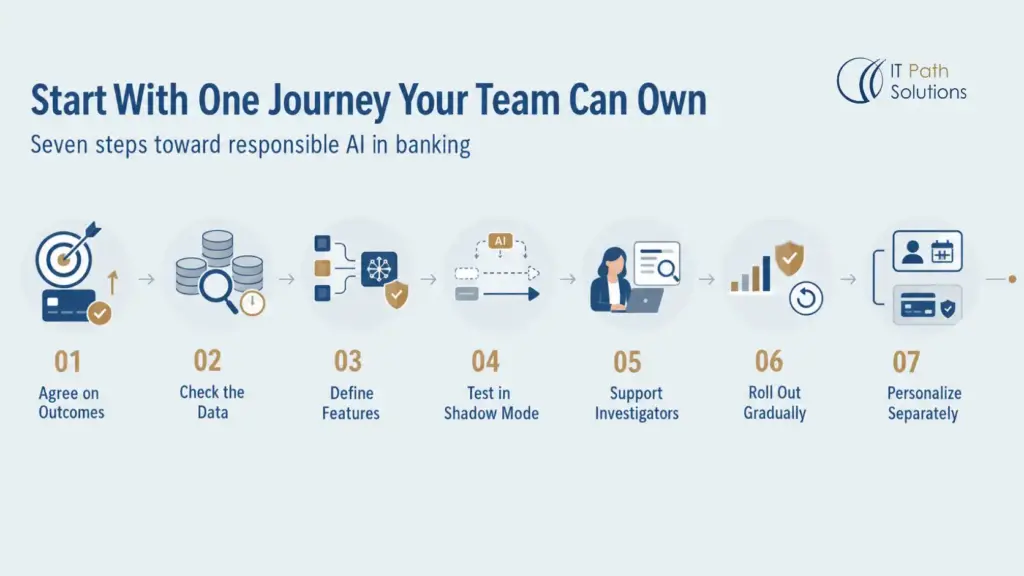
A proposal to transform fraud detection and personalization across the entire bank is difficult to evaluate. A proposal to improve payments to new recipients is easier to test.
Step 1: Agree on the outcomes
Agree what success means: which losses the team wants to reduce, how much additional verification customers can reasonably face and how many cases investigators can handle. Give personalization its own objective, such as helping customers anticipate upcoming bills.
Step 2: Check the available data
Examine the available data. Customer identifiers may not match across systems. Event times may be inconsistent. Confirmed fraud outcomes may arrive weeks later. Resolving these gaps often determines what the first release can realistically achieve.
Step 3: Define the features and permissions
Define features consistently for historical testing and live decisions. Check freshness, permissions and whether separate stores are needed.
Step 4: Test without changing customer outcomes
Before changing customer outcomes, run proposed scoring in shadow mode: record what it would have recommended while the existing controls remain in charge. Test missing data, duplicate requests and unavailable services alongside ordinary transactions.
Step 5: Equip investigators to review cases
Investigators need a usable case history, understandable reasons and a way to record what they found. Their feedback is part of the system, not an administrative task to add after launch.
Step 6: Roll out gradually and monitor results
Roll out gradually, keep a rollback route and monitor whether inputs and results change over time. A newly trained model should earn its place through evaluation and approval. It should not automatically replace the live version because training finished successfully.
Step 7: Add personalization within its boundaries
Add personalization within its own permissions and experiments. A recommendation outage should not hold up a payment, and an offer experiment should not alter fraud policy.
Have a first use case in mind? Bring the customer journey and current systems to IT Path Solutions to discuss a manageable scope and how to validate it. Discuss Your FinTech AI Roadmap.
What Your Team Needs to Explain After Launch
A customer disputes a blocked payment. Support asks why it happened. The answer cannot stop at “the model flagged it.”
Keep enough context to reconstruct the decision, including the model and policy versions. Explanations should help a reviewer understand the evidence, while recognizing that an explanation does not prove the prediction was right. The Bank of England’s AI survey discusses explainability methods used by financial firms.
This responsibility is receiving fresh regulatory attention. On 7 October 2026, Singapore’s financial regulator issued AI risk-management guidelines. They take effect from October 2027, with phased implementation through October 2028. They apply in Singapore, but the planning question travels well: who will oversee the AI once it starts influencing real customer outcomes?
Assign responsibility for model approval, overrides and incidents. Include provider outages and vendor version changes in ongoing review.
For fraud, track confirmed losses, detection coverage, false positives, verification completion, review backlogs and decision times. Define the reporting window and what each rate is measured against.
For personalization, examine whether insights help customers, alongside dismissals, complaints and permission handling. Controlled experiments can help establish whether a feature made a difference. Clicks alone are a limited measure of value.
Read these results together. Reducing fraud by rejecting most payments would leave the bank with a serious customer problem. Increasing offer clicks would not justify using data outside its permitted purpose.
Build, Buy or Partner: How To Decide
A specialist fraud product can be a sensible first purchase for a team that needs established scoring, device signals or investigation tools. Check the integration effort, data handling and access to decision records before committing.
Building internally becomes more credible when the institution has distinctive requirements, reliable data and people who can operate the capability after launch. That responsibility includes monitoring, investigator tools and incident response, as well as model development.
Many teams will combine approaches: buy specialist detection, retain control of decision policy and build the application experience around it. Consider custom software development where existing products leave a meaningful workflow or integration gap.
IT Path Solutions offers development services, so it has a commercial interest in this choice. Compare a proposed custom build with existing products before deciding where engineering work is justified.
Bringing the Work Back to the Customer
The customer with the new phone does not need to know which model assessed her payment. She needs the bank to recognize a legitimate request, intervene when something is wrong and help her recover when it makes a mistake.
IT Path Solutions is a global web, mobile and AI application development company with 13+ years of experience. Its fintech and banking software development offering includes financial applications, onboarding and integrations.
If you are planning a fraud or personalization project, start with the journey you want to improve. Talk to IT Path Solutions about the systems involved, the development needed and how to validate the result before a wider rollout.
Frequently Asked Questions
What is AI-powered fraud detection?
It uses machine learning to look for risk in transactions, logins and account activity. A model might spot a combination of signals that individual rules miss. The platform then combines that evidence with approved policies to allow an action, request verification, block it or send it for review. Human investigation and operational controls remain necessary.
How does real-time fraud detection work?
The platform assesses an event while there is still time to influence the outcome. For a payment, it gathers relevant information, requests a risk assessment and applies a decision before completion. The available time depends on the journey and its dependencies. Investigations, training and historical analysis can happen separately.
Is machine learning better than rules-based fraud detection?
Sometimes, but adding a model does not guarantee improvement. Rules work well for explicit limits and known conditions. Machine learning can identify more complex patterns when the data and evaluation are sound. Many platforms use both. Compare confirmed detection, false alarms and customer disruption with the existing process before deciding.
How is AI personalization used in digital banking?
It can help tailor spending summaries, bill forecasts, savings tools, offers and assistant responses. A useful feature should explain its assumptions and give customers control over optional experiences. Accurate calculations and permitted data use matter more than how fluent the assistant sounds. Product eligibility still needs its own checks.
Can fraud detection and personalization use the same customer data?
Some information and infrastructure can be shared where its use is approved. That does not make fraud-investigation records or device telemetry available for marketing by default. Document which inputs each function needs, restrict access and involve privacy and compliance teams. Some institutions will need separate datasets or feature stores.
What does IT Path Solutions build for FinTech companies?
Its published services include custom financial software, mobile applications, digital banking, onboarding and integrations. A fraud-detection or personalization project needs a specific assessment of the data, existing systems and intended decisions. Agree the development scope, acceptance criteria and support responsibilities before work begins.

Keyur Patel
Co-Founder
Keyur Patel is the director at IT Path Solutions, where he helps businesses develop scalable applications. With his extensive experience and visionary approach, he leads the team to create futuristic solutions. Keyur Patel has exceptional leadership skills and technical expertise in Node.js, .Net, React.js, AI/ML, and PHP frameworks. His dedication to driving digital transformation makes him an invaluable asset to the company.
Related Blog Posts

How to Build AI-Powered Visualization Software for Real Estate and Interior Design

AI-Powered Personalized Learning: How It Works and What EdTech Platforms Need