
AI-Powered Personalized Learning: How It Works and What EdTech Platforms Need
Keyur Patel
October 21, 2026
12 min
Last Modified:
October 21, 2026
Two learners start the same algebra course. One needs fractions practice before equations make sense. The other already mastered the prerequisites and is ready to progress. A large content library does not solve this problem. It gives learners options, not direction.
Learners arrive with different knowledge, goals, and support needs. In a small program, instructors personalize effectively through direct attention. As learner numbers grow, that attention becomes harder to sustain.
This article explains AI-powered personalized learning in practical terms. It covers the process, the platform capabilities behind it, and the decisions involved in building it.
What Is AI-Powered Personalized Learning?
AI-powered personalized learning uses learner data to adjust content, practice, feedback, and learning paths around individual needs. The platform updates its picture of each learner as evidence accumulates. It can also help instructors identify where support is needed. Effectiveness still depends on suitable content, reliable assessments, and well-designed learning workflows.
Personalization can shape goals, content, practice, pacing, feedback, and support. Pacing adjustments might unlock the next module for one learner and a practice set for another. Adaptive learning covers one part of that picture. Adaptive learning platforms adjust activities automatically based on evidence about a learner. Those adjustments can draw on a long-running learner profile, not only the latest quiz result.
Terminology overlaps across research and products. Treat the distinction above as a working explanation, not a universal classification. Personalization also includes instructor decisions and straightforward rules. Not every adjustment requires AI. A chat interface alone does not personalize learning. The substance lives in the data, decisions, and workflows behind the interface.
One caution deserves emphasis. Personalization should respond to evidence about knowledge and progress, not to a learner’s supposed style. A review in Psychological Science in the Public Interest examined the claim directly. It found no adequate evidence base for learning-styles instruction.
| Aspect | Adaptive learning | Broader personalized learning |
|---|---|---|
| Typical emphasis | Adjusting learning activities based on learner evidence | Shaping the experience around individual needs, goals, and context |
| Example | Assigning additional practice after repeated errors | Combining goals, diagnostic results, and instructor input to recommend a path |
| Relationship | Can support personalization | May combine adaptive technology, learner choices, and human guidance |
How AI-Powered Personalized Learning Works
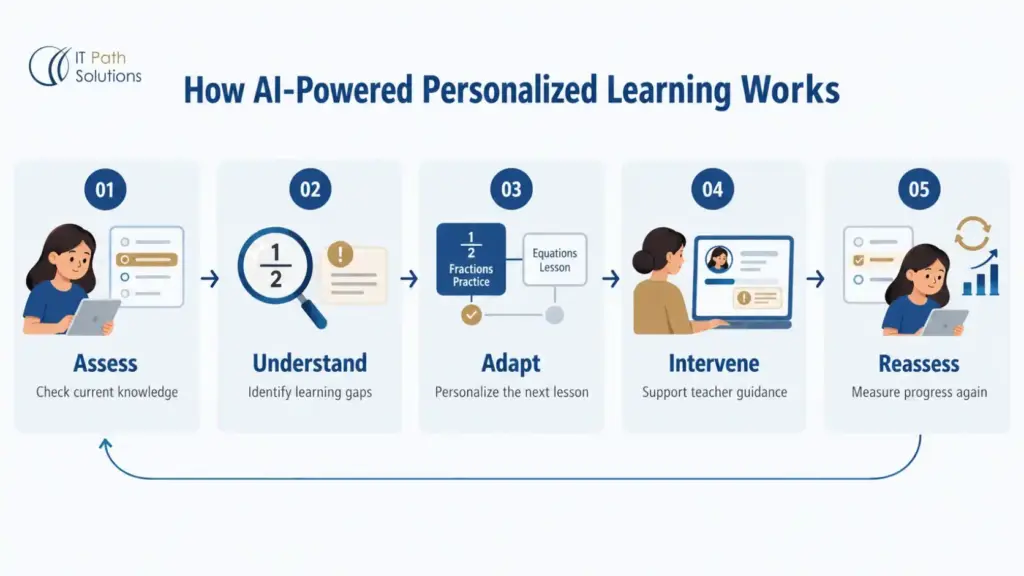
Personalized learning platforms run a continuous loop rather than a one-time setup. The steps below follow one hypothetical learner, Maya, through the cycle. She struggles with equations, and her platform needs to work out why.
- Assess: The platform gathers initial evidence through a diagnostic assessment, stated goals, or previous learning history. Maya takes a short diagnostic before her equations unit.
- Understand: The platform estimates current knowledge, likely gaps, and support needs. Her responses suggest difficulty with fractions.
- Adapt: The platform recommends suitable lessons, practice, explanations, or difficulty. It offers fractions practice before the next equations lesson.
- Intervene: The platform gives instructors useful information when additional support may help. Maya’s teacher sees the flagged gap on a dashboard.
- Reassess: The platform uses subsequent performance to update its recommendations. If equation errors continue, it adjusts the path and alerts the teacher again.
Treat these outputs as estimates. Mastery and skill gaps are inferences, not directly observed facts. Time spent, repeated attempts, and inactivity can each have several explanations. Recommendations should change when new evidence contradicts the initial assessment. Alerts work best when they show the evidence, not just a learner’s name.
The loop also differs by setting. Self-paced courses lean on automated adaptation, while instructor-led courses lean on the intervene step.
Flow diagram of the personalized learning loop: assess, understand, adapt, intervene, and reassess, with new evidence updating the learner profile
Five Capabilities a Personalized Learning Platform May Need
The loop above needs supporting capabilities behind the scenes. The list below offers one practical way to organize them. It is not a proprietary framework or an industry standard.
| Capability | What it does | Practical requirement |
|---|---|---|
| Learner understanding | Maintains an evolving picture of goals, performance, and progress | A learner profile that separates observed activity from inferred knowledge |
| Skill and curriculum mapping | Connects learning objectives, assessments, and prerequisites | Input from educators or subject specialists |
| Content intelligence | Connects learning materials to relevant skills and needs | Content tagged by objective, difficulty, and other useful attributes |
| Adaptive delivery | Selects suitable activities, practice, or feedback | Recommendation logic, delivery workflows, and fallback options |
| Instructor oversight | Helps educators interpret and act on learner information | Clear dashboards, useful alerts, and appropriate override controls |
Scope depends on the product. A focused practice tool may need fewer capabilities than a platform spanning multiple courses. The capabilities also reinforce each other. Adaptive delivery depends on content intelligence, and instructor oversight depends on learner understanding.
Technology choices differ by role. Rules can handle clear progression conditions, such as unlocking a module after a passing score. AI and machine learning can support estimates and recommendations where they fit the data. Generative AI can help produce explanations or feedback, with suitable grounding and review before release.
The Learner Data and Integrations Behind Personalization
Personalization quality depends on the data behind it. Useful inputs include assessment responses, attempts, assignments, completion records, activity history, and learner goals. Decide early which events matter. Track a few meaningful signals well rather than logging every click.
Keep inferred measures separate from their underlying evidence. A mastery estimate should stay traceable to the responses that produced it.
Existing systems often hold this information in separate places. Your LMS, assessment engine, and content library may need to share records. Consistent learner identities and content identifiers connect those records correctly. Incomplete or inconsistent data limits recommendation quality.
Some LMS products also restrict access to raw event data. Confirm your API and export options before committing to an architecture. Standards such as LTI and QTI can simplify connections between education systems.
New learners present an obvious problem: the platform knows almost nothing about them. Begin with a diagnostic assessment, stated goals, or a sensible default path. Refine recommendations as evidence accumulates.
Keep safeguards in scope from the start. Collect only necessary data, define access and retention rules, and provide appropriate privacy controls. Publish a plain-language privacy notice so learners know what you collect and why.
In the United States, FERPA regulates how schools handle student education records. Regulations differ by market, so plan a legal review for your situation.
You do not need complex data infrastructure for every project. Match the pipeline to the problem you chose.
Where Personalized Learning Can Add Value
Personalization suits different problems in different settings, from schools to corporate training. The examples below are hypothetical illustrations, not documented results.
| Application | Example | Relevant setting |
|---|---|---|
| Prerequisite practice | Recommend fractions practice before returning to equations | School education or test preparation |
| Targeted feedback | Explain a recurring error and suggest another practice activity | Language learning or higher education |
| Role-based learning paths | Recommend modules based on job responsibilities and diagnostic results | Corporate learning |
| Instructor support | Surface learners showing repeated difficulty with a concept | Instructor-led courses |
| Language support | Offer reviewed explanations in a learner’s preferred language | Multilingual learning platforms |
| Support prioritization | Flag changes in participation for an instructor to investigate | Longer courses and training programs |
These capabilities support decisions. They do not guarantee improved outcomes. Automated feedback on complex or open-ended work needs suitable validation and human review where stakes are high. Participation signals should prompt investigation rather than automatically label someone as disengaged. Match the applications you choose to your learning model and instructor capacity. Pick one or two first rather than pursuing all six at once.
Why Skill Mapping Matters for Prerequisite-Based Learning
A wrong answer does not always reveal the underlying problem. A learner who misses an equation question may actually struggle with the fractions inside it. That distinction determines whether a recommendation helps.
Skill mapping connects learning activities and assessment questions to defined skills. Prerequisite relationships then show what a learner may need to revisit. Consider a simplified, illustrative chain: fractions support ratios, and ratios support introductory algebra. A real curriculum map holds far more detail.
Mastery tracking should draw on sufficient evidence, not a single correct answer. Several consistent responses reveal more than one lucky guess.
A skill graph is a map of skills and the relationships between them. Building one takes curriculum expertise and ongoing maintenance. Plan a review cycle each term so curriculum changes reach the map quickly. Its value is clearest in subjects with strong prerequisite chains, such as mathematics. Not every product needs a detailed graph.
Common Reasons Personalization Projects Underperform
When personalization underperforms, the cause is usually implementation, not the absence of a smarter model. Watch for these risks from day one.
- Starting with an AI feature instead of a learning problem: The feature may not address a meaningful learner need.
- Unclear learning objectives or mastery criteria: Recommendations lack a reliable basis for what to suggest next.
- Poorly tagged or insufficient content: The system cannot offer suitable alternatives when a learner struggles.
- Weak assessment or learner data: Inferences about knowledge become unreliable.
- No useful instructor workflow: Insights never turn into action.
- Optimizing only for engagement: More activity gets mistaken for better learning.
- No fallback when recommendations are uncertain: Learners receive unsuitable guidance with no way forward.
Educators supply context, judgment, and motivation that platform signals cannot fully capture. US Department of Education guidance reaches a similar conclusion. Its 2023 report on AI in education calls for keeping humans in the loop.
Build vs. Buy: Where Does Custom Development Make Sense?
Your existing LMS, assessment tools, AI APIs, and recommendation products may already cover several requirements. Learner profiles, dashboards, and recommendation logic can be bought, configured, or built. None of these components automatically requires a custom solution.
Custom software development earns its place where differentiation matters. That includes the learning model, workflows, integrations, and product experience. If your product competes on how it teaches, bought components rarely carry that difference.
A hybrid approach often fits, but it should follow your requirements rather than act as the default answer. Compare every option against six questions:
- Fit with your curriculum and learning model
- Integration with your existing systems
- Access to and portability of learner data
- Ability to evaluate and adjust recommendations
- Ongoing licensing, infrastructure, and maintenance costs
- Internal capacity to operate the system
Bought components bring licensing dependencies and configuration limits. Custom builds bring maintenance responsibility and longer timelines. Weigh both against the value each option adds to learners. One common pattern keeps the LMS for delivery and adds a custom recommendation layer beside it.
What Should You Build First?
Start with a narrow first phase you can evaluate. This applies whether you are enhancing an existing product or starting EdTech platform development from scratch.
- Choose one learning problem: For example, prerequisite gaps in a specific course.
- Audit available content and data: Check assessment quality, content tagging, and integration requirements.
- Define a limited learner profile: Capture only the information your chosen problem needs.
- Deliver an initial recommendation workflow: Start with clear rules where they suffice. Bring in AI development only where you can evaluate its contribution.
- Provide instructor visibility and fallback paths: Make recommendations understandable and allow appropriate intervention.
- Pilot before expanding: Evaluate the experience with a suitable learner group.
A first release does not need a platform-wide skill graph, custom model training, or automated content generation.
Expect significant work beyond software: curriculum mapping, assessment design, content preparation, and educator feedback. Timelines and costs depend on scope, existing systems, and content readiness. Treat any universal estimate with caution.
Personalization also adds cloud infrastructure and DevOps demands as the pilot expands. Plan for data pipelines, monitoring, and scaling.
How to Measure Whether Personalization Works
Usage metrics show that learners are active. Learning outcomes show whether the product actually works. Track both, but judge success on outcomes.
Useful measures include:
- Improvement on assessments aligned with learning objectives
- Retention of knowledge when assessed later
- Ability to complete relevant tasks independently
- Time or attempts required to reach a defined level of competence
- Instructor workload and the usefulness of alerts
- Whether benefits and errors differ across learner groups
Many learning analytics dashboards emphasize completion, session time, and repeat visits. Those numbers provide context, but they do not independently prove learning improvement.
Agree on evaluation criteria before the pilot starts. Compare results against a suitable baseline. Prior cohorts or a comparable learner group can serve as that baseline. Resist attributing every gain to AI when teaching, content, or assessments also changed. A disciplined comparison protects your roadmap decisions.
Planning to add personalized learning to an existing product or build a new AI-powered EdTech platform?
IT Path Solutions can help you assess requirements and plan the work. That covers development, integrations, and the infrastructure needed to support your learning model.
Discuss Your EdTech ProjectFrequently Asked Questions
1. Can personalized learning work without large amounts of learner data?
Yes, if you design the starting point deliberately. Diagnostic assessments, stated goals, curriculum rules, and default paths all provide a working basis. Recommendations become more informed as evidence accumulates. Limited data does not support highly reliable predictions, so set expectations accordingly.
2. Does AI-powered personalized learning require an LLM?
No. Rules, recommendation models, and other approaches can support personalization effectively. An LLM may assist with explanations or feedback, but it is a component choice, not a prerequisite. Ground any generated feedback in your content and review it before release.
3. Can personalized learning be added to an existing LMS?
Often, yes. LMS integration depends on available connectors, access to learner and content data, and platform flexibility. Some capabilities may already exist through configuration or integrations. Where they do not, education software and LMS development work can extend the platform.
4. How much does it cost to develop a personalized learning platform?
AI learning platform development costs vary too widely for a reliable universal range. Main drivers include product maturity, data readiness, curriculum mapping, assessment complexity, integrations, AI usage, and ongoing maintenance. No one can price personalized learning software accurately without a defined scope. Start with a pilot scope, then request an estimate grounded in that work.
5. How long does it take to introduce personalized learning?
A limited pilot and a platform-wide rollout have different requirements. Scope, content readiness, integrations, and evaluation needs determine the schedule. Anchor your plan to the learning problem you chose, not to a fixed industry timeline.

Keyur Patel
Co-Founder
Keyur Patel is the director at IT Path Solutions, where he helps businesses develop scalable applications. With his extensive experience and visionary approach, he leads the team to create futuristic solutions. Keyur Patel has exceptional leadership skills and technical expertise in Node.js, .Net, React.js, AI/ML, and PHP frameworks. His dedication to driving digital transformation makes him an invaluable asset to the company.
Related Blog Posts

Automated Lead Qualification By Phone: AI vs. Human Reps
The Complete Guide to AI Call Centre Software: How It Works, Key Features & Top Picks
