AI Development Services: Real-World Business Use Cases & Benefits
Keyur Patel
March 7, 2026
8 min
Last Modified:
May 1, 2026
Artificial Intelligence is no longer a technology experiment. It is an investment decision.
Forward‑thinking organizations are allocating budget to AI. Not because it is trendy. But because it changes how businesses operate. It changes how they compete. It changes how they scale. AI reduces operational friction. It improves forecasting accuracy. It strengthens customer engagement. And it unlocks new revenue streams.
We are past asking “Can AI help us?” Now we ask “Where will AI make a real difference in our business?”
AI development services help answer that question in real terms. They turn raw data into smart systems. They take business goals and make them actionable. And they build AI software that can be used right away.
It points out the benefits that make a real difference. It even explains why structured implementation matters. This blog shows how AI can give companies an edge for years to come. It is about moving from ideas to results.
What are AI Development Services?
AI development services are about building smart systems in a structured way. They bring together design, development and optimization. And they make sure the software fits the goals of the business.
These services typically include:
- Machine learning model development
- Natural language processing (NLP) solutions
- Predictive analytics systems
- Computer vision applications
- Intelligent automation workflows
- AI system integration with existing platforms
Unlike generic tools, AI software development focuses on customized solutions that align with business goals, data structures and long-term scalability plans.
Real-World Business Use Cases of AI Development Services
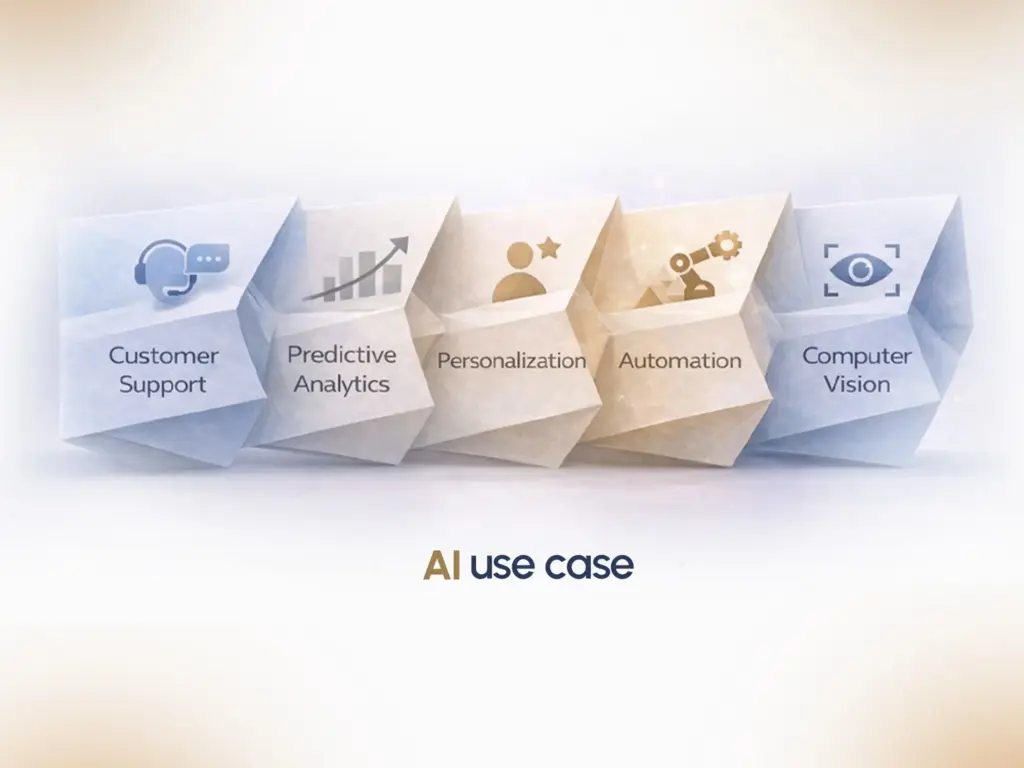
AI becomes truly valuable when applied to real operational challenges. Below are practical use cases. They have AI that is already delivering impact.
1. AI Software Development for Intelligent Customer Support
AI chat systems make running operations cheaper. They also help customers get answers more quickly.
Using Natural Language Processing, intelligent assistants can:
- Resolve high-volume repetitive queries
- Classify and route complex tickets
- Detect sentiment and urgency
- Continuously improve based on interaction data
Example:
A digital wellness platform supports thousands of users. It introduced AI‑driven content recommendations. It also added conversational guidance. Instead of generic content feeds, users received personalized pathways. These pathways were shaped by engagement behavior.
The result was that more users stay engaged and spend longer on the platform. Plus, less manual support was needed to keep things running smoothly.
In this context, AI is not just an automation. It becomes a driver of customer lifetime value.
2. Predictive Analytics in AI Development Services for Business Forecasting
Predictive models transform historical data. They turn it into forward‑looking insights.
Companies are using AI forecasting to:
- Identify churn risk
- Optimize demand planning
- Improve inventory management
- Detect operational anomalies
Example:
A school communication platform manages attendance and performance data. It implemented predictive modeling. The goal was to identify early risk indicators in student progress.
Administrators no longer had to wait until the end of a term to respond to falling performance. Automated systems provided early alerts. The alerts drew on attendance data and shifts in grades.
The result was early action and better student performance. Plus, stakeholders felt more assured and confident.
Predictive AI reduces risk exposure and improves strategic planning accuracy.
3. AI Development Services for Personalization and Intelligent Matching
Personalization used to be a bonus in marketing. Now, customers see it as something they should always get.
AI Software Development allows businesses to deploy recommendation engines that analyze:
- User behavior patterns
- Transaction history
- Geographic data
- Engagement frequency
Example:
A sports networking app rolled out AI matching. It linked people by skill, nearby location and shared activity trends.
Instead of manual searching, participants were automatically paired based on compatibility scoring.
The result was more engaged users who felt happier with the experience. And they came back more often by boosting participation.
AI personalization makes people stay longer on the platform. And it helps cut down on users leaving.
3. Intelligent Automation through AI Software Development
Traditional automation follows fixed rules. AI-powered automation adapts.
By combining machine learning with workflow logic, businesses automate:
- Document validation
- Claims processing
- Data reconciliation
- Compliance checks
Example:
Organizations implementing AI-driven automation consistently report:
- Reduced manual processing time
- Lower error rates
- Faster turnaround cycles
- Improved operational scalability
AI reduces dependence on labor-intensive workflows while increasing processing precision.
5. Visual Intelligence for Product Growth
Computer vision allows machines to process and make sense of images. It also allows them to act on what they see.
Applications include:
- Quality inspection
- Design recommendation systems
- Visual search capabilities
- Pattern detection
Example:
A digital textile design platform incorporated intelligent design suggestions based on user selections and trending pattern analysis.
AI recommended color palettes and layout variations dynamically.
The result was less friction in design and more freedom to experiment creatively. And users felt happier with the overall experience.
In this case, AI did not replace creativity. It enhanced it.
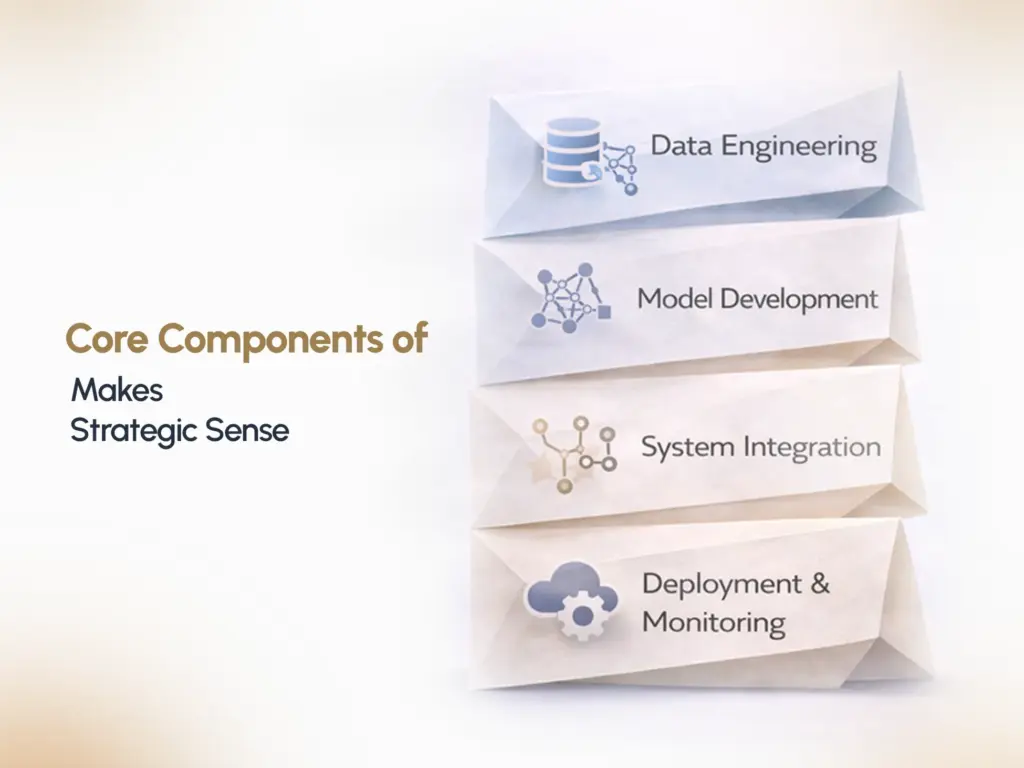
Core Components of AI Software Development
Successful AI implementation requires structured architecture.
1. Data Engineering
AI works best when the data is clean as well as structured. This starts with gathering and tidying the information. Then shaping it through normalization and transformation.
2. Model Development
Machine learning models are trained to classify or predict or recommend outcomes. The choice of model depends on business goals whether regression, classification, clustering or deep learning.
3. System Integration
AI systems must integrate seamlessly with CRMs, ERPs and mobile apps. They also need to connect with cloud platforms and internal databases.
4. Deployment & Monitoring
Once deployed, AI systems require ongoing performance monitoring. They also need regular retraining. And optimization to ensure long‑term accuracy and reliability.
These services provide complete support from start to finish.
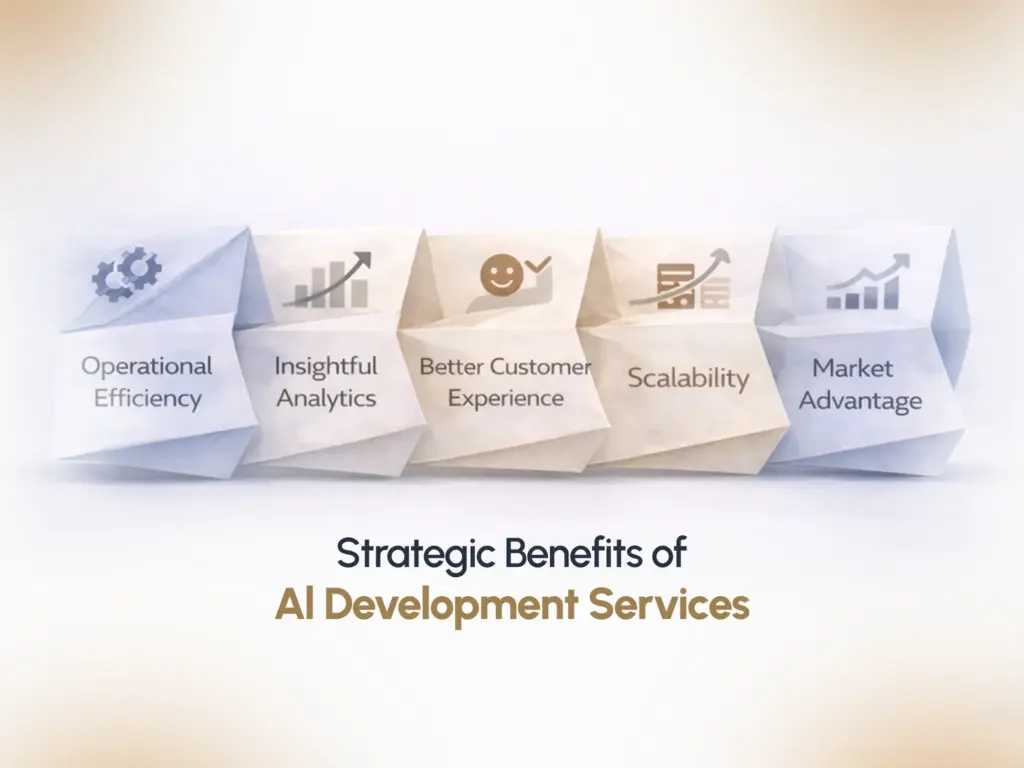
Strategic Benefits of AI Development Services
1. Operational Efficiency
AI takes care of repetitive and rule‑based work. This means that things get done quicker. And with fewer mistakes.
2. Insightful Analytics
AI processes large datasets. It is done faster than traditional systems. This uncovers patterns that support strategic decisions.
3. Better Customer Experience
Smart tips and chatbots are to keep people interested. Proactive updates add extra value. And together, they help users stay longer.
4. Scalability
AI systems scale efficiently across regions, users, and data volumes. They do so without proportional increases in cost.
5. Market Advantage
Businesses using smart automation create sharper products. They deliver services that move faster. It helps them keep things running smoothly.
Key Considerations Before Investing in AI
- Define measurable business objectives
- Evaluate internal data quality
- Start with controlled pilot implementations
- Ensure ethical AI governance
- Plan for continuous optimization
AI is not a one-time implementation. It is a growing capability that matures alongside business growth.
End Thought
AI is reshaping operational models. It is also transforming customer engagement strategies and digital product capabilities. AI enhances forecasting precision while deepening personalization. It also cuts inefficiencies and drives scalable innovation.
Organizations that treat AI development services as a strategic investment gain more. They avoid seeing it as just a productive experiment. This approach creates structural advantages. It strengthens agility and competitiveness.
The question is no longer whether AI will influence business. The question is how intentionally organizations integrate AI into their long-term strategy.
FAQs
What makes AI software development unique compared to traditional methods?
Traditional software development follows existing rules. It relies on fixed logic. AI software development works differently. It enables systems to learn from data. And improve overtime. AI applications use machine learning models. They also use natural language processing. And predictive analytics. Together, these make decisions that are data driven.
How long does it take to implement AI development services in a business?
The timeline depends on the complexity of project. It also depends on data readiness. And on integration requirements. Building a basic chatbot can be done in weeks. Enterprise‑grade predictive analytics can take several months. Automation systems also require months of work. This includes data preparation and model training. It even includes testing and deployment.
What type of data is required for AI software development?
AI systems need structured data. That data must be high‑quality. And it must be relevant. Examples include historical transaction records. Or user behavior data. Or customer interactions and operational metrics. It can also be images or text datasets. This depends on the use case. Data that is clean and well‑labeled improve accuracy and performance.
Are AI development services suitable for small and mid-sized businesses?
Yes. Cloud‑based infrastructure makes it accessible. Scalable AI tools add flexibility. Small and mid‑sized businesses can adopt targeted solutions. Examples include customer support, sales insights and workflow automation. And this is everything without heavy upfront investment.
How do businesses measure the ROI of AI implementation?
ROI is measured through efficiency gains. It also comes from cost reductions. And increased revenue. Improved customer retention adds value. Reduced error rates strengthen results. Faster decision‑making boosts performance. Clear KPIs must be defined before implementation. They help track measurable business outcomes.

Keyur Patel
Co-Founder
Keyur Patel is the director at IT Path Solutions, where he helps businesses develop scalable applications. With his extensive experience and visionary approach, he leads the team to create futuristic solutions. Keyur Patel has exceptional leadership skills and technical expertise in Node.js, .Net, React.js, AI/ML, and PHP frameworks. His dedication to driving digital transformation makes him an invaluable asset to the company.
Related Blog Posts

How RivalRadar Uses AI Agents to Track Competitors Automatically

Notion Client Portal: How to Build a Branded Client Experience Without Leaving Notion