Home
»Blog Insights
»Agentic Development Creates Code. Not Architecture. Here’s How Senior Engineers Work the Magic
Agentic Development Creates Code. Not Architecture. Here’s How Senior Engineers Work the Magic
Keyur Patel
April 2, 2026
18 min
Last Modified:
April 22, 2026
There is a version of the agentic development story that is entirely true: you can build faster now than at any previous point in the history of software.
A CTO with the right tools and a clear prompt can have a working service running in an afternoon. A solo founder can wire together an AI-powered workflow that would have required a six-person team eighteen months ago.
The output is real. The speed is real.
But, there is an other side of the coin too, which is also true, and less discussed: speed at the code level does not produce architecture at the system level.
These are different things, and conflating them is how agentic codebases accumulate structural problems that no amount of additional generation will fix.
Architecture is not code. Architecture is a set of decisions about how code is organised, how components communicate, how failure is handled, how data moves through a system, and how the whole thing holds together when real load, real users, and real operational pressure arrive simultaneously.
Those decisions are not outputs of generation. They are inputs to it. And when they are absent, the generation fills the void with assumptions.
The assumptions are usually fine for week one. By month six, they are the source of every problem you can’t explain.
We have inherited agentic codebases from CTOs who built serious products with serious traction. Smart teams. Real tools. Genuine effort. And in almost every case, the same five structural problems appear. Not variations on them. The same five, in the same form, caused by the same underlying dynamic. And that is what we will be covering in our blog. Where they come from, what they cost, and what it takes to fix them.
Why Agentic Tools Produce Code Without Architecture
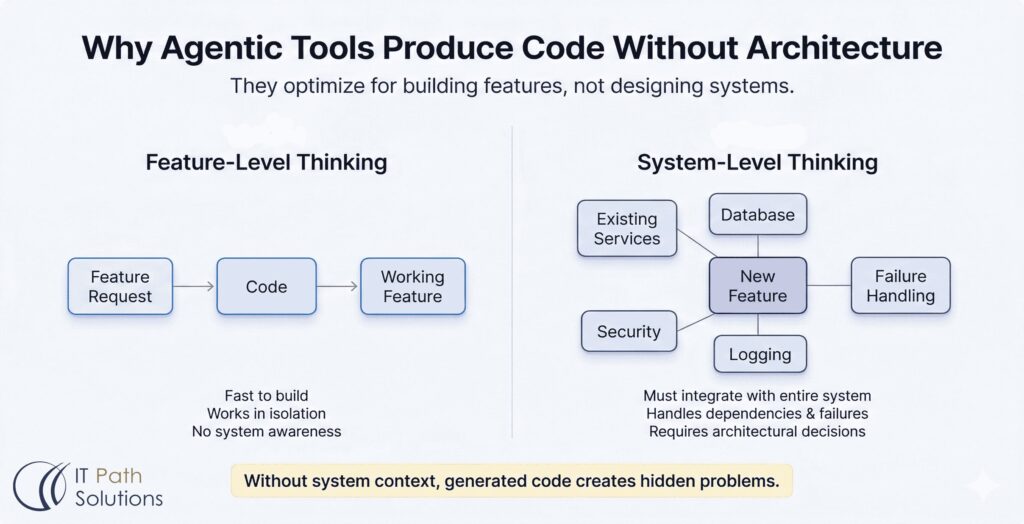
Agentic development tools are optimised to produce working software given a description of what the software should do. That optimisation is extremely powerful. It also has a natural boundary: the tools reason about the feature in front of them, not about the system the feature lives inside.
A senior engineer designing a new service thinks about the feature and about six other things simultaneously: how this service will communicate with the three services that already exist, what happens when this service is unavailable, where the data this service produces will live and for how long, who will maintain this service in a year, what the logging strategy looks like, and whether the pattern this service introduces is consistent with the patterns everywhere else.
Agentic tools do not think about those six things unless you tell them to. And most prompts do not tell them to, because most prompts describe what needs to be built, not how it should fit into everything that already exists.
The result is code that is correct in isolation and problematic in context. Correct in isolation means it passes tests, handles the happy path, and does what was asked. Problematic in context means it introduces patterns inconsistent with the rest of the system, makes assumptions about data availability that don’t hold under load, and creates coupling that wasn’t visible until something broke.
That is the gap. Five structural problems live inside it.
Problem 1: Services That Know Too Much About Each Other
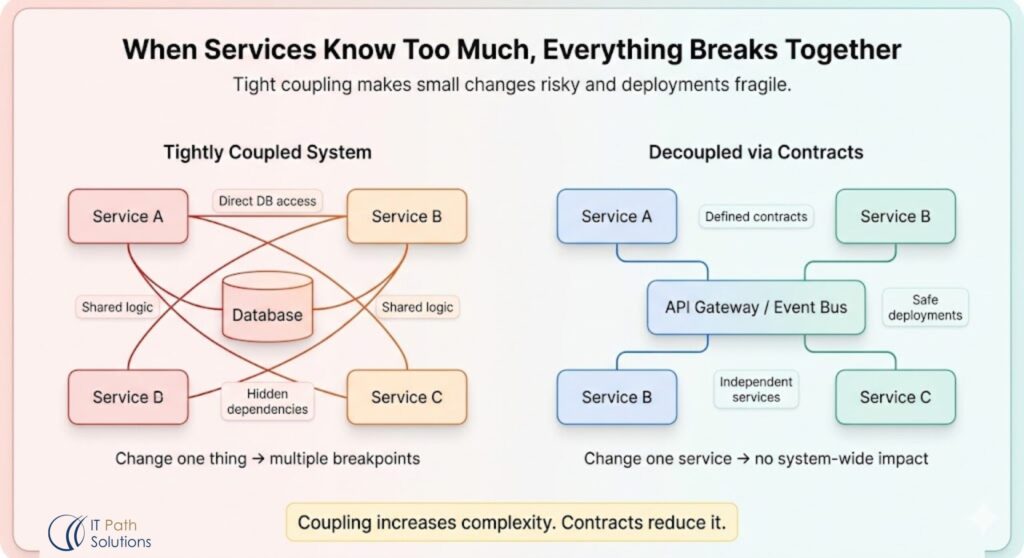
The first problem is tight coupling. In a well-architected system, services communicate through defined contracts, like an API, a message queue, a shared event schema. Each service knows what the others expose, not how they work. When one service changes, the others don’t break because they were only depending on the contract, not the implementation.
Agentic tools generate services by taking the most direct path to the working solution. The most direct path is almost always direct access: call the database of the service you need data from, import the functions you need from the service you need to talk to, share the state object between the services that need to coordinate.
This works. Until it doesn’t.
When Service A calls Service B’s database directly, any change to Service B’s schema breaks Service A silently, until a query fails in production.
When Service A imports functions from Service B, you cannot deploy them independently.
When they share a global state object, debugging a failure requires understanding both services at once, because neither is fully legible without the other.
The symptom in your codebase: you cannot change one thing without reading three things first. A one-line fix to the data model requires checking four files in four different services to understand what depends on it. PRs that should take an hour or so because the blast radius of every change is invisible until you start tracing it.
What fixing it looks like: Senior engineers define the contract first, then refactor each service to communicate through it. The contract is explicit, which is an API endpoint, a typed event, a well-defined shared schema and not an implicit assumption. Services that called each other’s databases get a data access layer between them.
This is not glamorous work. It takes longer than a generation. And it is the work that makes everything else faster for the next eighteen months.
Problem 2: No Strategy for When Things Break
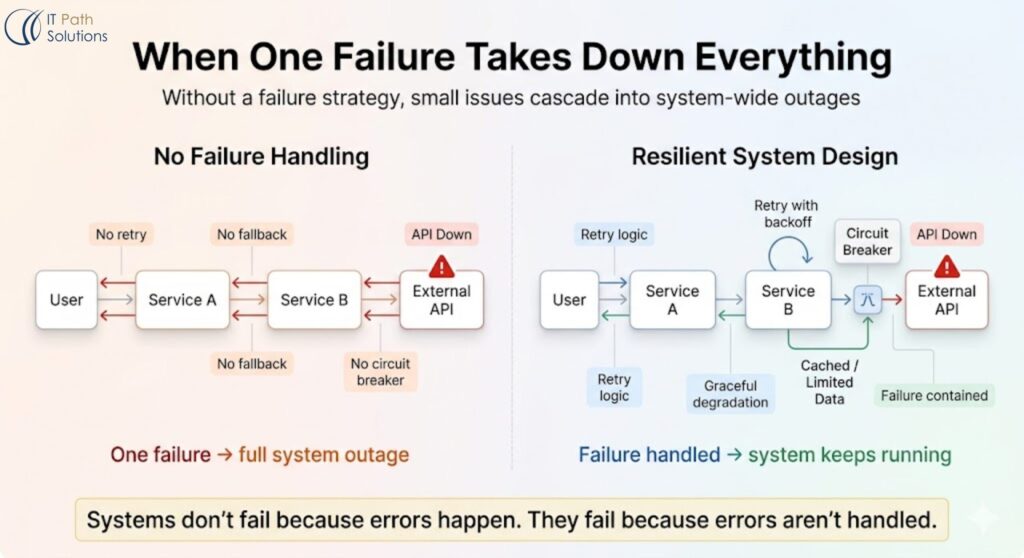
The second problem is missing failure architecture. Every system fails. Networks time out. External APIs return 500 errors. Databases go briefly unavailable. Queues back up. The question is not whether failure happens, it is whether your system has a defined response to it or just stops working.
Agentic tools build the path where everything works. That path is real and it should work well.
What they do not consistently build is the path where something in the middle fails. And those paths are not edge cases. They are regular occurrences in any system running at real scale.
The common patterns we find in agentic codebases:
- No retry logic on external calls. An API call that fails gets returned as an error to the user immediately. There is no attempt to retry after a delay, no distinction between a transient failure (try again) and a permanent one (fail fast). Users see errors that would have resolved in 200 milliseconds if the system had tried once more.
- No circuit breakers. A circuit breaker is a pattern that detects when a downstream dependency is consistently failing and stops calling it for a period, returning a degraded response instead of waiting for a timeout on every request. Without circuit breakers, a slow or failing external service can cascade into your entire system stalling.
- Silent failures in background jobs. A scheduled task or async process that fails in an agentic system often fails invisibly. No alert, no log at the right level, no retry. The job just does not run, and nothing tells you until you notice the downstream effect, data that wasn’t processed, emails that weren’t sent, records that weren’t updated.
- No graceful degradation. When a non-critical component fails, the system should continue operating in a reduced state rather than returning a full error. Agentic-generated systems tend to treat all failures as equally fatal because there was no explicit decision about which components are critical to core function and which are not.
The symptom in your codebase: incidents that look catastrophic at first but turn out to be a single external API that was down for three minutes. And a codebase that has no way to prevent the same three-minute outage from causing the same user-facing failure next time.
What fixing it looks like: A senior engineer maps the failure modes explicitly: for every external dependency, what is the consequence of it being unavailable, and what is the correct response. Then they implement that response: retry with backoff, circuit breaker, graceful degradation, or hard fail with a clear error. This is architecture-level work. It cannot be added as an afterthought to generated code without reading the entire system first.
Problem 3: Data That Lives in the Wrong Place
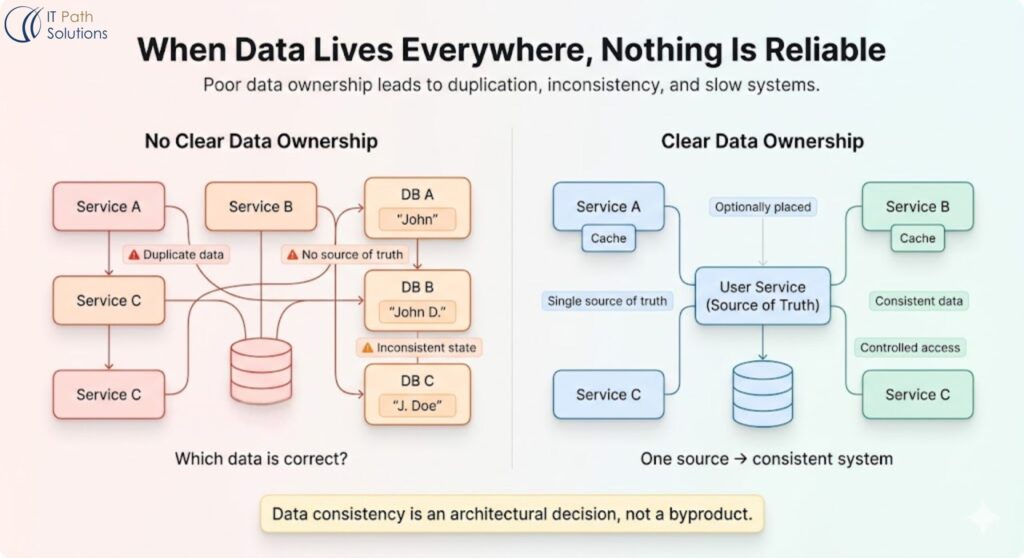
Agentic tools make fast decisions about where data lives. Those decisions are sensible in the context of the feature being built. They are often wrong in the context of the system the feature is part of.
The specific patterns we see:
- Duplicated data without a source of truth. Service A stores user profile information. Service B also stores user profile information, slightly differently, because it was generated without knowing what Service A already had. Now you have two versions of the same data that can diverge, two places to update when something changes, and a recurring question of which version to trust.
- Business logic embedded in the database. Agentic tools sometimes push logic into database triggers, stored procedures, or computed columns because it produces the cleanest implementation for the feature at hand. This makes the logic invisible to your application layer, difficult to test, and nearly impossible to migrate later.
- Unindexed queries on growing tables. A query that filters a table by a user ID runs instantly when the table has 500 rows. It runs in seconds when the table has 500,000. Agentic tools add indexes when they are obviously needed. They miss the queries that are fine today and catastrophic six months from now, because they have no model of what your data volume will look like six months from now.
- Event sourcing introduced inconsistently. Some agentic codebases partially implement event sourcing, a pattern where every state change is stored as an immutable event, and the current state is derived from the event history. Done fully, this is powerful. Done partially, it creates a system where some state is event-sourced and some is mutated directly, and the two approaches contradict each other in ways that only surface in edge cases.
The symptom in your codebase: queries that slow down as the product grows without any change to the code, inconsistent data between services that requires periodic reconciliation jobs to fix, and a growing reluctance to change the database schema because the blast radius is unpredictable.
What fixing it looks like: A data architecture review that maps where every significant piece of data lives, which service owns it, and what the consistency guarantees are. Duplicate data gets a canonical source; the others become caches with explicit refresh logic. Missing indexes get added after query analysis, not guesswork. The business logic that belongs in the application layer gets moved there.
Problem 4: Security Decisions Deferred to Generation Time
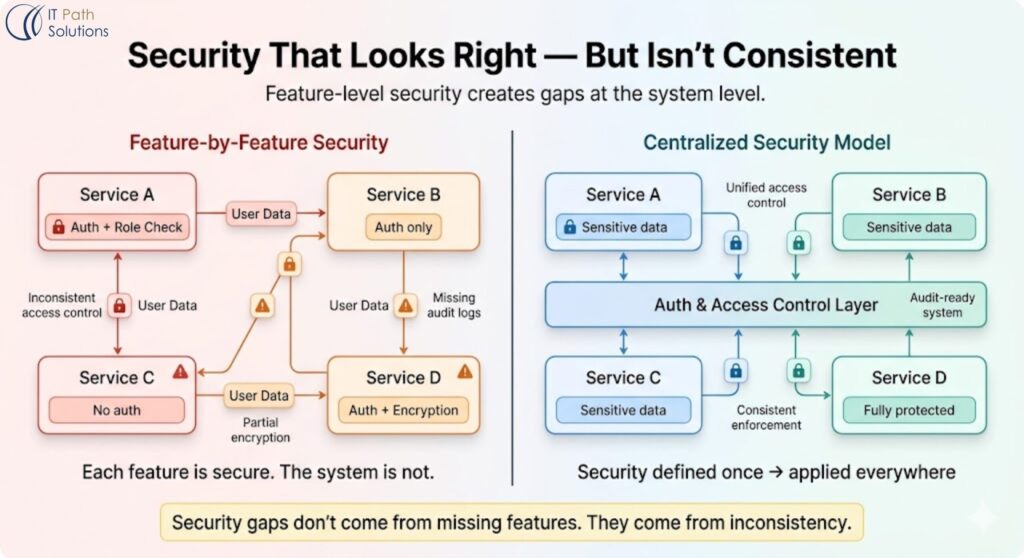
Agentic development tools are not security tools. They apply general security practices like parameterised queries, environment variables for secrets, HTTPS for external calls, and they do this reasonably well. What they do not do is apply your security model.
Your security model is specific to you: which roles exist, what each role can access, which data is sensitive, which operations require audit logging, which endpoints should be rate-limited, and how you handle a user whose account is compromised.
None of that lives in the training data. It lives in decisions you made, or should have made, about your specific product.
When security decisions are deferred to generation time, what you get is security that looks correct in isolation. Endpoints that require authentication. Queries that use parameterised inputs. API keys in environment variables.
What you do not get is security that holds together as a system. The authentication is present but the authorisation is inconsistent — some endpoints check role, some check only login status, some check neither.
The sensitive data is stored encrypted in some tables and plaintext in others, based on whether the table was generated before or after a decision was made to encrypt it. The audit log exists for some operations and not for others, based on whether the feature that generated the operation was prompted with audit logging in mind.
The recent security breach incidents involving AI-built applications, where thousands of user records were exposed through misconfigured access policies, were not the result of tools that ignored security. They were the result of security that was applied feature by feature rather than system by system. Each feature was secure in isolation. The system had gaps.
The symptom in your codebase: a security audit that produces a list of inconsistencies rather than a list of missing features. You have some of the right pieces everywhere and all of the right pieces nowhere.
What fixing it looks like: A security posture review that starts from your data classification, what is sensitive, what is restricted, what is public and works backwards to verify that every layer of the system applies those classifications consistently.
Access control policies get written once and applied everywhere, not generated separately for each endpoint. Audit logging gets a strategy, not an ad hoc implementation. This is not about adding more security. It is about making the security you have coherent.
Also Read – How We Embedded in an Antigravity Codebase in 24 Hours and Shipped in 48 Hours
Problem 5: An Observability Gap That Only Shows Up in Production
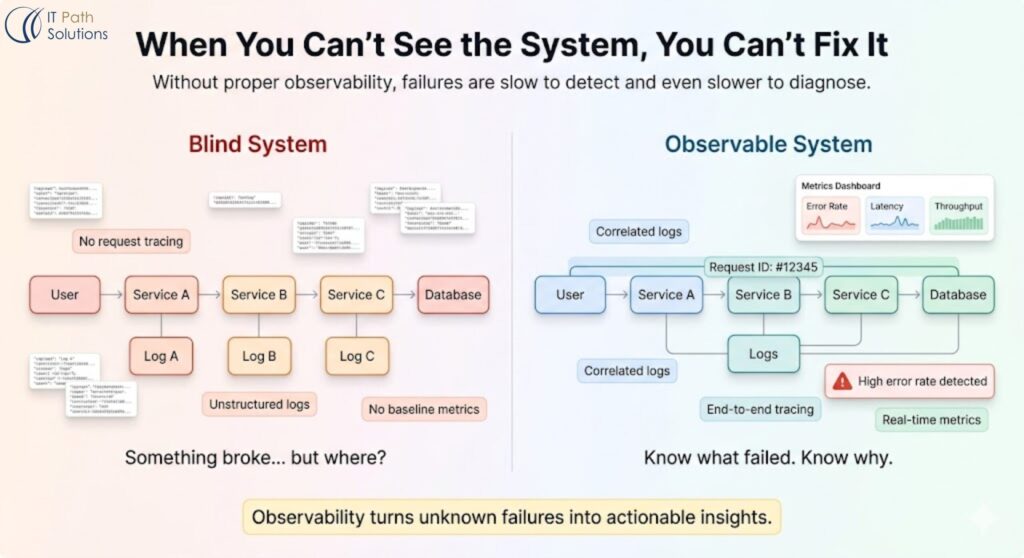
Observability means knowing what your system is doing, why it is doing it, and what went wrong when something fails. It requires three things: logs that contain the right information, metrics that tell you the state of the system over time, and traces that let you follow a single request through every service it touches.
Agentic tools add logging. They add it the way a developer adds it when they are focused on making the feature work: at the points that seem interesting during development. What they miss is the logging strategy that makes the logs useful during an incident, when you are under pressure and need to find the root cause in minutes.
The specific gaps we find:
- Logs without correlation. A request arrives at Service A, gets passed to Service B, triggers a job in Service C. If each service logs independently with no shared request identifier, you cannot trace that request through the system. You have three logs, each showing part of the story, with no way to connect them.
- Metrics without baselines. A spike in error rate is only meaningful if you know what the normal error rate is. Agentic systems often have metrics on individual operations without a picture of what the system’s normal operating state looks like. Incidents go undetected because there is no baseline to deviate from.
- Missing slow query logging. Database queries that are fine today and slow tomorrow are only detectable if you are logging query execution times and alerting when they exceed a threshold. Without this, the first sign that a query has become a problem is a user complaint, not a metric.
- Alerts on the wrong things. Agentic systems sometimes have alerting configured on the things that were obviously important during generation: service uptime, deployment failures, critical errors. They often lack alerting on the business-level signals that matter to a CTO which are conversion step failure rates, background job completion rates, payment processing error rates. The infrastructure alert fires. The business-critical silent failure doesn’t.
The symptom in your codebase: incidents that take four times as long to resolve as they should, because the first hour is spent trying to understand what happened before you can start diagnosing why.
What fixing it looks like: A senior engineer defines the observability strategy before adding any tooling: what questions do you need to be able to answer during an incident, and what does the system need to log to answer them?
Structured logging, where logs formatted as machine-readable key-value pairs rather than free text that gets implemented consistently across every service. Distributed tracing, where a unique identifier is attached to every request and logged at each service it passes through, gets added at the entry point.
Dashboards get built around business metrics, not just infrastructure metrics.
The Five Problems Together
These five problems are not independent. They compound.
A system with tight coupling and no failure architecture breaks in ways that are hard to recover from, because one service’s failure cascades to others and there are no circuit breakers to contain it.
A system with tight coupling and no observability takes hours to diagnose, because you cannot trace the cascade.
A system with security decisions deferred to generation time and no observability may be breached without your knowing, because there is no audit trail that would surface it.
| Problem | What It Looks Like in the Codebase | What It Costs in Production |
|---|---|---|
| Tight coupling | Cannot change one service without reading three | Every change is slow and risky; deployment requires whole-system coordination |
| Missing failure architecture | No retry, no circuit breakers, silent background failures | Single dependency outage causes full system failure; incidents recur with the same root cause |
| Wrong data location | Duplicate data, inconsistent state, unindexed queries | Performance degrades as data grows; reconciliation jobs become permanent infrastructure |
| Deferred security | Inconsistent access control, partial audit logs | Security gaps that pass feature-level review and fail system-level audit |
| Observability gap | Unstructured logs, no tracing, infrastructure alerts only | Long incident resolution times; same incident recurs because root cause was never found |
The reason these problems cluster together is that they all come from the same root cause: agentic tools were not given the architectural context to avoid them. They are not failures of generation quality. They are the predictable result of generating without architecture as an input.
What Senior Engineers Do That Agentic Tools Cannot
The answer to these five problems is not better prompts. It is not more generation. It is a different kind of thinking.
Senior engineers who work on agentic codebases do not just review the code that was generated. They hold the system model in their head and check each piece of generated code against it.
They ask:
Does this fit?
Does this break the service boundary we agreed on?
Does this make the failure mode we discussed worse?
Does this change what we can observe?
That reasoning requires holding two things simultaneously: the feature in front of you and the system it is part of.
Agentic tools hold only the first one. That is not a limitation to work around. It is a handoff point.
The tools generate the feature. The senior engineer integrates it into the system.
The teams that scale agentic development without accumulating catastrophic structural debt are not the teams that prompt more carefully. They are the teams that have senior engineers setting the architectural constraints before generation starts, reviewing generated code against those constraints, and doing the refactoring work that generation cannot do, i.e., the coupling reduction, the failure mode mapping, the observability strategy, the security posture review.
That combination of agentic speed at the feature level plus senior judgment at the system level is the actual model for sustainable agentic development. Not one or the other.
Also read – How Senior Engineers Evaluate Agentic AI Systems: The Checklist Experts Follow
If You Are Recognising Your Codebase in This Post
If two or three of these five problems are familiar, your codebase is not in an unusual state. It is in the expected state for an agentic build that has not yet had a senior architectural review.
The code you have is good. The features you shipped are real. The speed advantage you gained from agentic development is genuine and worth preserving. The structural work ahead is not a rebuild. It is a set of targeted interventions that make what you built sustainable.
Those interventions are scoped, sequenced, and deliverable without stopping your roadmap. They take weeks, not months. And the codebases that come out of them are not just structurally sound — they are faster to work in, because the accidental complexity that slows everything down has been removed.
Your agentic stack is only as good as the engineering behind it.
Book a Free Session or email us directly, and let our senior engineers work their magic and help you with your developed app.
When the Problem Is Smaller Than This
Not every team reading this is dealing with all five structural problems. Some are dealing with one specific coupling issue that is creating risk ahead of a launch, or an observability gap that is making a recent incident impossible to diagnose.
If your issue is more contained like a specific integration that needs architectural review, a codebase that is accumulating debt faster than your team can address it that is a scoped engagement, not a full architectural overhaul.
The right scope depends on what you are actually facing, and that is a conversation worth having before assuming the answer.
And if your foundation sits on a no-code or low-code layer that has its own structural issues underneath the agentic layer above it, that changes the sequence of fixes. There are engineers who work at both levels on the agentic layer and on the production-readiness gaps below it and the right entry point depends on where the risk actually lives.

Keyur Patel
Co-Founder
Keyur Patel is the director at IT Path Solutions, where he helps businesses develop scalable applications. With his extensive experience and visionary approach, he leads the team to create futuristic solutions. Keyur Patel has exceptional leadership skills and technical expertise in Node.js, .Net, React.js, AI/ML, and PHP frameworks. His dedication to driving digital transformation makes him an invaluable asset to the company.
Related Blog Posts

How RivalRadar Uses AI Agents to Track Competitors Automatically

How to Build an AI Influencer Platform in 2026: The Next Frontier for Brands, Creators, and Digital Product Teams