How Senior Engineers Evaluate Agentic AI Systems: The Checklist Experts Follow
Keyur Patel
March 21, 2026
22 min
Last Modified:
April 22, 2026
Most agentic codebases are not ready for production the day they feel ready. The features work. The demos are clean. The agents do what they were designed to do in controlled conditions.
What hasn’t been tested is what happens under real load, with unexpected inputs, when a dependency is slow, when a user does something the agent was never prompted to handle, or when the team that built it needs to hand it to someone new.
Standard software quality checklists were designed for deterministic systems that, given the same input, produce the same output every time. Write a test, confirm the output, ship.
Agentic systems are not deterministic. The same input, on a different day, with a different model state or a different upstream API response, can produce a different output. The agent that completed a task correctly in 500 tests may fail the 501st in a way none of the 500 anticipated. Not because the code changed. Because the system involves reasoning, external state, and probabilistic outputs that no fixed test suite fully covers.
That gap between “tested” and “production-ready” is where most agentic systems fail. Not in week one, when everyone is watching. In week six, when the edge cases that didn’t appear in testing start appearing in front of real users. This is not just anecdotal, but analysts like Gartner have predicted that up to 40% of agentic AI projects may struggle when exposed to real-world conditions, where reliability, edge cases, and system complexity become harder to control
The checklist below is not about finding bugs in the traditional sense. It is about evaluating whether the system has been designed to handle the unpredictable, recover from failure, protect your users and their data, and be understood and maintained by engineers who weren’t in the room when it was built.
The Checklist
1. Agent Failure Modes Are Defined and Handled Explicitly
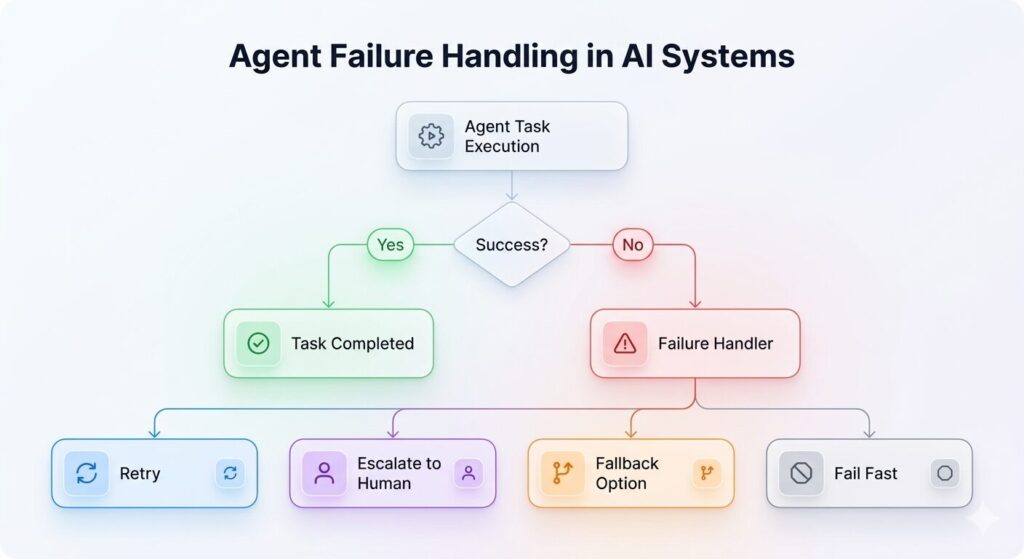
Every agent in your system will eventually fail to complete its task. The question is not whether that happens, it is whether your system has a defined response for it.
Agentic tools scaffold the success path in detail. The failure path is where the engineering debt hides. An agent that times out, receives an unexpected response from an external tool, encounters a context window limit, or produces an output that downstream validation rejects needs a specific, documented response. That response should be one of four things: retry with modified input, escalate to a human review queue, fall back to a deterministic alternative, or fail fast with a clear error to the calling system. “Do nothing” and “crash the parent process” are not valid responses.
Before production, map every agent in your system and answer, for each one: what happens when it fails? If the answer involves a shrug or a “we’ll handle it when it happens,” the failure mode is undefined. Undefined failure modes become production incidents.
Diagnostic question: Can you describe, for each agent in your system, the exact execution path that runs when the agent does not complete its task successfully? If you cannot describe it from memory, it has not been built.
2. Every Tool Call Has a Timeout and a Circuit Breaker
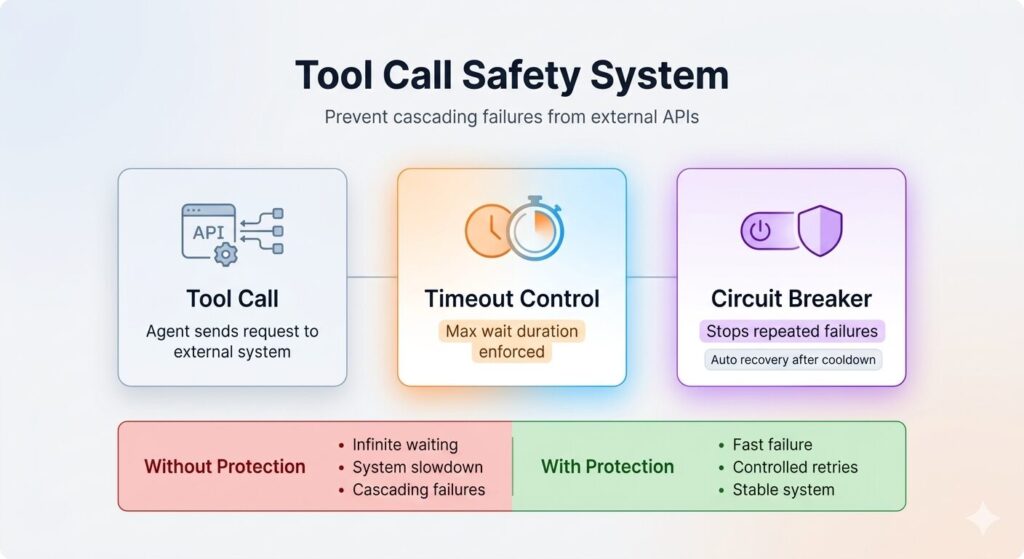
Agent tool calls which are the actions agents take to interact with external systems, APIs, databases, and services are the single most common source of production failures in agentic architectures. They are calls to systems your agents do not control, and those systems will sometimes be slow, sometimes unavailable, and occasionally return responses that make no sense.
A timeout is the minimum requirement: every tool call that makes an external request needs a maximum duration, after which the call is abandoned and the failure path runs. Without timeouts, a slow external API holds your agent in a waiting state indefinitely, blocking other work and eventually exhausting your thread or process pool.
A circuit breaker is the production-grade requirement. A circuit breaker (pattern) that monitors call failure rates and, when they exceed a threshold, stops making calls to the failing dependency for a defined period prevents a slow or unavailable external system from cascading into a full system failure. It returns a known degraded response immediately rather than waiting for a timeout on every attempt.
Check every tool call in your agentic system. Find the ones with no timeout configured. Find the ones with no circuit breaker. Those are the ones that will take down your system when a third-party API has a bad hour.
Diagnostic question: Pick the external tool call your agents make most frequently. Simulate the downstream system being unavailable for five minutes. What does your system do? How many user-facing requests are affected? How does it recover when the system comes back?
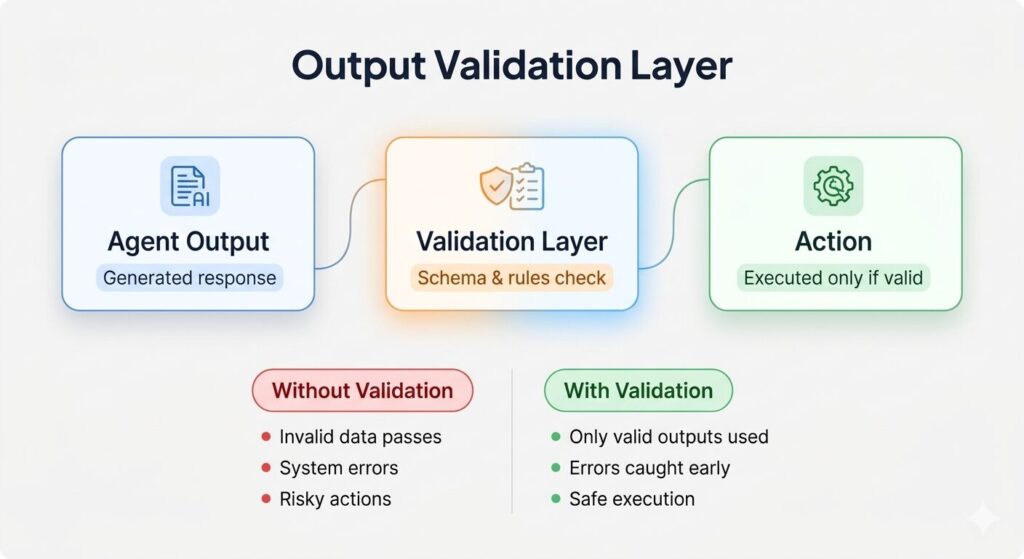
3. Agent Outputs Are Validated Before They Are Acted On
Agentic systems make decisions and take actions. The actions of writing to a database, sending a communication, making a payment, updating a record are often irreversible. An agent that produces a malformed output and has that output acted on without validation can cause damage that takes hours to detect and longer to undo.
Output validation means checking the agent’s response against a defined schema or constraint before passing it to the action layer. Not trusting that because the agent was prompted correctly, its output will always be correct. It won’t. Model outputs are probabilistic. Edge cases produce unexpected structures, missing fields, values outside expected ranges, and occasional outputs that are structurally valid but semantically wrong.
The validation layer is not a test. It is runtime infrastructure. It runs on every production output, flags deviations, and either rejects the output and retries, routes it to human review, or fails the action with a clear log of what was produced versus what was expected.
Diagnostic question: Take the most consequential action your agents trigger the one where a wrong output causes the most damage. What validates the agent’s output before that action executes? If the answer is “the action itself will fail if the output is wrong,” you have error handling but not validation. They are different.
4. Sensitive Data Is Scoped to the Minimum Required Context
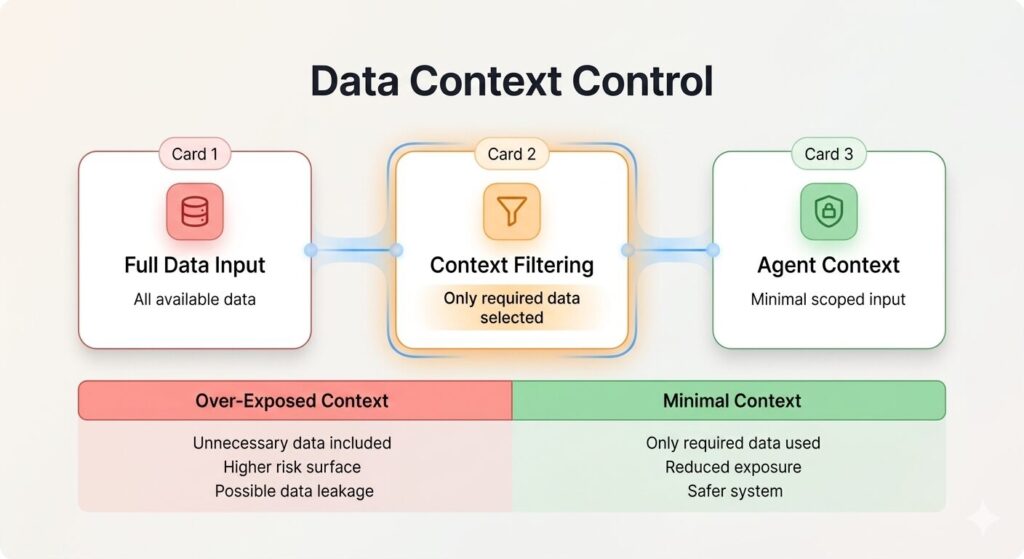
Agent context windows, the block of text and data fed to the model as input on each call have a tendency to expand. The easiest way to make an agent more capable is to give it more context. More user data, more account history, more configuration, more system state. More context usually produces better outputs.
It also produces a larger attack surface and a more significant data exposure risk.
Every piece of sensitive data in an agent’s context window is data that, if the agent’s output is logged, cached, or forwarded to an external system, could be exposed. Personally Identifiable Information (PII), any data that identifies a specific individual should be in context only when the agent’s task requires it. Payment details, authentication credentials, and internal system configuration should almost never be in context.
Before production, audit the context window for every agent that handles user data. Document what is in it and why each piece is required. Remove anything that isn’t.
If the agent produces slightly worse outputs without a piece of data, that is a tradeoff to evaluate explicitly, not an implicit decision to include everything.
Diagnostic question: For your highest-sensitivity agent, what PII or sensitive data appears in the context window on a typical call? Is each piece there because the agent’s task requires it, or because it was convenient to include during development?
5. Agent Actions Are Idempotent Where Reversibility Matters
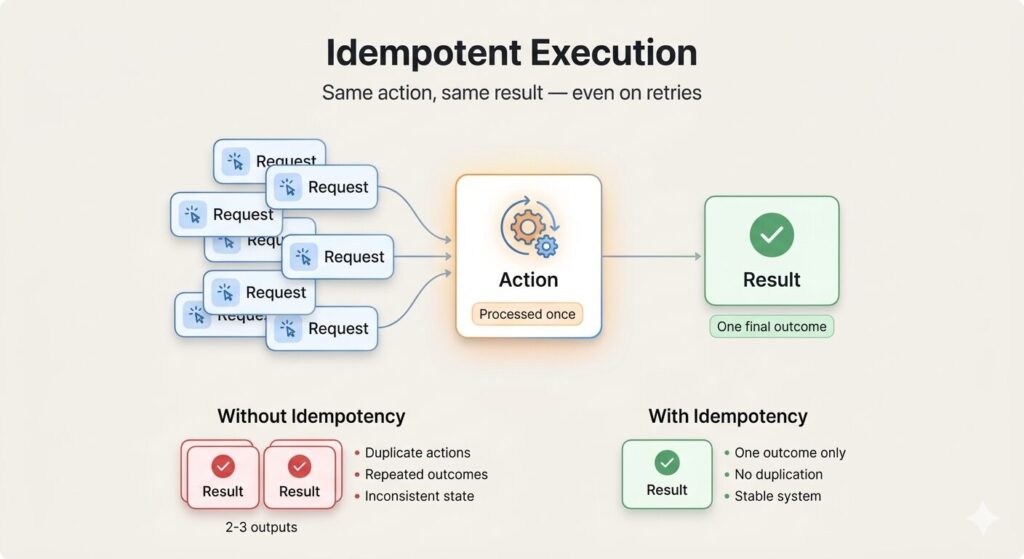
Idempotency means that performing an action multiple times produces the same result as performing it once. It is a critical property for any agentic action that could be triggered more than once, due to a retry, a duplicate event, a network error that caused the first attempt to appear to fail while actually succeeding, or a user action that triggers the same workflow twice.
Non-idempotent actions compound on retry. An agent that sends a notification, creates a record, or makes a payment needs to check whether it has already performed that action before performing it again. The check is not expensive.
The absence of the check produces duplicate records, duplicate charges, and duplicate communications all of which are expensive to remediate and damaging to user trust.
In agentic systems, the retry surface is larger than in traditional software because agents are more likely to be triggered by external events, message queues, and orchestration systems that have their own retry logic. Every action that matters needs to be designed so that running it twice produces the same outcome as running it once.
Diagnostic question: Identify the three most consequential actions your agents take. For each one, what happens if it is triggered twice with the same input within a 60-second window? If the answer is “two of the same thing happen,” the action is not idempotent.
6. The Human Escalation Path Is Tested, Not Assumed
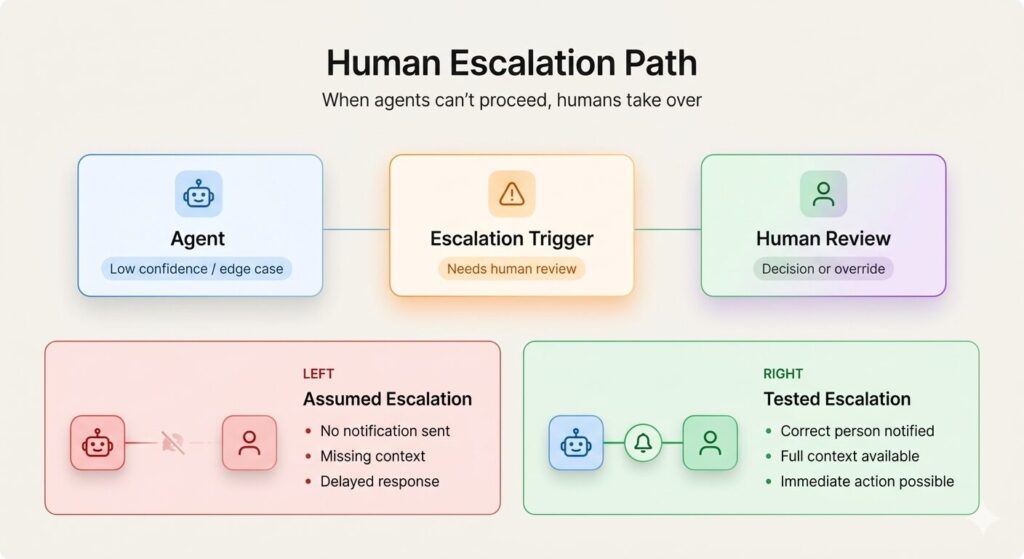
Every agentic system designed for production needs a path from agent to human. The cases where an agent should not proceed autonomously because the task is outside its competence, because the output confidence is too low, because the stakes of a wrong action are too high need to be defined, and the escalation path for each one needs to be tested.
“Tested” means: a real engineer has triggered each escalation path, confirmed the right human was notified through the right channel, confirmed the notification contained the context needed to act on it, and confirmed the agent’s state was preserved correctly so the human can resume or override from the right point.
Untested escalation paths fail in the moments they matter most. A path that was designed to route to a Slack channel fails silently when the webhook URL rotates. A path that was designed to email a review queue goes to an inbox nobody checks. An escalation that was designed to pause the agent creates a deadlock in the parent orchestration process.
Diagnostic question: Trigger your most important human escalation path in staging, right now, using real notification infrastructure. Does the right person receive the notification? Does it contain enough context to act? Can the recipient complete the escalation without asking a developer for help?
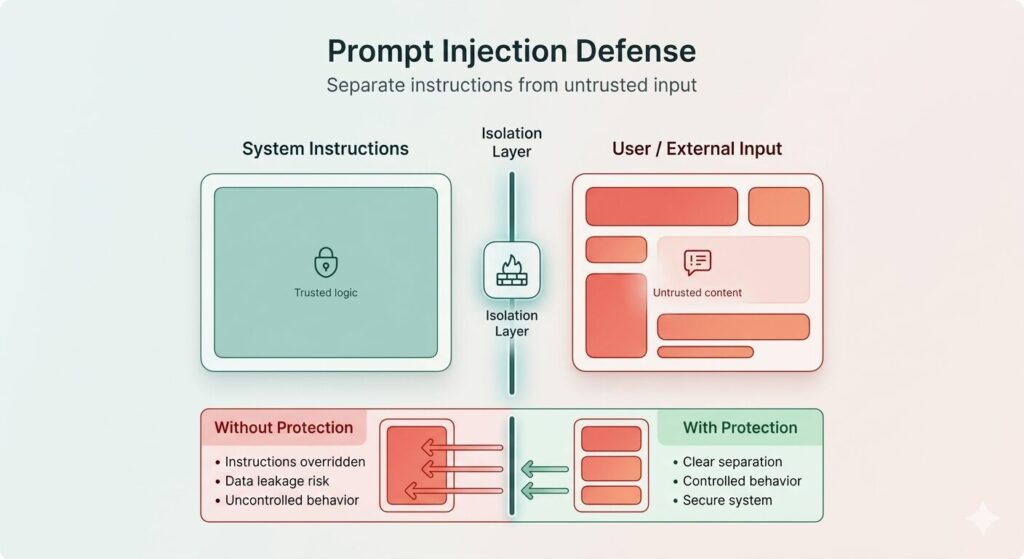
7. Prompt Injection Attack Surface Has Been Mapped and Mitigated
Prompt injection is the agentic equivalent of SQL injection. An attacker who can control text that is inserted into an agent’s context window can potentially manipulate the agent’s behavior causing it to ignore its instructions, reveal information it should not, take actions it was not intended to take, or exfiltrate data through its outputs.
The attack surface is anywhere user-supplied or externally-sourced content enters a context window. A user’s message in a chatbot. A document the agent is asked to summarise. A web page the agent is asked to read. An email the agent is asked to classify.
If any of these contains instructions rather than data, and the agent treats them as instructions, you have a prompt injection vulnerability.
Mitigation is not a single fix. It is a design posture: separating instructions from data in context construction, validating that agent outputs are consistent with the agent’s defined task scope, logging context and outputs for anomaly detection, and applying the principle of least privilege to every tool the agent can access.
Diagnostic question: In every place your agents consume user-provided or externally-sourced content, what prevents that content from containing instructions that would change the agent’s behavior? If the answer is “nothing” or “the model is smart enough to ignore them,” you have an unmitigated attack surface.
8. Costs Are Bounded and Monitored
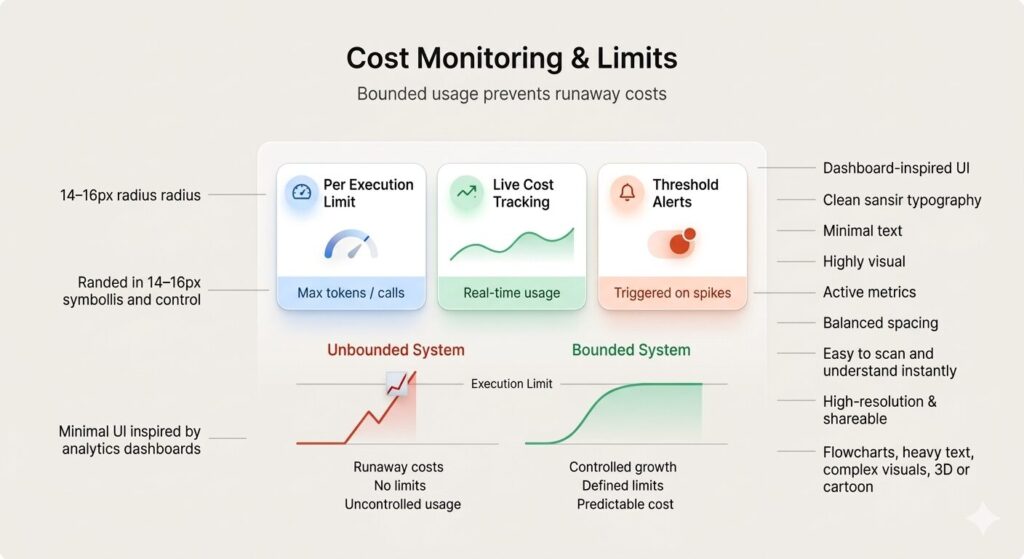
Agentic systems have development costs that scale with usage in ways that traditional software does not. Every model call costs money. Every tool call that invokes a paid external API costs money. An agent that enters a retry loop, a multi-step reasoning chain that takes twice as many steps as expected, or a workflow triggered by a misconfigured event can generate costs in minutes that exceed your monthly budget.
Cost bounding means two things.
- Per-execution limits: a maximum number of model calls, tool calls, and total tokens per agent run, beyond which the run is terminated and flagged.
- Aggregate monitoring: alerts that fire when hourly or daily costs exceed defined thresholds, before they compound into a billing crisis.
Without cost bounding, a single bug in an orchestration loop can generate thousands of dollars of API costs before anyone notices. With cost bounding, the same bug hits the per-execution limit, terminates, and creates an alert.
Diagnostic question: What is the maximum cost your system can generate in a single hour if one agent enters an unintended loop? If you cannot answer this because there are no per-execution limits or aggregate cost alerts, cost bounding is not in place.
9. The Data Lineage Is Traceable End to End
Agentic systems transform data: they receive it, reason about it, pass it between agents and tools, store intermediate results, and produce outputs that affect downstream systems.
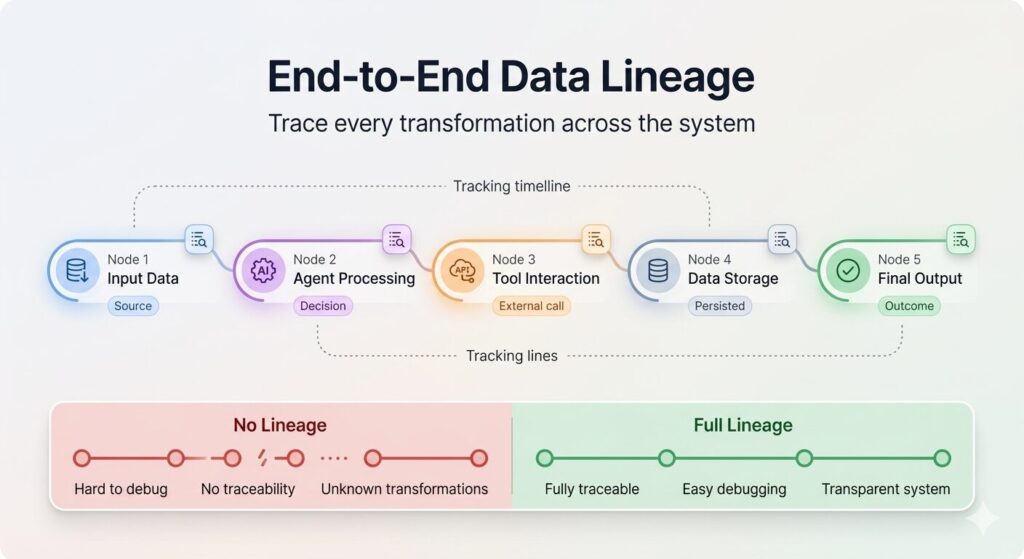
In a production environment with compliance requirements, audit obligations, or debugging needs, you need to be able to trace exactly what data entered the system, what transformations it underwent, which agent made each decision, and what the final output was.
Data lineage which is the full chain of custody for a piece of data through your system is not automatically produced by agentic tools. It requires deliberate logging at every transformation point, structured enough to be queried and reconstructed after the fact.
The absence of data lineage is not just a compliance problem. It is a debugging problem. When an agent produces a wrong output, the question “why did this happen?” requires reconstructing the execution history. Without structured lineage logging, that reconstruction is guesswork.
Diagnostic question: Take a specific piece of data that entered your system last week. Can you trace, from logs alone, every agent and tool that touched it, every transformation applied to it, and the final output it contributed to? If you cannot do this without a developer manually reading code, data lineage is not in place.
10. Concurrent Agent Executions Do Not Produce Race Conditions
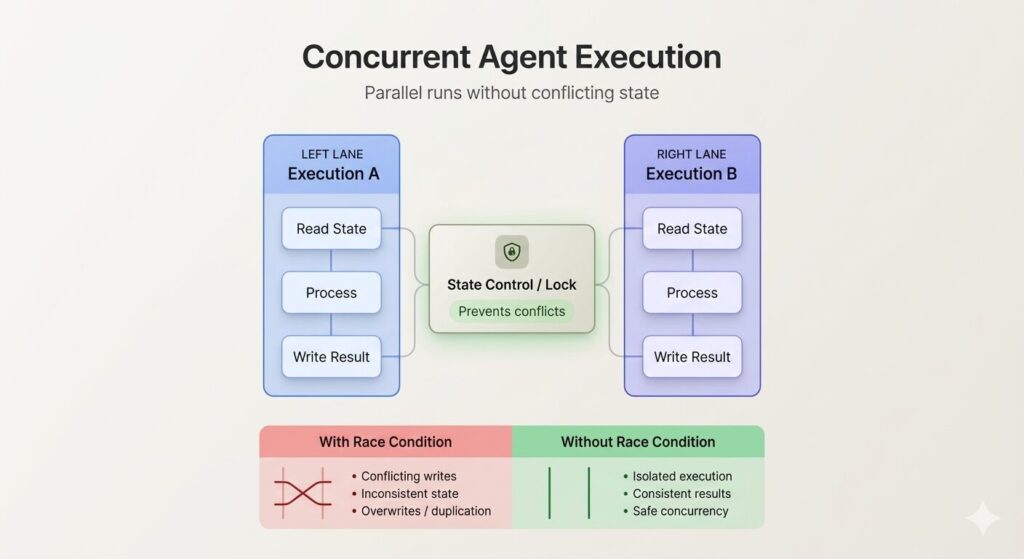
Agentic systems are often designed around a single execution of a workflow. In production, with real users, multiple executions of the same workflow run concurrently. Two users submit the same task type at the same time. A retry and a new execution of the same workflow run simultaneously. A scheduled agent triggers at the same moment as a user-initiated trigger.
Race conditions in agentic systems occur when two concurrent executions read the same state, make decisions based on that state, and write conflicting results. Unlike traditional race conditions, agentic race conditions can be subtle: the executions are logically correct individually but produce inconsistent system state when interleaved.
Specifically check: agents that read then write a record without a lock or a transaction, workflows that modify shared state without checking whether another execution has modified it since the last read, and queue processors that can pick up the same item twice if two workers poll simultaneously.
Diagnostic question: Run two instances of your most frequently triggered workflow simultaneously, targeting the same user or resource. Does the final state of the system reflect both executions correctly? Is any state written twice, skipped, or inconsistent between what each execution expected and what it found?
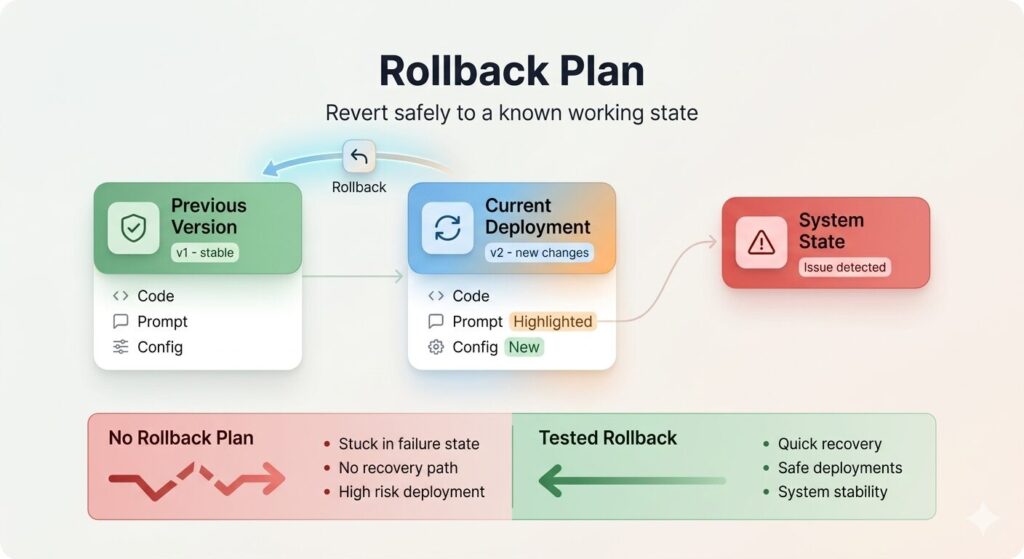
11. The Rollback Plan Is Documented and Tested
Production deploys of agentic systems require a rollback plan that accounts for more than just the application code. An agentic system deploy often includes: updated agent prompts, new tool definitions, changed orchestration logic, database migrations, and updated environment variables for model API keys or endpoint URLs.
Rolling back the application code without rolling back the prompt changes produces a system where the old code interprets new prompts.
Rolling back without accounting for database migrations can leave the schema in a state inconsistent with either version.
Rolling back an agent’s tool access in the middle of an in-progress execution can strand running workflows in a state they cannot complete.
A tested rollback plan defines the rollback procedure for each component of the deploy, the order in which components are rolled back, how in-progress executions are handled during rollback, and the verification steps that confirm the rollback succeeded. “Tested” means someone has executed the rollback procedure in staging, confirmed it worked, and documented the steps so anyone on the team can run it under pressure.
Diagnostic question: If this deploy needs to be rolled back at 2am by an engineer who was not involved in writing it, do they have a documented procedure they can follow without calling anyone? If not, the rollback plan is not production-ready.
12. Agent Versioning Is In Place for Breaking Changes
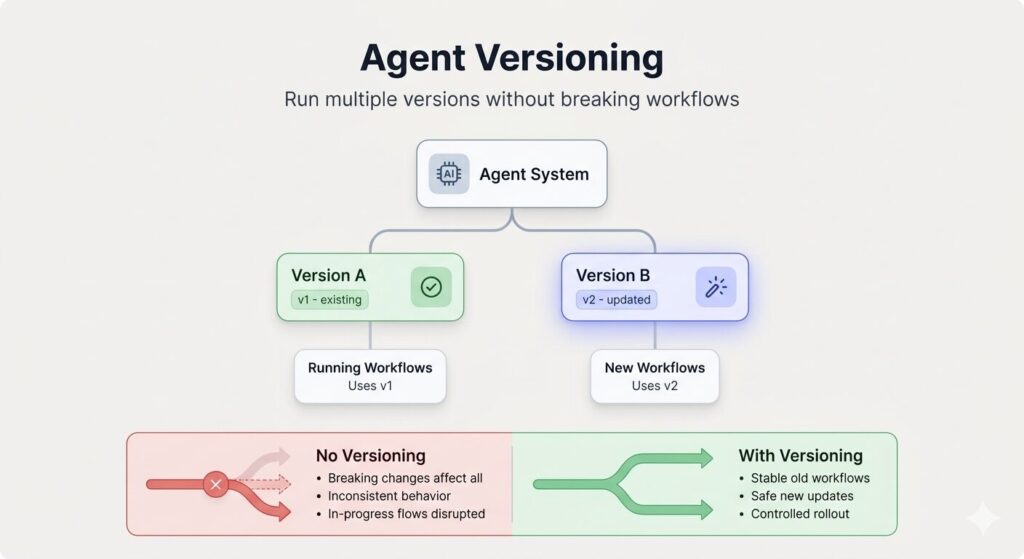
Agent prompts change. Model versions change. Tool definitions change. In a production system, changes to any of these can change agent behavior in ways that are functionally breaking they alter the outputs users or downstream systems depend on, even when no application code has been modified.
Agent versioning means treating prompts, model configurations, and tool definitions as versioned artifacts: changes are tracked, old versions are preserved, and the system can run a specific version of an agent for in-progress executions while new executions use the updated version.
Without versioning, a prompt change mid-execution changes the behavior of workflows that were started under the previous prompt. A model version upgrade changes outputs for all in-progress executions simultaneously. Users who started a workflow under one set of agent behaviors complete it under different ones.
Diagnostic question: If you change the system prompt for your primary agent today, what happens to workflow executions that started yesterday and have not yet completed? Do they complete under the old prompt or the new one? Is that the intended behavior?
13. The System Has Been Tested With Adversarial Inputs
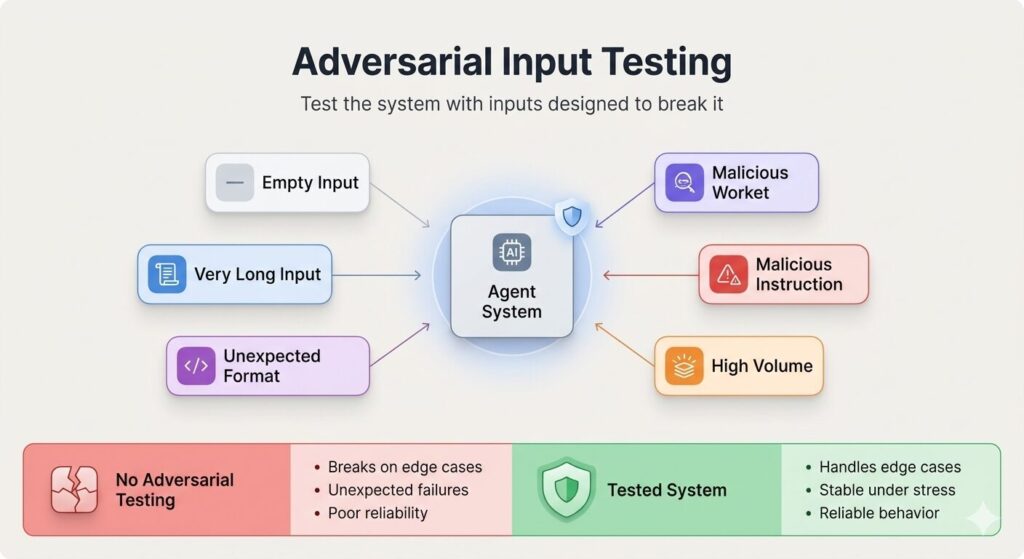
Most agentic systems are tested with representative inputs that look like what real users will send. Representative inputs are necessary but not sufficient for production readiness. Real users, and real attackers, send inputs that are empty, extremely long, structured as commands rather than requests, formatted in unexpected languages, or designed to probe the boundaries of what the system will do.
Adversarial input testing for agentic systems covers four categories: edge cases in format and length (empty strings, inputs at the context window limit, inputs in non-Latin scripts), semantic edge cases (requests that are technically within scope but at the boundary of the agent’s design), adversarial instructions (inputs crafted to manipulate agent behavior, as covered in item 7), and high-volume concurrent inputs (many requests simultaneously, to surface race conditions and resource exhaustion).
Each category should be covered by a defined test suite that runs before every production deploy. Not a one-time exercise. Every deploy.
Diagnostic question: When did you last run your agentic system against inputs designed to break it rather than inputs designed to succeed? If the answer is “during initial development” or “we haven’t,” adversarial testing is not part of your deploy process.
14. The System Can Be Understood and Operated Without Its Original Authors
The final check is the one most often skipped because it requires stepping outside the builder’s perspective.
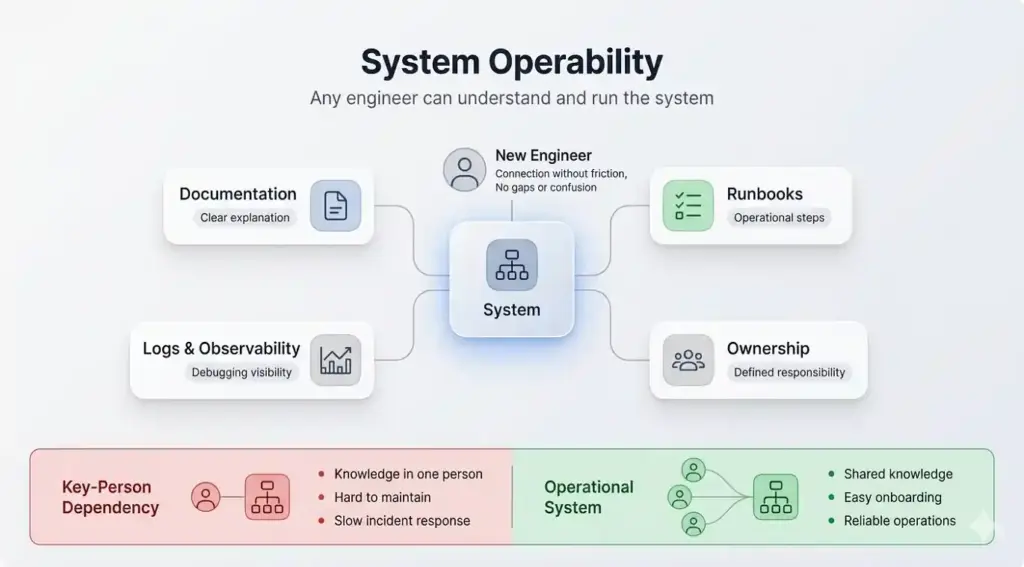
Could an engineer who has never seen this codebase before, a senior engineer with strong general skills but no knowledge of your specific system be on-call for it within 48 hours? Could they diagnose an incident, understand the orchestration flow, know which logs to look at, and make a targeted fix without breaking something they didn’t see?
If the answer is no, your system has key-person risk. The knowledge required to operate it lives in the heads of the people who built it, not in the system’s documentation, runbooks, and code comments. Key-person risk is acceptable in early development and dangerous in production.
Also read – How We Embedded in an Antigravity Codebase in 24 Hours and Shipped in 48
Documentation for agentic systems needs to cover four things that standard software documentation often omits: the reasoning behind agent design decisions (why this agent was split into two instead of one, why this tool has this permission scope), the expected behavior envelope for each agent (what outputs are normal, what outputs are anomalous), the operational runbook for each class of incident (what to do when the queue backs up, when a model API is down, when a specific agent consistently fails), and the escalation chain (who owns what, who makes the call to roll back).
Diagnostic question: Hand the documentation for your agentic system to a senior engineer who has never seen it before. Ask them to describe, from the documentation alone, what the system does, how it handles a failure in the most critical agent, and where to look when something goes wrong. If they cannot do this without asking the authors, the documentation does not meet production standards.
The Full Checklist at a Glance
Run every item before every production deploy. No item is optional. The ones that feel least relevant for your specific system are often the ones where the highest-severity finding lives.
| # | Check | What It Catches | Severity If Skipped |
|---|---|---|---|
| 1 | Agent failure modes defined | Silent failures, undefined behavior on task incomplete | Critical |
| 2 | Timeouts and circuit breakers on all tool calls | Cascading failures from slow or unavailable dependencies | Critical |
| 3 | Agent outputs validated before action | Irreversible actions triggered by malformed or wrong outputs | Critical |
| 4 | Sensitive data scoped to minimum context | PII and credentials exposed through logs, outputs, or external calls | Critical |
| 5 | Agent actions are idempotent | Duplicate records, charges, or communications on retry | High |
| 6 | Human escalation path tested | Escalation fails silently when it matters most | High |
| 7 | Prompt injection attack surface mapped | Agent behavior manipulated through user or external inputs | Critical |
| 8 | Costs bounded and monitored | Uncontrolled spend from loops, retries, or misconfigured triggers | High |
| 9 | Data lineage traceable end to end | Compliance failures, debugging impossible without reconstruction | High |
| 10 | Concurrent executions tested for race conditions | Inconsistent or corrupt shared state under real load | High |
| 11 | Rollback plan documented and tested | Failed deploy with no recovery path at 2am | Critical |
| 12 | Agent versioning in place | In-progress executions broken by mid-flight prompt or model changes | Medium |
| 13 | Adversarial inputs tested | Edge cases and boundary conditions not caught by representative tests | High |
| 14 | System operable without original authors | Key-person risk, incidents that can’t be diagnosed without the builder | High |
How to Use This Checklist
This checklist is not a one-time gate. It is a deploy discipline.
Run it before every production deploy that touches an agent’s prompt, a tool definition, an orchestration flow, or any infrastructure component that agents depend on. Not just the first deploy. Every deploy. Agentic systems change frequently because their prompts and models change frequently, and each change is a new risk surface.
The checklist has four items marked Critical: failure mode handling, timeouts and circuit breakers, output validation before action, and minimum-scope sensitive data. If any of these four are not in place, the deploy should not proceed. The risk of a production incident is too high relative to the value of shipping one sprint faster.
The remaining ten items marked High or Medium should all be in place before a first production deploy. After that, they are verification checks at deploy time confirming that a change did not inadvertently break something that was previously working.
What This Checklist Is Not
This checklist covers whether your agentic system is production-ready. It does not cover whether your agentic system is architecturally sound for scale.
Architectural soundness whether the service boundaries are correct, whether the data model supports the access patterns you will have in six months, whether the orchestration layer can handle ten times your current throughput is a separate evaluation that comes earlier in the build cycle, not at the deploy gate.
If you are running this checklist and finding that items 1, 2, and 3 surface significant gaps, the issue is often architectural rather than operational. Undefined failure modes and missing circuit breakers that are pervasive across the system usually indicate that the agentic architecture was not designed with failure as a first-class concern. That is a pattern we covered in detail in a previous post in this series. The deploy gate is the wrong place to discover it, but better then than after.
Also read – Agentic Development Creates Code. Not Architecture. Here’s How Senior Engineers Work the Magic
If You Are Looking at This Checklist and Need Someone in the Room
Most CTOs who find significant gaps in their agentic system when running this checklist are not looking at a rebuild. They are looking at targeted work: defined failure modes for each agent, circuit breakers on specific tool calls, an output validation layer, a documented rollback plan. These are scoped, sequenced, and deliverable in weeks, not months.
What they require is an engineer who has done this before, knows the order that matters, and can execute without stopping your roadmap.
Your agentic stack is only as good as the engineering behind it.
Book a Free Session → or email us directly.
If Your Gap Is Earlier in the Stack
Some teams who encounter this checklist are not yet at the agentic layer. They are working with AI-assisted development tools at the sprint level and dealing with the debt that accumulates when generated code ships faster than it is reviewed.
That is a different kind of problem at a different layer. The right intervention for a team whose AI-assisted sprint velocity has plateaued is not the same as the right intervention for a CTO whose agentic architecture needs a production readiness review. Both are real. Both are solvable. The right entry point depends on where the actual gap is.
And if you are building on a no-code or low-code foundation that has its own production-readiness questions below the agentic layer, that layer needs to be addressed before the agentic one can be trusted. The sequence matters.
A 30-minute conversation usually makes the right starting point clear.

Keyur Patel
Co-Founder
Keyur Patel is the director at IT Path Solutions, where he helps businesses develop scalable applications. With his extensive experience and visionary approach, he leads the team to create futuristic solutions. Keyur Patel has exceptional leadership skills and technical expertise in Node.js, .Net, React.js, AI/ML, and PHP frameworks. His dedication to driving digital transformation makes him an invaluable asset to the company.
Related Blog Posts

How RivalRadar Uses AI Agents to Track Competitors Automatically

How to Build an AI Influencer Platform in 2026: The Next Frontier for Brands, Creators, and Digital Product Teams