
Home
»Blog Insights
»Hybrid Mobile App Development: Cost-Effective Solution for Startups & Enterprises
Hybrid Mobile App Development: Cost-Effective Solution for Startups & Enterprises

Keyur Patel
March 6, 2026
6 min
Last Modified:
March 6, 2026
Most organizations initially lean toward developing individual native apps for Android and iOS. It appears to be the most robust and dependable method. Native development does provide unmatched control over platform‑level functionality.
However, the real architectural decision is not about control alone. It is about alignment.
Choosing between native development, Hybrid Mobile App Development, and Cross‑Platform Mobile App Development starts with a foundational question:
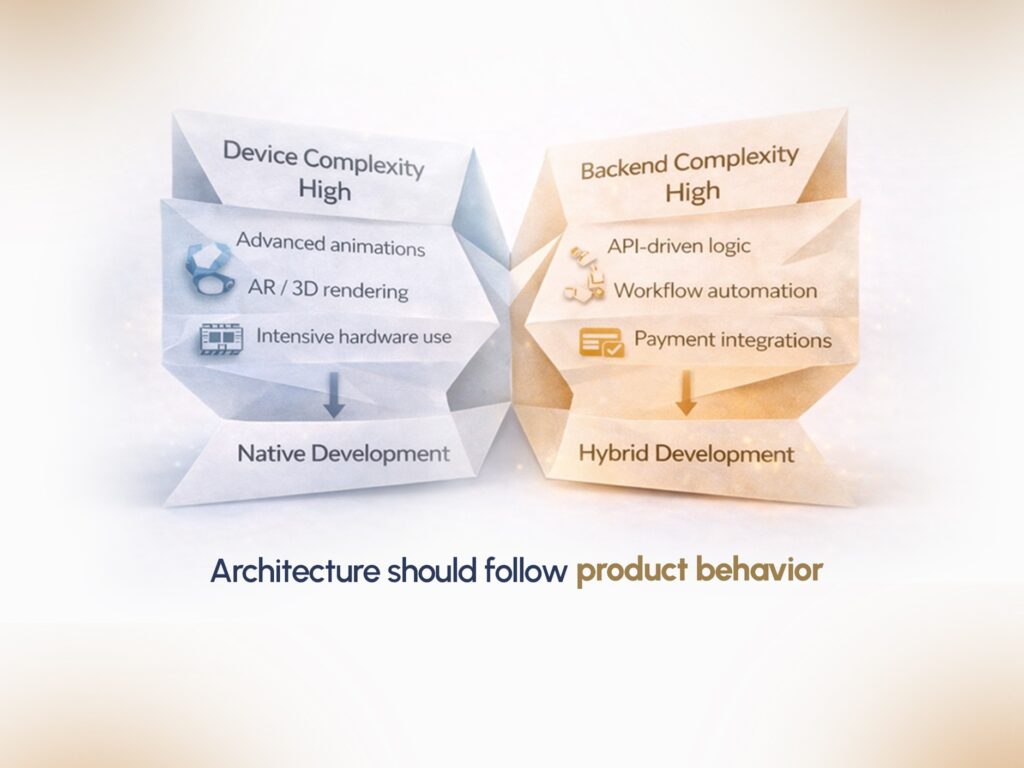
Does the primary complexity exist on the device or within the backend architecture?
This defines scalability potential, maintenance workload, and long‑term operational performance.
IPS makes these decisions through detailed evaluations of performance limits, backend infrastructure, integration scope, and future growth patterns, not based on trends or temporary cost advantages.
Understanding Hybrid Mobile App Development
With Hybrid Mobile App Development, developers create one web‑built application that is deployed inside a native container, making it cross‑platform by default.
From the user’s perspective, there is no visible compromise:
- The app is downloaded from the app store
- Push notifications function normally
- Camera and GPS access are available
- Secure authentication and payments work seamlessly
- The interface behaves like a native app
Internally, both platforms share a common core. Rather than maintaining two fully independent codebases, the development process is consolidated.
Hybrid architecture is frequently compared with Cross‑Platform Mobile App Development. While both aim to reduce duplication, they differ technically in rendering methods and integration depth.
From a business standpoint, the key difference lies in performance expectations and hardware interaction requirements.
If the majority of the product’s logic is authentication, payments, workflow management, content synchronization, operates through APIs and backend systems, Hybrid Mobile App Development is often sufficient and efficient.
For modern apps, the backend architecture usually has a bigger impact on scalability than the UI rendering layer.
Comparison of Hybrid Mobile App Development and Cross‑Platform Mobile App Development
Although these terms are utilized in a way that they can be considered to mean the same thing, they define various architectural structures
- Under Hybrid Mobile App Development, one web-based interface is presented in the form of native container which is used on both platforms.
- Cross-Platform Mobile App Development uses frameworks designed to render components closer to native performance layers.
The selection depends on:
- Device-level performance requirements
- Rendering complexity
- Hardware interaction intensity
- Real-time processing needs
- Long-term feature roadmap
Native or advanced cross-platform solutions can be the best option when an application requires rich animations and experiences, high-performance interactions
Conversely, apps based on workflow, which are heavy in integrations with their backends typically do not require high-level rendering control.
The architecture should follow product behaviour, not preference.
Where Hybrid Mobile App Development Makes Strategic Sense
Hybrid development is not a universal solution. It delivers strong results when applied in the right scenarios.
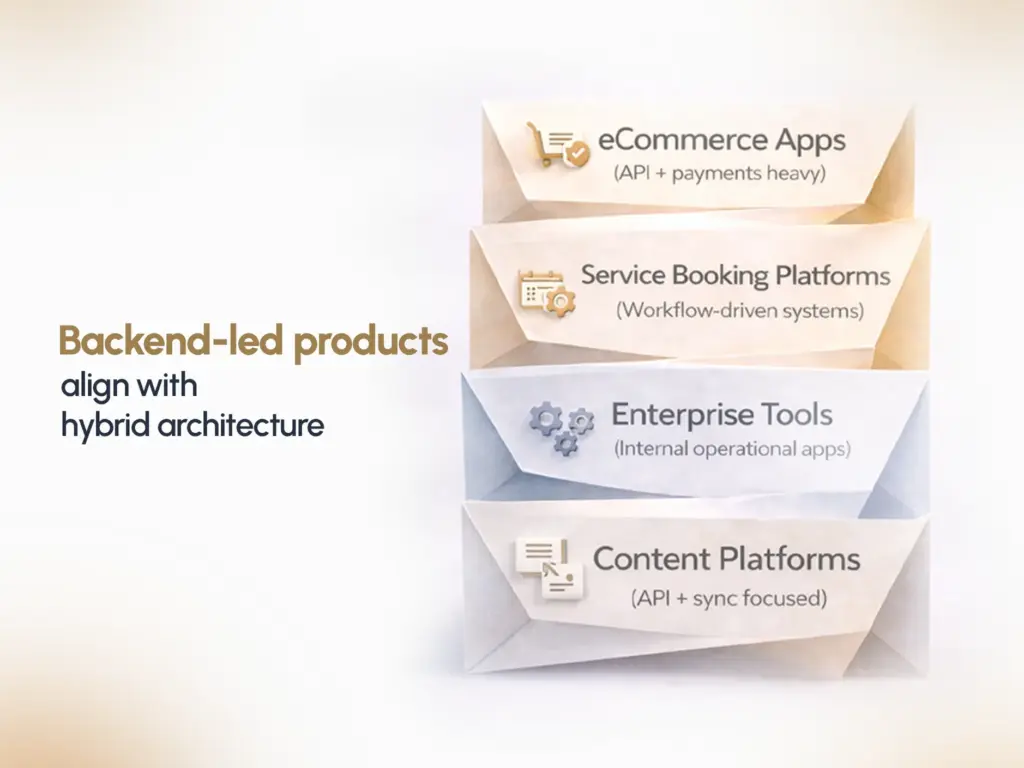
1. eCommerce and Retail Platforms
Retail applications rely on:
- Inventory management systems
- Payment gateway integrations
- Order processing workflows
- Customer account handling
Most of the complexity exists in backend systems. The mobile interface primarily enables browsing and transaction execution.
In such cases, Hybrid Mobile App Development allows faster multi-platform deployment while keeping backend logic centralized and scalable.
2. Service Booking and Marketplace Applications
Appointment scheduling platforms depend on structured workflows:
- User onboarding
- Time-slot management
- Payment confirmations
- Notification systems
These systems are logic-driven rather than graphics-intensive. Hybrid architecture supports centralized updates and synchronized feature releases across platforms.
3. Enterprise Operational Tools
Internal business applications such as attendance tracking, reporting dashboards, and workflow approval systems prioritize stability and maintainability.
Here, the benefits of Hybrid Mobile App Development include:
- Simplified updates
- Consistent deployment across teams
- Reduced long-term maintenance duplication
Performance demands in such tools are rarely device intensive.
4. Content and Engagement Platforms
Applications delivering courses, media streaming, or community features depend heavily on:
- Content synchronization
- API-driven updates
- Notification infrastructure
- Secure user management
Performance is largely backend governed. Hybrid architecture aligns efficiently with this structure.
How IPS Structures Hybrid Mobile App Development
The success of hybrid architecture depends on execution quality and the selection of appropriate App Development Software.
At IPS, hybrid implementation follows a structured process:
- Backend-First Planning :- We design scalable APIs and infrastructure before mobile development begins.
- Secure Native Wrapper Integration :- Device-level features such as camera access and push notifications are integrated through controlled native layers.
- Responsive Frontend Engineering :- The interface is optimized for consistent performance across device sizes and operating systems.
- Platform-Specific Testing :- Even with shared codebases, Android and iOS environments are tested independently to ensure stability.
- Scalability Simulation :- Projected user load and growth scenarios are evaluated to ensure long-term sustainability.
If a product demands high-performance rendering or intensive hardware interaction, IPS recommends native development.
And, if the product’s value lies in workflows, integrations, and backend systems, Hybrid Mobile App Development becomes strategically stronger.
Architecture is selected through analysis, not assumption.
Business Outcomes of Hybrid Mobile App Development
When implemented correctly, hybrid architecture produces measurable operational advantages:
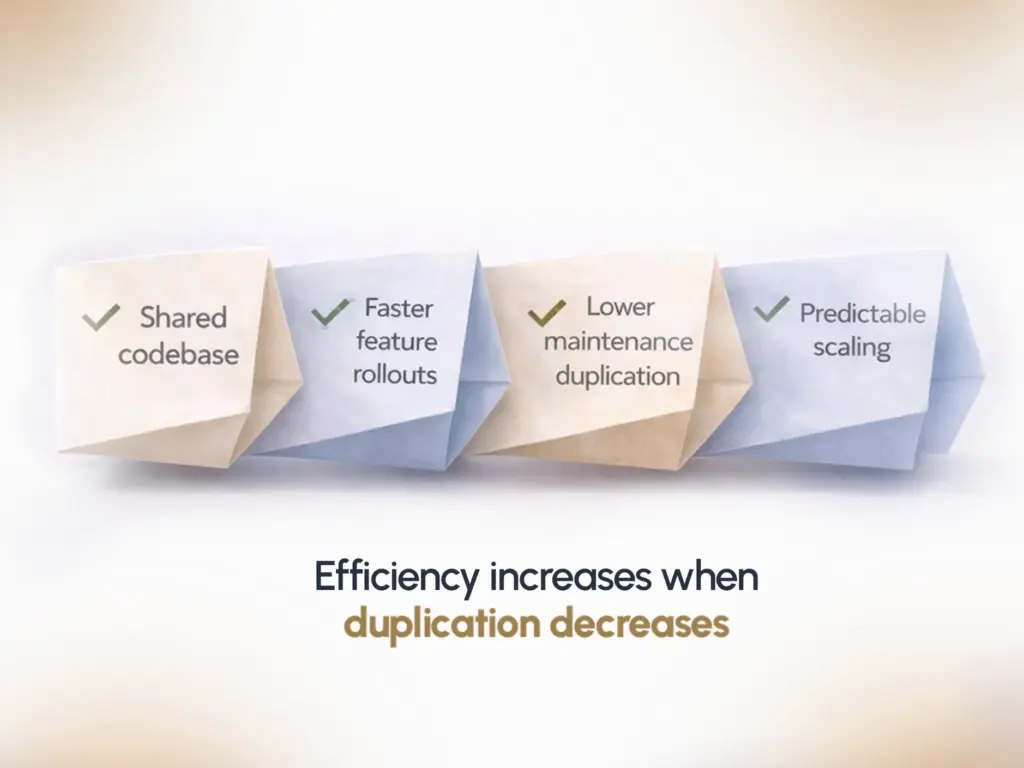
- Reduced engineering duplication across platforms
- Faster synchronized feature rollouts
- Lower long-term maintenance costs
- Simplified product roadmap management
- More predictable scaling as user numbers grow
Instead of allocating resources to maintaining two parallel mobile codebases, teams can focus on improving product features and backend optimization.
The result is operational clarity and improved release coordination.
When Hybrid Mobile App Development Is Not Ideal
Hybrid architecture may not be suitable when:
- Hybrid architecture may not be suitable when:Real-time augmented reality processing is central
- Ultra-high frame rates are mandatory
- Hardware-level performance defines user experience
In such cases, native development offers deeper control over system resources.
These choices at IPS are based on careful technical analysis and benchmark information, rather than cost minimization.
Conclusion
The decision between native development and hybrid or cross-platform is a subject that demands technical expertise, as well as long-term strategic perspective.
Hybrid development is effective when:
- The application is API-centric
- Backend systems carry operational complexity
- Cross-platform consistency is required
- Scalability is a primary objective
With the right architecture in place, scalability happens without inflating operational demands.
IPS is committed to developing systems engineered for long‑term stability, scalability, and maintainability.
FAQs
What is the difference between the native apps and the Hybrid Mobile App Development?
Native apps have to be written separately to each OS and hybrid apps use the same core code in a native container in order to run across all platforms.
Is Hybrid Mobile App Development scalable long term?
Scalability depends primarily on backend infrastructure. When APIs and systems are designed properly, hybrid applications can scale effectively with increasing users and feature expansion.
What is the difference between Cross-platform Mobile App Development and hybrid?
Cross‑platform development offers more direct control over native UI behaviour, while hybrid development embeds web content inside a native layer.
Does hybrid development impact performance?
For most business applications that are backend-driven, performance remains stable. Limitations generally arise only in graphics-heavy or hardware-intensive products.

Keyur Patel
Co-Founder
Keyur Patel is the director at IT Path Solutions, where he helps businesses develop scalable applications. With his extensive experience and visionary approach, he leads the team to create futuristic solutions. Keyur Patel has exceptional leadership skills and technical expertise in Node.js, .Net, React.js, AI/ML, and PHP frameworks. His dedication to driving digital transformation makes him an invaluable asset to the company.
Related Blog Posts

DevExpress Web Reporting: A Complete Guide to Browser-Based Reporting
Build an App Like TaskRabbit With AI (2026): Cost, Features & Top Alternatives