
How to choose the right Mobile App Development Partner for your Business Growth

Keyur Patel
December 22, 2025
9 min
Last Modified:
December 22, 2025
Let’s start with a story that haunts the IT industry.
A well-funded logistics company decided they needed a custom mobile app to track their fleet. They did what most companies do: they Googled mobile app development company, sent out a generic Request for Proposal (RFP) to the top five results, and picked the one with the shiniest presentation and the safest looking price tag.
After some time, they launched. The UI was breathtaking. The colors matched the brand perfectly. But there was a problem. The problem was that the drivers hated it. The buttons were too small to press along with wearing work gloves. The app crashed whenever the truck entered a tunnel. This was because offline mode was not prioritized. The drivers went back to using pen and paper.
That company didn’t lose money because of bad code. They lost money because they hired a vendor, not a partner. They hired someone who said Yes to their requirements, instead of someone who asked, Have you watched your drivers actually work?
In 2025, building an app is easy. But building a business on mobile is slight tough.
You are looking to hire app developers. Then you are likely overwhelmed by options. Every agency website looks the same. Everyone claims to be agile. Everyone has award-winning developers. So, how do you cut through the noise? You need to stop acting like a purchaser who buys a commodity. And start acting like a VC investing in a team. Here is the step-by-step guide to finding the right app development partner for your growth.

Phase 1: The Philosophy Check (Vendor vs. Partner)
The first step happens before you even send an email. You need to define what relationship you want. In our experience providing mobile app development services, clients usually fall into two traps:
The Factory Mindset This is when you view development as a transaction. I give you a spec sheet; you give me code.
Why it fails: Software evolves based on user behavior, edge cases and feedback loops. A factory-style relationship leads to:
- Zero strategic input
- Rigid execution
- Building exactly what you ask for even when it’s wrong
This is the trap.
The Co-Founder Mindset – This is when you do not hire someone to “build what you say.” You look for a team that thinks with you.
A real partner doesn’t say yes to everything. They ask tough questions, point out blind spots and even help you avoid wasting money on features your users won’t even need.
Here’s a quick thing to test:
When you tell them your idea in the first meeting:
Do they just smile, nod, and write things down?
Or do they share their honest thoughts and suggest improvements and challenge assumptions?
If by the second meeting they have not questioned at least one thing… then, they are not focused on building the best product. They are focused on getting the project.
Phase 2: The Technical Interrogation
Once you have filtered out the Yes-Men, you need to audit their technical chops. But since you might not be a code expert, you can’t just look at GitHub repositories. You need to look at their decisions.
The Scalability Bluff
Every agency says their code is “scalable.” But what does that actually mean? Scalability is not about adding more servers. It is about designing the architecture so growth does not break the system.
Here’s the difference between a fragile build and a future-proof one:
The Amateur App:
- Crashes because database queries were not optimized.
- Takes seconds to load due to synchronous APIs.
- Adds new features painfully because the codebase was not modular.
- Gets overwhelmed during traffic peaks. It occurs because the system relies on manual scaling.
In short, the app was not designed with growth in mind. It was designed just to “work.”
The Pro App:
- Runs on auto-scaling cloud infrastructure that expands instantly during traffic spikes.
- Uses load balancers to distribute traffic evenly.
- Has caching layers so that responses stay lightning fast.
- Follows a microservices-ready structure, so features can be updated independently. This is not luck. It is an engineering discipline.
Scalability is a mindset that is built into architecture from Day 1.
The Code Hostage Check
Ask this specific question: Who owns the code repositories during development? If they say, We transfer ownership upon final payment, be very careful.
The Right Answer: We set up the repositories in your name (Bitbucket/GitLab). You have full admin access from Day 1. We are just contributors. This ensures you never face a Code Hostage situation where a developer disappears with your IP.
Phase 3: The Talent Audit
You are impressed by the Sales Director. You love the CTO. But neither of them will be writing your code. One of the biggest secrets in the industry is The Bait and Switch. You are sold by senior experts, but your project is handed off to junior interns or outsourced to a third-party freelancer.
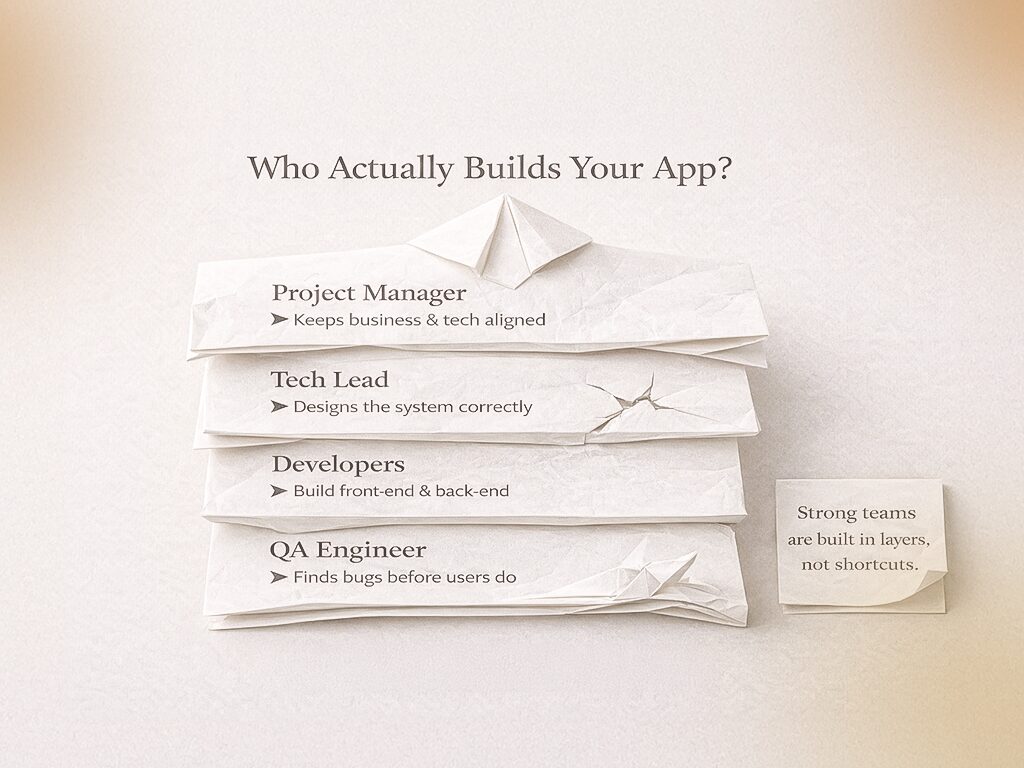
How to Audit the Team: Don’t settle for a company profile. Ask for the Team Composition for your specific project. You want to see a Pod structure, typically consisting of:
- Project Manager (The Bridge): They translate business needs to tech tasks.
- Tech Lead (The Architect): They ensure code quality and security.
- Developers (The Builders): They are for Front-end and Back-end.
- QA Engineer (The Gatekeeper): They break the app even before the users do.
The Interview plus point: You can ask to have a 15-minute casual chat with the lead developer who is assigned to your project. Do this before signing the contract. Ask them that what is the biggest technical risk you see in this project? A developer who is actually going to work on your project will have an immediate and specific answer (e.g., The integration with your legacy SAP system might be tricky. That’s because of API rate limits). A salesperson will just give you fluff.
Phase 4: The Reality of Commercial (Pricing Models)
This is where relationships often sour. Pricing disputes usually happen because the model didn’t fit the project type.
Model A: Fixed Price
Pitch & Reality
The project will be of $50,000.
Reality is that this sounds safe but… it creates a perverse incentive. If the developer finishes early or cuts corners, they make more profit. If you want to change anything (and you will), they will slap you with a Change Order fee.
- ● Verdict: Good for small, very strictly defined MVPs. Bad for innovation.
Model B: Time & Material (T&M)
- The Pitch: You pay for the hours we work.
- The Reality: This scares clients because the budget feels open-ended.
- The Opinion: For enterprise mobile app solutions or long-term startups, T&M is actually safer. It aligns incentives. You can pivot direction next week without rewriting a contract. It allows you to build the best product, not just the cheapest one that fits a fixed scope.
The Hybrid Solution: At IT Path, we often recommend a hybrid approach.
- Discovery Phase: Fixed Price. We scope out the wireframes and architecture.
- Development Phase: T&M. This gives us the flexibility to adapt to user feedback while you keep control of the monthly burn rate.
Phase 5: The Day 2 of the Reality (Post-Launch)
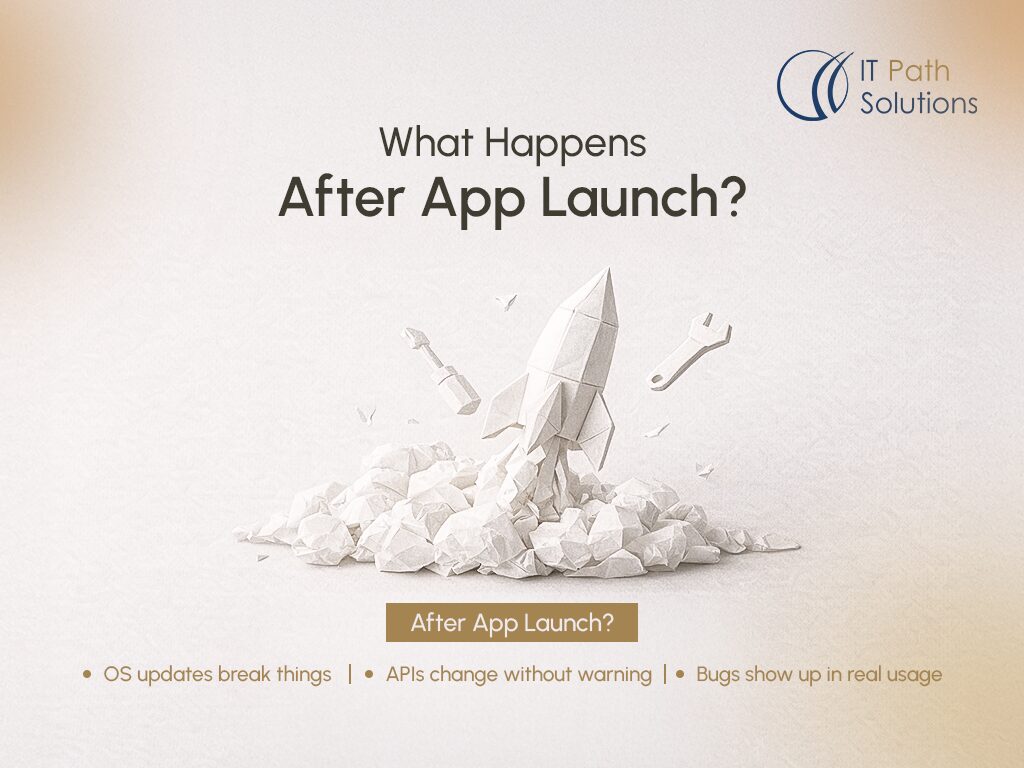
Reality is the day you launch your app is not the finish line. It is the starting line. Most mobile apps require updates within 45 days of launching.
- Apple releases a new iOS? You need an update.
- A third-party API (like Google Maps or Stripe) changes its policy? You need an update.
- Users find a bug? You need a hotfix.
The Ghosting Risk: Many agencies are project-based. They want to finish your app. And move on to the next client. And months later, when support is needed, the original team is often reassigned to a new project.
The Solution: The SLA (Service Level Agreement) When looking for mobile app development services, look for a partner that offers a dedicated Support & Maintenance Retainer. This isn’t just hosting fees. This is buying insurance. It guarantees that you have a dedicated number of developer hours per month reserved strictly for you.
Checklist for your SLA:
- Response Time: If the server goes down on a Sunday, how fast will they respond? (Aim for < 4 hours for critical issues).
- OS Updates: Is compatibility with new Android/iOS versions included?
- Security Patching: How often do they audit for vulnerabilities?
Phase 6: The Enterprise Grade (Security & Compliance)
If you are a startup, you might skip this. But if you are a mid-sized or large organization, this is the most critical section. Data privacy laws (GDPR, CCPA) are not suggestions; they are laws. If your app leaks user data, you aren’t just looking at a failed project; you are looking at lawsuits.
The Security First Approach: A mature mobile app development company integrates security. It is integrated into the design phase.
- Data Encryption: Can you make sure that on the phone, the app encrypts data locally? Plus, during transfer to the server?
- Vulnerability Scanning: Do you check the app for common issues of security? Even before it goes live?
The Compliance Interview Question: Tell me about your experience. Be it with GDPR or HIPAA compliance. If they say that, Oh, we just add a Terms of Service page… then, they are dangerous. Real compliance involves how data is stored, how users can request deletion, and how logs are managed.
Conclusion
After you have checked the technical skills, the portfolio, the pricing model, and the security protocols, there is one final, human test.
Would you enjoy having a difficult conversation with this person?
Software development is stressful. There will be bugs. There will be delays. There will be times of high pressure. Time when things go wrong. And they will. You need a partner who picks up the phone and says that here is how we are going to fix it together. You do not want someone who hides behind email threads and blames games.
Choosing an app development partner is like moving in together. You are going to be working with these people daily for at least the next 8 to 12 months.
The IT Path Promise – We don’t just write code. We build businesses. We know that you aren’t looking for a vendor who says Yes to everything. You are looking for a guide who knows the terrain.

Keyur Patel
Co-Founder
Keyur Patel is the director at IT Path Solutions, where he helps businesses develop scalable applications. With his extensive experience and visionary approach, he leads the team to create futuristic solutions. Keyur Patel has exceptional leadership skills and technical expertise in Node.js, .Net, React.js, AI/ML, and PHP frameworks. His dedication to driving digital transformation makes him an invaluable asset to the company.
Related Blog Posts
DevExpress Web Reporting: A Complete Guide to Browser-Based Reporting
Build an App Like TaskRabbit With AI (2026): Cost, Features & Top Alternatives