
Essential Features every Scalable Mobile App must have in 2026
Keyur Patel
January 17, 2026
9 min
Last Modified:
January 17, 2026
Let’s start with a situation most product leaders recognize.
It is early 2026. Your mobile app has finally found traction. Daily active users are climbing. Marketing campaigns are working. Investors are optimistic. Then something breaks.
Screens take too long to load. This happens during peak hours. A payment fails silently. A security audit flags basic vulnerabilities. A simple feature update takes weeks because the codebase resists every change.
The problem is not growth.
The issue lies in the app’s lack of scalability by design.

Mobile app development is less about speed and more about sustainability in 2026. It is about surviving success. Scalability is not something you “add later.” It is something you either design for early or pay for repeatedly.
This is a pattern we see repeatedly when working with growing product teams. Most scalability issues are not caused by bad intent or poor execution. They come from early architectural shortcuts that seemed harmless at the time but quietly compound as usage grows.
Below are the essential mobile app features every scalable mobile app should have.
Feature 1: A Scalable Mobile App Architecture
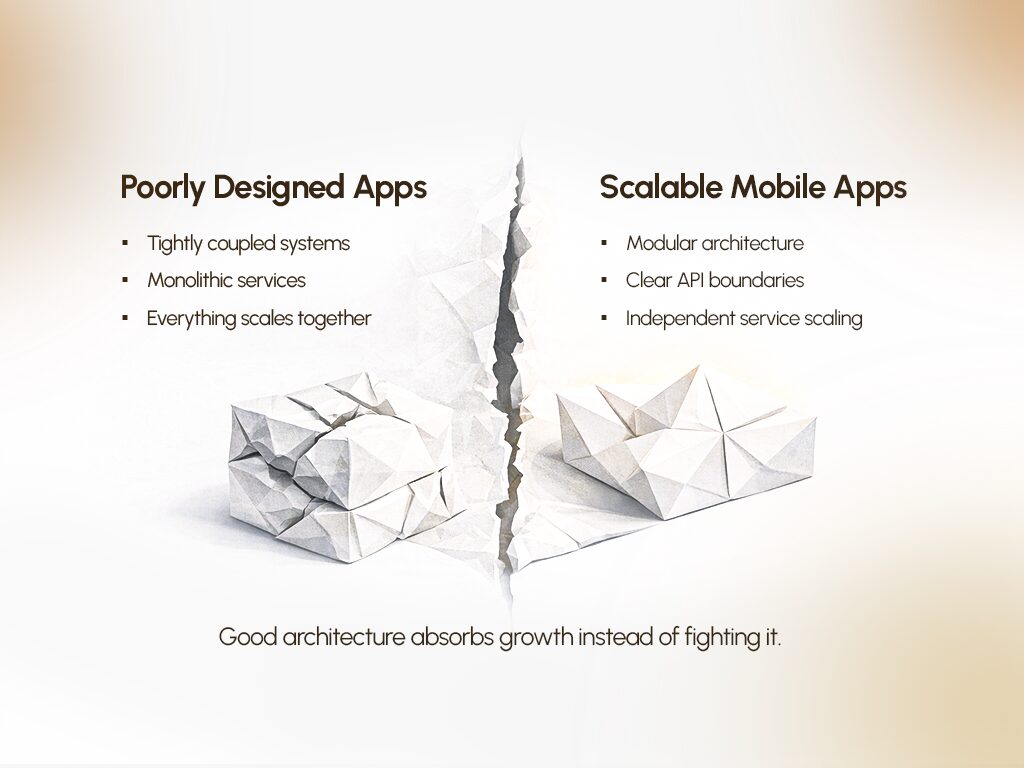
A strong mobile app architecture keeps growth from turning into chaos. Modular services, clean APIs and loosely coupled systems allow scalable mobile apps to handle traffic spikes. They even add features faster. They evolve without breaking what already works.
Mobile app architecture is not an internal technical concern. It directly determines:
- How fast new features can ship
- Whether traffic spikes crash the system
- How expensive growth becomes
What breaks in poorly designed apps:
- Tight coupling between frontend and backend
- Monolithic services that scale together (or fail together)
- No separation between business logic, APIs, and data layers
Business outcomes:
- Faster time-to-market for new features and updates
- Lower long-term development costs as growth does not require rebuilds
What scalable mobile apps do differently:
- Modular or service-oriented architecture
- Clear API contracts between systems
- Independent scaling of services based on demand
This allows an app to grow from 10,000 users to 1 million users. That also without rewriting everything.
Scalability is not an infrastructure. It is an architectural discipline.
Feature 2: Cloud-Native Infrastructure
Cloud mobile apps scale effortlessly. It is because they are built for elasticity. Auto-scaling, load balancing and distributed systems make sure that performance stays stable. This stability is necessary during sudden growth or seasonal traffic or viral moments without manual intervention.
Cloud Mobile Apps use elastic infrastructure that expands and contracts automatically. It is based on usage.
Non-scalable setup:
- Fixed servers
- Manual scaling
- Downtime during traffic surges
Scalable setup:
- Auto-scaling groups
- Load balancers
- Distributed databases
- Cloud-native storage and caching
Business outcomes:
- No revenue loss during traffic spikes, campaigns, or seasonal demand
- Reduced operational overhead due to automated scaling and infrastructure management
This matters because growth is rarely linear. Campaigns or seasonal traffic or regional launches create unpredictable spikes. Cloud-native systems absorb that volatility instead of collapsing under it.
Scalable mobile apps assume volatility. They are designed to handle it gracefully.
Feature 3: Mobile App Performance
Mobile app performance decides that users will stay or leave. Optimized APIs, smart caching and asynchronous processing keep apps fast even under heavy load. This ensures smooth experiences during peak usage instead of slowdowns and crashes.
Common performance killers:
- Blocking APIs
- Heavy payloads
- Poor caching strategies
- Inefficient database queries
Performance-first apps focus on:
- Asynchronous processing
- Intelligent caching layers
- Background task handling
- Optimized API responses
Business outcomes:
- Higher user retention and lower uninstall rates
- Better conversion rates during peak usage periods
Performance is not something you “improve later.” Once users experience lag, they leave. Scalability requires speed under pressure and not just speed in demos. This is why performance is treated as a design principle and not a post-release task. IT Path teams bake performance checks into development cycles instead of firefighting phases.
Feature 4: Cross Platform App Development
Cross platform app development helps teams in scaling faster across devices. But only when done right. Shared logic, platform-specific optimizations and clean separation of concerns maintain performance. Also, consistency and long-term scalability are important.
When cross-platform fails:
- Shared codebases with platform-specific hacks
- Performance compromises for complex workflows
- No clear separation between UI and business logic
When it works:
- Clean architecture with shared logic and native extensions
- Performance-critical features handled natively
- Consistent release cycles across platforms
Business outcomes:
- Faster expansion across Android and iOS markets
- Lower development and maintenance costs with a unified codebase
Scalable mobile apps use cross-platform frameworks strategically. The goal is speed without sacrificing long-term maintainability.
Feature 5: Mobile App Security
Mobile app security must grow with your user base. Encryption, secure authentication, protected APIs and continuous monitoring safeguard user data. They prevent vulnerabilities that become costly risks as scalable mobile apps expand.
Mobile App Security cannot be a post-launch checklist item in 2026.
What breaks in insecure apps:
- Hardcoded credentials
- Weak authentication flows
- Insecure APIs
- Poor access controls
What scalable apps implement:
- Complete encryption
- Access control by role
- Secure API gateways
- Continuous Security Checks
Business outcomes:
- Protection from costly data breaches and compliance penalties
- Increased user trust by leading to higher adoption and engagement
The scale of security incidents increases disproportionately. One flaw can expose millions of users. Scalable apps assume they will be targeted. And are designed accordingly.
Feature 6: APIs at the Core of Growth
API based design allows apps to grow into ecosystems. This allows seamless integrations with payments and analytics. It also connects smoothly with CRMs. And even supports future platforms. This is done by ensuring new connections scale smoothly without disrupting core mobile app functionality.
Scalable mobile apps are designed to integrate with:
- CRMs
- Payment systems
- Analytics platforms
- Third-party services
- Internal enterprise tools
An API-first approach makes sure that new integrations do not require core system rewrites.
Without API-first design:
- Integrations become fragile
- Feature additions slow down
- External dependencies break internal logic
With API-first design:
- Systems evolve independently
- Integrations scale without chaos
- New platforms can plug in seamlessly
Business outcomes:
- Faster integrations with partners, tools and new platforms
- Ability to launch new revenue streams without disrupting existing systems
This is how scalable apps become platforms instead of dead ends.
Feature 7: Observability and Monitoring
Scalable mobile apps rely on visibility. Real‑time logs, performance dashboards and error tracking help teams by detecting issues early. They also make it easier to understand user behavior. This allows problems to be fixed before they affect performance or customer trust.
Scalable mobile apps include visibility into:
- User behavior
- Performance bottlenecks
- Error patterns
- Infrastructure health
This is operational awareness.
Essential observability features:
- Real-time logs and alerts
- Performance dashboards
- Crash reporting with context
- Usage-based scaling insights
Business outcomes:
- Reduced downtime and faster issue resolution
- Improved customer experience through proactive performance management
When issues appear, scalable teams detect and fix them before users feel the impact.
Feature 8: Scalable Mobile App Development Process
A scalable mobile app development process embraces change. Modular releases, CI/CD pipelines and feature toggles allow teams to ship faster. They adapt continuously and improve without fearing system-wide failures.
Non-scalable process:
- Long release cycles
- Fear of touching existing code
- Heavy dependencies between teams
Scalable process:
- Modular releases
- Feature toggles
- Ongoing Integration and Delivery
- Architecture that welcomes change
Business outcomes:
- Faster release cycles without risking system stability
- Greater ability to adapt to market changes and user feedback
This is where scalable mobile app development separates itself from short-term execution.
Feature 9: Scalable Data Strategy
Data multiplies faster as users grow. Smart data partitioning, optimized queries and long-term storage planning makes sure that mobile apps stay fast, reliable and insightful. Instead of slowing down under increasing data loads.
Scalable mobile apps plan for:
- Data partitioning
- Archival strategies
- Read/write optimization
- Analytics without performance degradation
Without this, apps slow down as they succeed. With it, growth strengthens the system instead of weakening it.
Business outcomes:
- Consistent app performance even as user data grows
- Better business insights from analytics without slowing down operations
The Final Reality Check
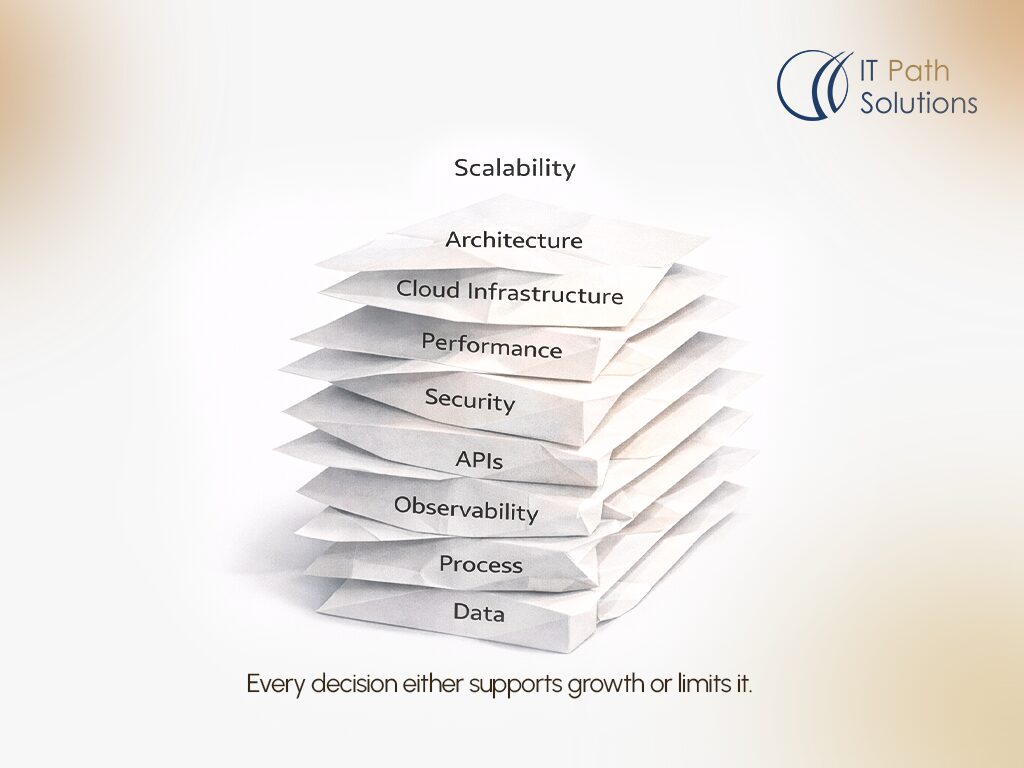
Scalability is not one feature. It is a mindset. A mindset that influences every technical decision.
The biggest mistake teams make is focusing on mobile app features users can see, while ignoring the systems users never notice until they fail.
In 2026, scalable mobile apps are:
- Architected for change
- Built for performance under load
- Secured against growth-driven risks
- Designed to integrate, evolve, and adapt
At IT Path Solutions, we do not treat scalability as an upgrade. We treat it as a baseline. Our teams design scalable mobile apps that are ready for growth from day one and not patched together after success creates pressure.
If you are thinking of planning your next mobile product, the question that should click your mind should not be what features you need today. It should be whether your app will survive success tomorrow.
Let’s move past feature lists and talk about building something that actually scales.
People Also Ask
1. What makes a mobile app truly scalable?
A scalable mobile app has a flexible architecture, extensive API integration and cloud-native infrastructure so it can handle increased users and features without performance degradation. Effective caching, modular design and asynchronous processing are key scalability components.
Why is API-first design important for app growth?
API-first design allows mobile apps to integrate smoothly with payment systems, CRM tools, analytics platforms and future services. This is by enabling new capabilities without major core system rewrites.
3. How does cloud infrastructure help with mobile app performance?
Cloud-native setups automatically adjust capacity via auto-scaling and load balancing. It is done by maintaining stable performance during traffic spikes or seasonal demand. This leads to reducing downtime and operational overhead.
4. What common issues break mobile apps as they grow?
Common problems include tightly coupled components, monolithic services, inefficient caching, blocking APIs and poor database management. They all lead to slowdowns or failures when user load increases.
5. How do observability and monitoring support scalable apps?
Real-time logs, performance dashboards and crash reporting let teams identify bottlenecks. It even fixes issues before users notice by improving uptime and trust in the app.

Keyur Patel
Co-Founder
Keyur Patel is the director at IT Path Solutions, where he helps businesses develop scalable applications. With his extensive experience and visionary approach, he leads the team to create futuristic solutions. Keyur Patel has exceptional leadership skills and technical expertise in Node.js, .Net, React.js, AI/ML, and PHP frameworks. His dedication to driving digital transformation makes him an invaluable asset to the company.
Related Blog Posts

DevExpress Web Reporting: A Complete Guide to Browser-Based Reporting
Build an App Like TaskRabbit With AI (2026): Cost, Features & Top Alternatives